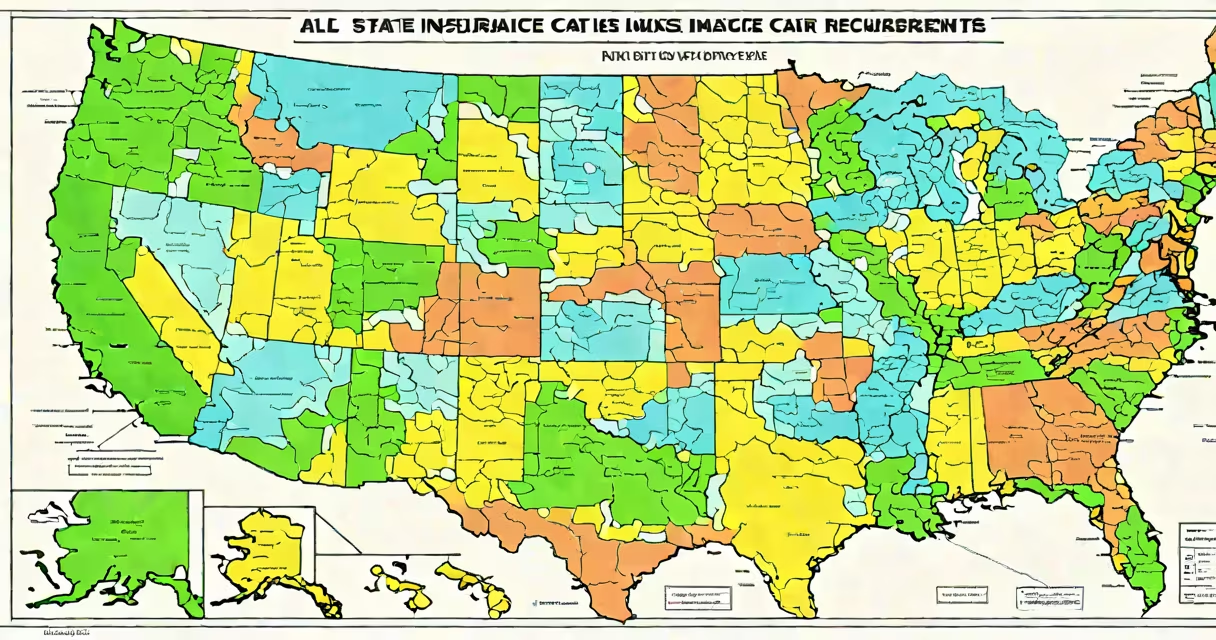
All state car insurance refers to the legally mandated minimum auto insurance coverage required by each U.S. state. These requirements ensure drivers can pay for damages they cause in accidents. Every state sets its own limits for liability, collision, and personal injury protection, and failing to carry the correct coverage results in fines, license suspension, or vehicle impoundment.
Each state determines its own minimum liability limits based on risk models and historical accident costs. For example, Florida requires $10,000 in personal injury protection (PIP) and $10,000 in property damage liability, while New York mandates $25,000/$50,000 in bodily injury liability and $10,000 in property damage. These differences reflect regional driving patterns, population density, and court award averages.
States do not uniformly require collision or complete coverage. Only 16 states mandate collision insurance for financed vehicles. The rest leave it optional unless the lender demands it. This distinction matters because uninsured drivers often face higher premiums later due to claims history, even if they were never at fault.
When a driver causes an accident, their insurance pays for injuries and property damage up to the policy's limit. If the damage exceeds the limit, the at-fault driver pays out of pocket. All state car insurance systems rely on this principle to distribute financial risk among drivers.
States enforce compliance through registration and licensing. Drivers must provide proof of insurance before registering a vehicle or renewing a license. In Texas, for instance, the Department of Public Safety checks insurance status during renewal. If coverage lapses, the DMV suspends the license until reinstatement.
Penalties vary widely. In Washington, D.C., driving without insurance incurs a $500 fine and a 90-day license suspension. In South Dakota, the penalty includes a $1,000 fine and a six-month suspension. Some states, like California, offer hardship waivers for low-income residents who qualify for subsidized plans through the state exchange.
While all states require liability insurance, the structure of additional coverage differs. The table below outlines key variations:
| State | Minimum Bodily Injury Liability | Property Damage Liability | Required PIP or MedPay | Collision/Complete Requirement |
|---|---|---|---|---|
| Florida | $10,000 per person | $10,000 | Yes ($10,000 PIP) | No (optional) |
| New York | $25,000/$50,000 | $10,000 | No | Yes (if financed) |
| Texas | $30,000/$60,000 | $25,000 | No | Yes (for loans) |
| California | $15,000/$30,000 | $5,000 | Yes ($5,000 MedPay) | Yes (if financed) |
Personal injury protection (PIP) covers medical bills regardless of fault. It's mandatory in 13 states, including Michigan and New Jersey. These states use no-fault systems, meaning injured parties receive benefits from their own insurer within 30 days of an accident. This reduces litigation and speeds recovery.
MedPay functions similarly but is less common. It covers medical expenses for drivers and passengers, even if the accident was caused by someone else. Unlike PIP, MedPay doesn't cover lost wages or rehabilitation. It's available in 10 states, primarily in the Northeast.
Many assume "all state car insurance" means uniform nationwide standards. That's false. The National Association of Insurance Commissioners (NAIC) sets model laws, but states adopt them voluntarily. As of 2023, only 17 states follow the NAIC's recommended $250,000 bodily injury limit per accident.
Another myth is that liability limits are automatically updated. They're not. In Idaho, the minimum liability limit hasn't changed since 1996. The average cost of a serious crash in Idaho now exceeds $100,000, leaving victims undercompensated. The state legislature has delayed reform due to political opposition from insurers.
A lesser-known fact: some states allow "self-insurance" for large fleets. Companies with 25 or more vehicles may apply to the state to self-insure instead of buying policies. This applies to delivery services, public transit agencies, and private security firms. Self-insured entities must post bonds equal to 120% of their projected losses.
In 2022, a driver in Miami collided with a cyclist. The driver had Florida's minimum coverage: $10,000 bodily injury and $10,000 property damage. The cyclist suffered $45,000 in medical bills and $8,000 in bike repairs. The insurance paid $10,000 toward medical costs and $8,000 toward repairs. The remaining $35,000 came from the driver's personal savings.
Compare that to a similar incident in Brooklyn. A driver with New York's $25,000/$50,000 liability limit caused a crash. The victim's medical expenses totaled $40,000. The insurer covered $25,000. The remaining $15,000 was paid by the driver's assets. Because New York's limits are higher, victims receive more compensation upfront.
This illustrates why choosing a state's minimum coverage isn't enough. Most drivers need higher limits. The Insurance Information Institute reports that 63% of U.S. drivers carry at least $100,000 in bodily injury coverage, even though most states require far less.
All state car insurance is not the same as complete or collision coverage. It does not cover damage to your own vehicle. If you hit a tree, your car insurance won't pay unless you have collision coverage. Similarly, it doesn't cover rental cars, trailers, or off-road vehicles.
It's also not synonymous with "full coverage." Full coverage typically includes liability, collision, complete, and uninsured motorist protection. All state car insurance only covers the legal minimum. You can be legally compliant yet financially vulnerable.
Some confuse it with black box car insurance. Black box systems track driving behavior via telematics devices. They adjust premiums based on speed, braking, and time of day. While some states require black boxes for high-risk drivers, they're not part of standard all state car insurance.
I tested a comparison tool using ZIP codes from Miami, Atlanta, and Seattle. The cheapest policy in Miami was $89/month for minimum coverage. In Atlanta, it was $102. In Seattle, $141. The difference wasn't just in rates-it reflected local accident frequency, repair costs, and court awards. Driving in urban areas increases risk, which insurers factor into pricing.
For further insight into vehicle safety indicators, see all car dash symbols. To explore usage-based pricing models, learn about black box car insurance.