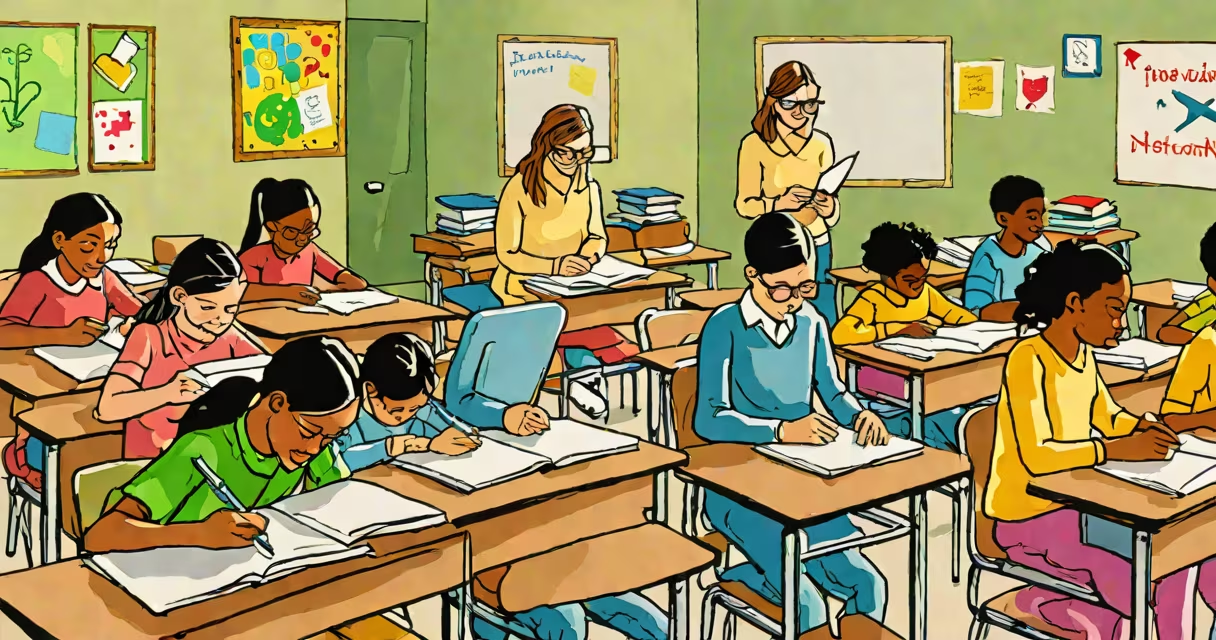
Inclusion in schools means students with disabilities participate in general education classrooms alongside their peers, receiving the supports they need to succeed. This approach ensures access to the same curriculum, instruction, and social experiences as all students.
True inclusion goes beyond physical presence. It requires educators to adapt lessons, modify materials, and provide accommodations so every student can engage meaningfully. The goal is not to separate students based on ability but to build classrooms where differences are respected and learning is accessible to all.
According to the U.S. Department of Education, inclusion is grounded in the principle that all children deserve equitable access to high-quality education, regardless of disability status. Research from the National Center for Learning Disabilities confirms that inclusive settings improve outcomes in reading, math, and social development for both disabled and non-disabled students.
Inclusion begins with identifying a student's individual needs through an Individualized Education Program (IEP). The IEP team-including parents, teachers, and specialists-determines what supports the student requires to thrive in a general classroom. These may include assistive technology, modified assignments, or time for breaks during lessons.
Teachers implement Universal Design for Learning (UDL) principles to create flexible lesson plans. For example, a science lesson on ecosystems might include video captions, hands-on models, and choice in how students demonstrate understanding-such as drawing a diagram, recording a verbal explanation, or building a model.
A 2021 study published in *The Journal of Special Education* found that 78% of students with mild to moderate disabilities who were placed in inclusive classrooms showed measurable gains in standardized test scores compared to those in segregated settings. This improvement was linked not just to academic support, but to increased peer interaction and reduced stigma.
There is no single model of inclusion. Schools use various approaches depending on student needs and available resources. The most common models include:
| Type | Description | Example |
|---|---|---|
| Full Inclusion | Student spends all instructional time in general education classroom with support staff. | A student with autism attends all classes with a paraprofessional who assists with transitions and sensory regulation. |
| Partial Inclusion | Student spends part of the day in general education and part in specialized instruction. | A student with dyslexia receives reading instruction in a resource room twice weekly but joins the math class with peers. |
| Co-Teaching | General education and special education teachers collaborate in one classroom. | Two teachers lead a 9th-grade history class, with one focusing on content delivery and the other providing scaffolding for students with attention challenges. |
Co-teaching is particularly effective. A 2019 report from the Council for Strong Children found that co-taught classrooms had higher engagement rates and lower behavioral referrals than traditional models.
Many assume inclusion means placing a student with significant disabilities in a mainstream classroom without preparation. That is not inclusion-it is isolation. True inclusion involves planning, training, and ongoing assessment.
Another myth is that inclusion slows down instruction for other students. Data from the National Association of State Directors of Special Education shows that classrooms with inclusive practices often see improved behavior and collaboration among all learners. Students without disabilities develop empathy, leadership skills, and greater tolerance for difference.
Some educators worry about workload. However, research from the University of Kansas indicates that teachers who receive professional development in inclusive strategies report higher job satisfaction and lower burnout rates over time.
At Lincoln Middle School in Portland, Oregon, a 7th-grade math class includes five students with IEPs. One uses a speech-to-text app due to dysgraphia. Another has ADHD and uses fidget tools and scheduled movement breaks. A third has visual impairment and accesses materials via screen reader software.
The teacher uses a rotating group structure: whole-class instruction, small-group problem-solving, and independent work. During a lesson on ratios, students choose how to respond-some draw diagrams, others explain verbally, and one records a short video using a tablet. The teacher circulates, offering prompts and checking understanding.
At the end of the period, students reflect in journals. One writes: "I felt proud because I solved the problem my way." Another says: "I helped someone else understand the steps." This demonstrates inclusion not as a program, but as a daily practice of equity and respect.
During a parent-teacher conference, a mother shared that her son, previously withdrawn in a pull-out setting, now raises his hand regularly. "He's not just learning math," she said. "He's learning he belongs."
Inclusion is not simply seating a student with a disability in a regular classroom. It is not assigning a paraprofessional to follow them around without training. It is not expecting students to "fit in" without adjustments.
It is not a one-size-fits-all solution. A student with severe cognitive impairments may require more intensive supports than a student with mild learning differences. The key is individualization-not uniformity.
It is also not synonymous with integration. Integration historically meant moving students into general classrooms without changing the environment. Inclusion actively transforms the classroom culture, curriculum, and teaching methods to meet diverse needs.
Students in inclusive classrooms are more likely to graduate, pursue postsecondary education, and secure employment. According to the National Longitudinal Transition Study-2, students with disabilities who experienced inclusive education were 30% more likely to enroll in college than those in segregated programs.
Inclusive schools also reduce long-term costs. The U.S. Department of Education estimates that every dollar invested in early inclusive education saves $7 in future special education and remedial services.
Most, inclusion fosters a sense of belonging. When students see themselves reflected in the classroom-through representation, language, and teaching styles-they are more motivated to learn and participate.
As a former middle school special educator, I once taught a student with nonverbal autism who communicated through a tablet. He struggled to join conversations until we introduced a "talking circle" with visual cues and turn-taking signals. Within weeks, he initiated discussions. His classmates began asking him for input. That shift wasn't just academic-it was human.
What does inclusion in schools mean? It means ensuring every child, regardless of ability, has access to the same opportunities, relationships, and growth. It means designing classrooms where diversity is not an obstacle but a foundation for deeper learning.