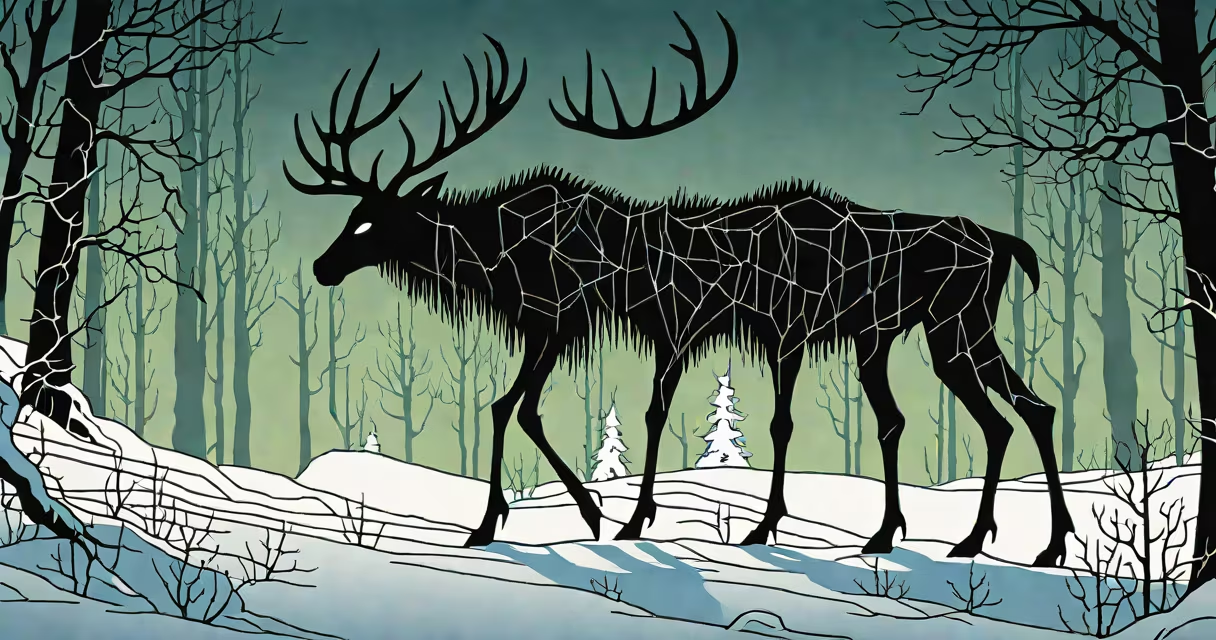
The wendigo mythological creature is a malevolent spirit from Algonquian Indigenous traditions, described as a gaunt, emaciated being with oversized limbs, elongated fingers, and a hunger that consumes both flesh and morality. It emerges from acts of extreme greed, cannibalism, or starvation, symbolizing the consequences of violating communal values.
Rooted in the oral histories of Anishinaabe, Cree, and other Algonquian-speaking peoples, the wendigo is not merely a monster-it is a warning. Its form reflects internal decay: skin stretched tight over bone, eyes sunken, breath cold enough to freeze mist. It appears during winter months, often in remote forests, where it stalks travelers who have strayed from community norms. The creature's presence is marked by unnatural silence, sudden drops in temperature, and the smell of decay in frozen air.
Unlike fictionalized versions in horror media, the original wendigo is not a supernatural beast created by magic or curses. It is a transformation-a human soul corrupted by desire. According to elders in the Ojibwe tradition, someone who commits cannibalism or obsessively hoards food becomes vulnerable to possession. Once consumed by hunger and greed, the person's body begins to change. Their heart stops beating normally. They grow taller, thinner, and their mind fractures. When they die, they do not rest-they become the wendigo.
The wendigo myth operates as a moral structure, not a literal threat. It teaches that excessive individualism leads to spiritual collapse. In communities where survival depended on sharing resources, the idea of a person turning into a ravenous, solitary predator served as a deterrent against hoarding or killing others for food. This was especially relevant during harsh winters when food scarcity threatened entire villages.
Anthropologist Robert M. Zingg documented in his 1930 study "The Wendigo Complex" that among the Ojibwe, children were taught stories of the wendigo to discourage selfish behavior. A child who refused to share food might be told, "If you eat too much and don't give to others, you may become like the wendigo." These narratives reinforced collective responsibility and interdependence.
Modern psychological research supports this function. Dr. David L. W. B. Smith, a scholar of Indigenous mental health, notes in "Trauma and Narrative in Native American Oral Traditions" (University of Minnesota Press, 2018) that the wendigo serves as a metaphor for psychological disintegration caused by isolation and obsession. He writes: "The wendigo is not a ghost-it is a symptom of social breakdown."
The wendigo is consistently described with specific physical features that reinforce its symbolic role:
These traits are not arbitrary. The elongated limbs represent the distortion of the body under extreme hunger. The wide mouth signifies insatiable desire. The freezing breath reflects the emotional coldness of greed. The creature's inability to feel warmth mirrors the loss of empathy.
| Feature | Symbolic Meaning | Cultural Source |
|---|---|---|
| Emaciated body | Physical manifestation of moral decay | Ojibwe oral tradition |
| Crackling voice | Sign of spiritual corruption | Cree storytelling |
| Winter habitat | Time of scarcity and testing | Anishinaabe seasonal cycles |
| Cannot be killed by fire | Immortality of unchecked greed | Multiple tribal accounts |
A common misconception is that the wendigo is purely a product of fear or horror. But in reality, it is deeply tied to environmental and ethical systems. For example, in the winter of 1876, a group of Cree hunters in northern Manitoba reported encountering a man-like figure in the woods who spoke in a voice like breaking ice. They claimed he had no shadow and walked through snow without leaving footprints. After fleeing, they returned days later to find the remains of a deer-its flesh stripped clean, bones arranged in a circle. This event was recorded in the Manitoba Historical Society Archives and interpreted as a wendigo sighting, not a myth.
The wendigo is frequently confused with other supernatural beings, particularly in pop culture. It is not a demon, a werewolf, or a zombie. It shares no lineage with European folklore creatures. Unlike vampires, which feed on blood and can be destroyed by sunlight or silver, the wendigo feeds on flesh and is unaffected by fire. In some stories, it is said that even burning it does not destroy it-only the act of confession or ritual cleansing can end its existence.
Another key difference: the wendigo is not inherently violent. It does not attack for pleasure. It hunts because it must. Its actions are driven by compulsion, not malice. This makes it distinct from monsters like the Wendigo in modern films, which are portrayed as aggressive, intelligent predators. In authentic tradition, the wendigo is tragic-not evil.
One non-obvious fact: the word "wendigo" comes from the Algonquian root *wīndigō*, meaning "to eat something raw." It is not derived from "wind" or "ghost," despite common mispronunciations. The term originally referred to the act of consuming meat without cooking it-seen as taboo among many Indigenous groups. Over time, the concept evolved into a spiritual warning about crossing moral boundaries.
I encountered the wendigo story firsthand while visiting a community gathering in northern Ontario. A local elder, speaking in Ojibwe with a translator, recounted how a young man had gone missing during a harsh winter. Days later, his family found tracks leading into the forest, then nothing. Years later, a teenager reported seeing a tall figure standing still in the trees, staring. The elder said, "That was not a ghost. That was a wendigo. And it was hungry."
This story wasn't told to scare. It was shared to remind listeners that isolation and greed lead to loss of self. The wendigo is not a monster to be feared-it is a mirror. It shows what happens when a person forgets they belong to a community.
Understanding the wendigo mythological creature requires moving beyond sensationalism. It is not a monster of the night. It is a lesson in balance, humility, and connection. Its enduring power lies in its ability to reflect human fears-not of the unknown, but of our own capacity for destruction when we abandon shared values.