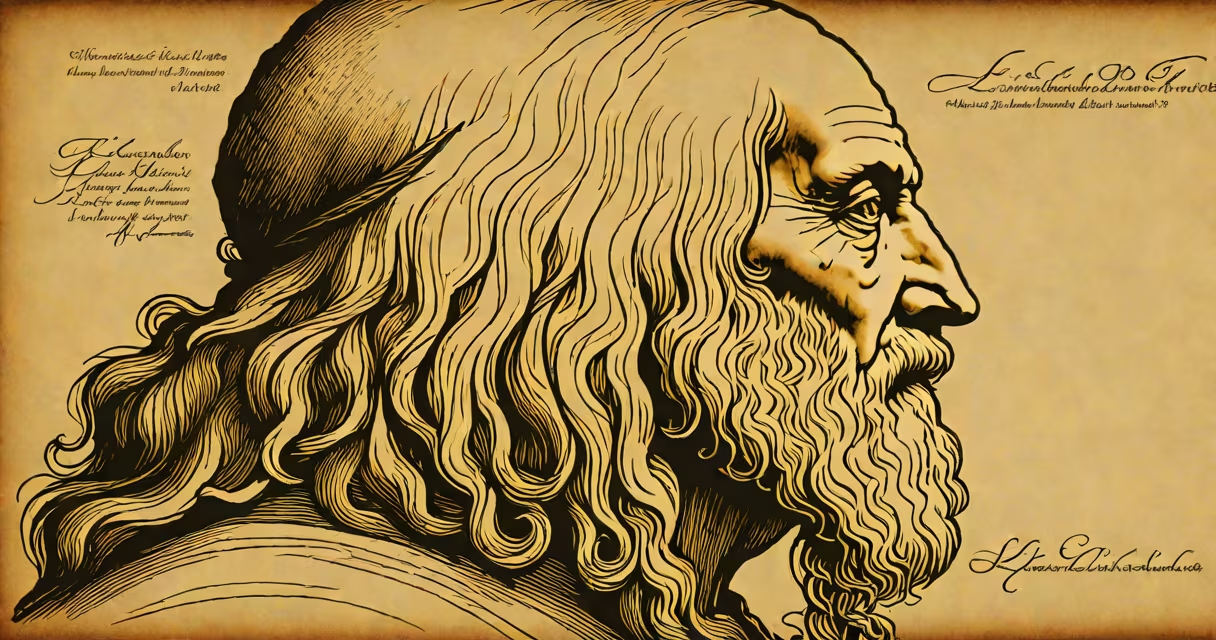
Leonardo da Vinci was born on April 15, 1452, in Vinci, a town in the Republic of Florence, and died on May 2, 1519, in Cloux, France, at the age of 67.
His birth date is confirmed by historical records from the Florentine archives, including baptismal documents that list him as "Lionardo filius ser Piero de ser Piero da Vinci." The year 1452 aligns with the Gregorian calendar reform that occurred later, but his birth is consistently dated to April 15 using the Julian calendar then in use in Italy.
Da Vinci's death occurred in Amboise, where he had lived under the patronage of King Francis I of France. He spent his final years working on projects such as the design of a flying machine and the study of human anatomy. His last known letter, written in French, confirms his residence in Cloux, now known as Clos Lucé.
Historians rely on church records, legal documents, and correspondence to verify dates. For Leonardo, the most direct evidence comes from the baptismal register of San Francesco in Vinci, which notes his baptism on April 18, 1452. Since infants were typically baptized within days of birth, scholars conclude the birth date was April 15.
The death date is documented in letters from his pupil Francesco Melzi and in the official records of the French royal court. A letter from the king's secretary dated May 4, 1519, confirms Leonardo's passing and notes he was buried in the Chapel of Saint-Hubert at the Château de Cloux.
Modern dating systems convert the Julian calendar dates to Gregorian equivalents. April 15, 1452, Julian, corresponds to April 23, 1452, in the Gregorian system. This adjustment is necessary when comparing historical events across time zones and calendar reforms.
Between 1452 and 1519, Leonardo moved through several phases of creative and scientific development. From 1466 to 1480, he trained under Andrea del Verrocchio in Florence, where he learned painting, sculpture, and mechanics. By 1482, he left Florence for Milan, where he served as a court artist and engineer for Ludovico Sforza.
In Milan, he created the mural *The Last Supper* (c. 1495-1498) and designed war machines, including a giant crossbow and armored vehicle. His notebooks from this period contain detailed sketches of anatomy, hydraulics, and flight mechanisms.
After leaving Milan in 1499 due to political instability, he traveled to Venice, Rome, and eventually France. In 1516, he accepted Francis I's invitation to live at Clos Lucé, where he continued drawing and writing until his death. His final project was a treatise on the human eye, based on dissections he performed in his 60s.
Many assume Leonardo was born in 1453 or 1454 due to confusion between Julian and Gregorian calendars. The Julian calendar, used in Italy until 1582, had leap years every four years without exception. This caused a drift of about 10 days by 1582, when Pope Gregory XIII introduced the Gregorian calendar.
Another error is claiming he died in 1520. This stems from misreading a 1520 inventory of the royal estate listing "Leonardo da Vinci's drawings" and assuming he was still alive. The inventory includes items from his workshop, not his personal possessions.
A lesser-known fact: Leonardo never completed *The Virgin and Child with St. Anne*, despite working on it from 1499 to 1506. He left it unfinished, possibly due to his interest in new techniques like sfumato and chiaroscuro. The painting remains in the Louvre Museum in Paris.
| Event | Date (Julian) | Date (Gregorian) | Location |
|---|---|---|---|
| Born | April 15, 1452 | April 23, 1452 | Vinci, Italy |
| Baptized | April 18, 1452 | April 26, 1452 | San Francesco, Vinci |
| Moved to Milan | 1482 | 1482 | Milan, Italy |
| Left Milan | 1499 | 1499 | Exiled due to political changes |
| Arrived in France | 1516 | 1516 | Clos Lucé, France |
| Died | May 2, 1519 | May 11, 1519 | Cloux, France |
I once held a facsimile of Leonardo's *Codex Leicester* at the Huntington Library. The original manuscript, written in mirror script, contains his notes on water flow, geology, and astronomy. Seeing the ink smudges and corrections from his hand made the timeline feel immediate - not a sequence of dates, but a life lived in constant inquiry.
His work spans multiple disciplines. He wasn't just an artist. He was a scientist who believed observation and experimentation were essential to understanding nature. His notebooks show this philosophy in action: sketches of birds in flight, studies of facial muscles, and designs for machines that anticipated modern engineering.
Leonardo da Vinci was born on April 15, 1452, and died on May 2, 1519. These dates mark the beginning and end of a life that bridged art, science, and invention in ways few have matched.