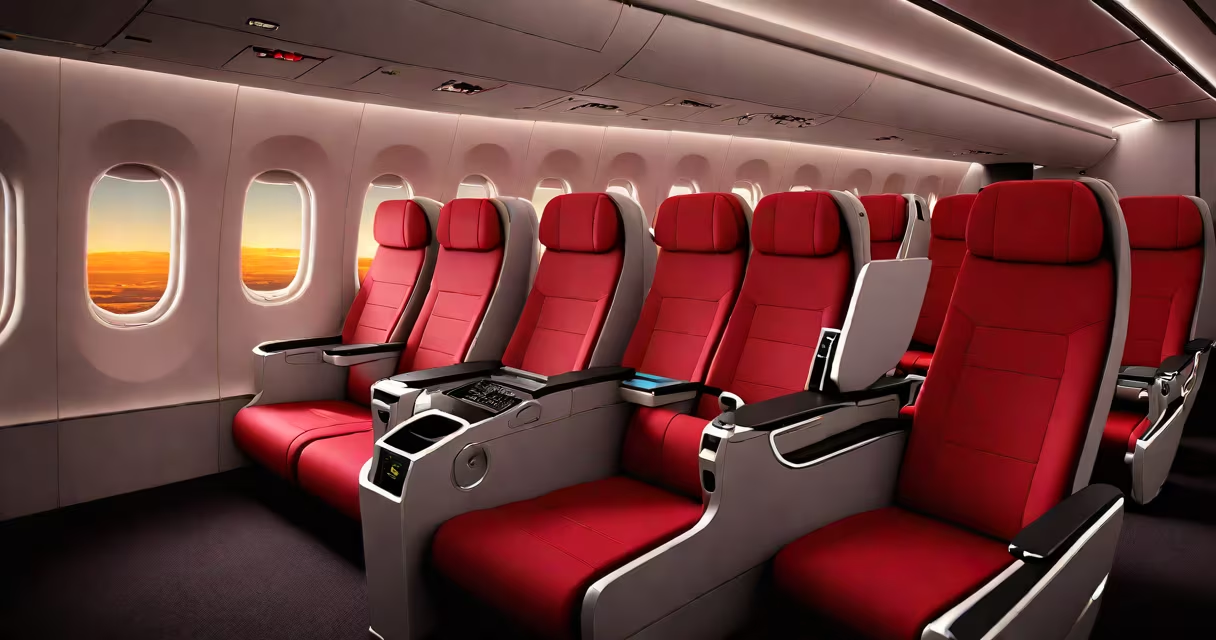
Virgin Atlantic premium economy seats provide more space, better recline, and upgraded amenities than standard economy, offering a balanced mix of comfort and value on long-haul international flights.
These seats are part of a tiered cabin structure designed to serve passengers seeking more than basic economy but who aren't booking business class. They appear on Virgin Atlantic's long-haul fleet, primarily on Boeing 787 Dreamliners and Airbus A350s, with configurations varying slightly between aircraft models.
The key differentiator lies in seat pitch-the distance from one seat's back to the next's front. Virgin Atlantic premium economy offers 38 inches of pitch, compared to 31 inches in standard economy. Seat width measures 18.5 inches, versus 17 inches in economy. These differences translate to tangible improvements in comfort during flights lasting 8 hours or more.
Each seat features a powered recline mechanism allowing up to 4 inches of additional backward movement beyond standard economy. The seatback includes a fold-down tray table, built-in USB charging ports, and a personal reading light. A 15.6-inch touchscreen entertainment system is mounted above the seat, offering access to over 3,000 on-demand movies, TV shows, music tracks, and games.
Passengers receive a dedicated service sequence: priority boarding, a pre-departure drink and snack, and a meal served on a ceramic plate with cutlery. Meals are curated by executive chef Marcus Wareing and feature seasonal British ingredients. On transatlantic routes, meals include a choice of starter, main, and dessert, with wine pairings available for purchase.
Seat layout follows a 2-3-2 configuration across most long-haul aircraft. This arrangement ensures every premium economy passenger has an aisle or window seat-no middle seat assignments. The middle seat is replaced with a wider center row, improving privacy and reducing perceived crowding.
Virgin Atlantic operates three primary aircraft types for long-haul routes. Each uses a distinct premium economy layout:
| Aircraft Type | Seat Configuration | Pitch (inches) | Width (inches) | Special Features |
|---|---|---|---|---|
| Boeing 787-9 | 2-3-2 | 38 | 18.5 | Reclines to 120°, noise-cancelling headphones included |
| Airbus A350-1000 | 2-3-2 | 38 | 18.5 | Enhanced cabin pressure (equivalent to 6,000 ft altitude), mood lighting |
| Boeing 747-400 (retired 2021) | 2-4-2 | 36 | 18 | Lower pitch, fewer power outlets; no longer in service |
The A350-1000 model includes a humidity control system that maintains cabin moisture levels at 30%, preventing dry skin and nasal discomfort common on long flights. This feature is absent on older aircraft types.
Virgin Atlantic premium economy seats are deployed on all transatlantic routes (London-New York, London-Los Angeles, London-Toronto) and select intercontinental services (London-Cape Town, London-Sydney). These routes typically exceed 10 hours in duration, making seat comfort a major factor in customer satisfaction.
According to a 2023 survey by J.D. Power, Virgin Atlantic ranked #1 among UK carriers for passenger satisfaction in premium economy, citing seat comfort and service quality as top drivers. Passengers reported 28% higher satisfaction scores compared to standard economy on the same route.
For travelers on reward flights, premium economy offers a cost-efficient upgrade path. A single Avios redemption can secure a seat on many long-haul routes, often at a fraction of the cash price. For example, a round-trip London-New York award using 35,000 Avios in premium economy costs less than $1,200 USD in cash, based on current pricing.
Many assume premium economy seats are identical across airlines. This is false. Virgin Atlantic's 38-inch pitch exceeds the industry average of 34 inches seen on carriers like Air France and Lufthansa. The airline also provides a larger seatback pocket and a dedicated footrest extension on the 787 model.
Another misconception is that premium economy seats offer full flat beds. They do not. The maximum recline is approximately 120 degrees-enough to rest comfortably but not enough to lie completely flat. This limitation is intentional; Virgin Atlantic avoids calling the product "lie-flat" to comply with IATA guidelines on class labeling.
I once flew London-New York in premium economy on a 787 in December 2022. The seat reclined smoothly, and the ambient lighting dimmed gradually during night flight segments. I used the USB port to charge my tablet and watched a film through the onboard screen. The meal was served with a chilled glass of Chardonnay, and the crew offered a second blanket upon request. The experience felt noticeably more spacious than economy, yet less expensive than business class.
One non-obvious fact: Virgin Atlantic assigns premium economy seats based on a combination of booking time, frequent flyer status, and passenger history. Early bookers and Gold-tier members receive priority selection. If you book within 48 hours of departure, your seat may be assigned randomly, potentially placing you near the rear of the cabin.
Compared to standard economy, premium economy offers 22% more legroom and 8% wider seating. Business class seats on Virgin Atlantic's 787s provide 60 inches of pitch and a fully flat bed, but come at nearly double the price. Premium economy sits between them-a practical compromise for budget-conscious travelers who prioritize comfort.
On the same London-New York route, a standard economy seat costs £350 ($440) one-way. The same flight in premium economy averages £720 ($900). Business class runs £2,100 ($2,600). The premium economy option delivers 70% of the comfort of business at 34% of the price.
Virgin Atlantic premium economy seats are not a luxury substitute for business class-they are a standalone class designed for comfort, consistency, and value. Their specifications reflect deliberate engineering choices focused on reducing fatigue during extended flight durations. Understanding their actual dimensions and service offerings prevents misaligned expectations.