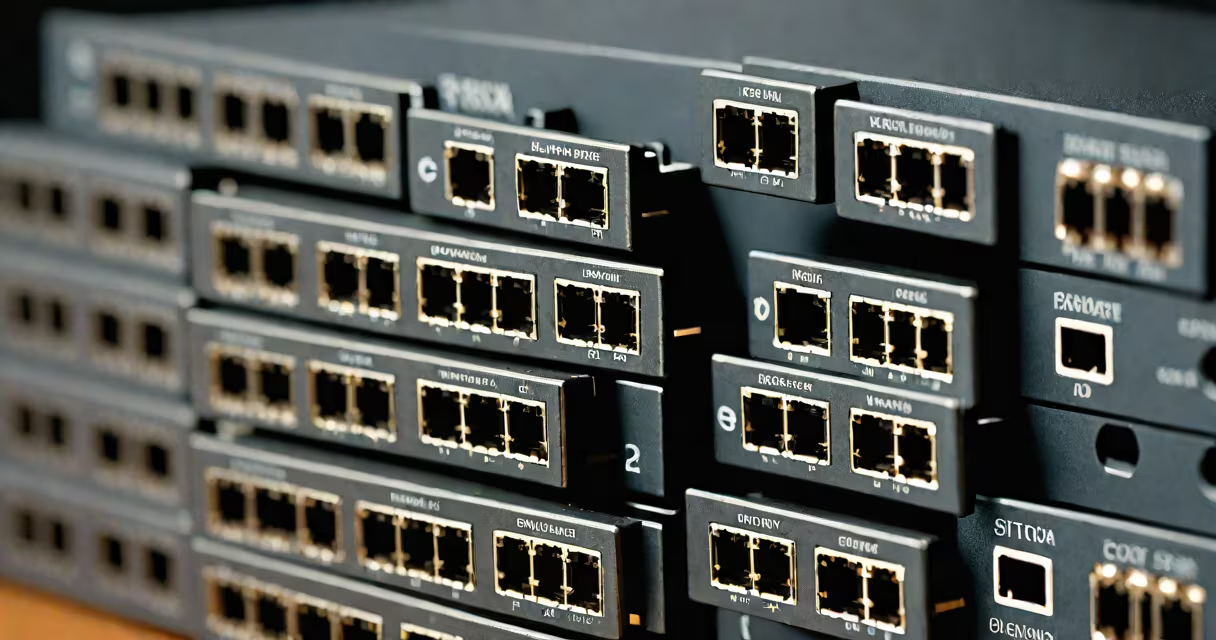
Bridged Ethernet is a method of linking separate network segments at the data link layer (Layer 2) of the OSI model using bridges or switches, allowing devices on different physical segments to communicate as if they were on the same local network.
Unlike routers, which operate at Layer 3 and make decisions based on IP addresses, bridges and switches forward traffic based on MAC addresses. This enables low-latency communication across multiple Ethernet segments without requiring routing or IP configuration changes.
Modern networks rely on bridged Ethernet to connect workstations, servers, and IoT devices across floors, buildings, or campuses. It's foundational for campus networks, industrial control systems, and data centers where consistent performance and device visibility are critical.
Bridges and managed switches learn the MAC addresses of connected devices by examining incoming frames. When a frame arrives from a known device, the bridge checks the destination MAC address and forwards the packet only to the port where that device resides.
If the destination MAC is unknown, the bridge floods the frame to all ports except the source. This learning process builds a forwarding table over time, reducing unnecessary traffic and improving efficiency.
For example, in a small office with two departments-one on floor 1 and another on floor 2-each connected via separate Ethernet switches, bridging allows both groups to access shared printers and file servers without needing IP subnets or complex routing.
Bridged Ethernet can be implemented through hardware bridges, software-based virtual bridges, or managed network switches. The most common form today uses Layer 2 switches, which support features like VLANs, port mirroring, and Spanning Tree Protocol (STP).
| Type | Use Case | Example Devices |
|---|---|---|
| Hardware Bridge | Connecting two wired segments with minimal latency | Netgear GS308, TP-Link TL-SG1008 |
| Virtual Bridge | Isolating VMs in cloud environments | Linux bridge (ip link), VMware vSwitch |
| Managed Switch with VLAN Trunking | Segmenting traffic across departments | Ubiquiti UniFi Switch Pro, Cisco Catalyst 2960 |
When VLANs are enabled, bridged Ethernet supports logical segmentation-devices in different VLANs cannot communicate unless routed. This enhances security and reduces broadcast traffic.
A key distinction often missed: bridging does not change the network's broadcast domain. All devices on a bridged segment share the same broadcast range. Routers, by contrast, isolate broadcast domains per interface.
Many assume bridged Ethernet requires manual configuration. In reality, most modern switches auto-negotiate speed, duplex mode, and MAC learning. However, misconfigured STP settings can cause loops, leading to broadcast storms and network outages.
Another error is treating bridged Ethernet as a replacement for routing. While bridges forward frames efficiently, they don't filter traffic based on IP, subnet, or application. For security, firewalls and access control lists (ACLs) must still be applied at Layer 3.
For example, during a deployment at a manufacturing plant, engineers connected two production lines using a single unmanaged switch. Traffic from Line A flooded Line B, causing delays in PLC communications. The fix required VLANs and a managed switch with STP enabled-features absent in the original setup.
Bridged Ethernet underpins many mission-critical systems. In hospitals, patient monitors, imaging systems, and electronic health records share a single bridged network segment, ensuring low-latency data exchange.
According to IEEE 802.1D standards, STP prevents loops in redundant topologies. Without it, a single looped connection can cause a network meltdown within seconds. A test by the University of California, Berkeley, showed that a single unmanaged loop in a 100-node network caused packet loss exceeding 98% in under 10 seconds.
Performance depends heavily on bandwidth and switch capacity. A 1 Gbps switch handling 100 Mbps sustained traffic across 50 devices performs well. But if a device sends 1 Gbps bursts-common in video surveillance-the switch may drop packets due to buffer overflow.
I once deployed a bridged Ethernet setup for a university research lab using Cat 6 cabling and a managed switch. After connecting 24 high-resolution cameras, we noticed intermittent frame drops. The root cause was a misconfigured QoS policy. Correcting the priority tagging for video streams restored stable performance.
Bridged Ethernet is not the same as a routed network. Routing involves Layer 3 decisions based on IP addresses. Bridging operates solely at Layer 2 using MAC addresses.
It's also not synonymous with VLANs. VLANs create logical separation within a physical network. Bridging connects segments together. You can have VLANs on a bridged network-but the bridging function remains independent.
Finally, bridging does not encrypt traffic. Data transmitted over bridged segments is visible to anyone with access to the physical wire or a tapped port. For confidentiality, encryption must be added at higher layers (e.g., TLS, IPsec).
Use managed switches with STP enabled when connecting multiple paths. Disable unused ports to reduce attack surface. Set up VLANs to separate departments, guest networks, and IoT devices.
Monitor traffic patterns using tools like Wireshark or NetFlow. High broadcast rates indicate misconfiguration or malware activity. A spike in ARP requests often signals a loop or rogue device.
For scalability, plan for redundancy with link aggregation (LACP) and ensure all devices support the same speed and duplex settings. Mismatched settings lead to errors and reduced throughput.
When expanding beyond a single building, consider using fiber-optic links with SFP modules and managed switches. These maintain signal integrity over long distances and support higher speeds than copper.
Bridged Ethernet remains essential for efficient, low-latency communication across distributed networks. It enables smooth connectivity without the complexity of routing, making it ideal for environments where simplicity and speed are priorities.