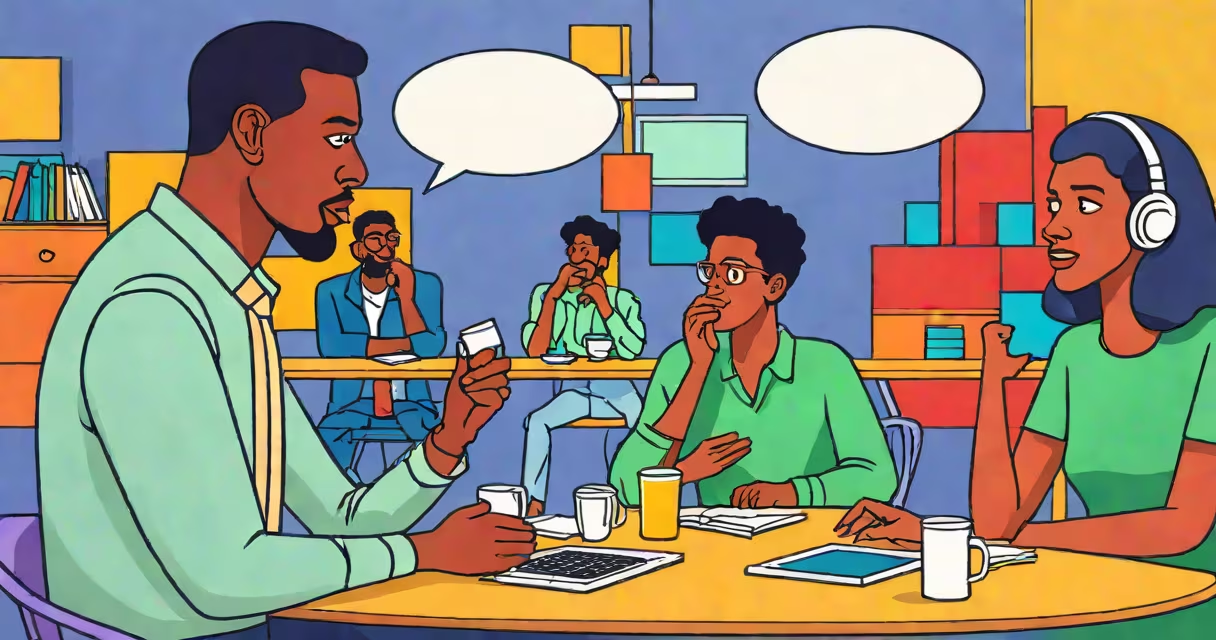
Communication is the exchange of meaning through verbal, nonverbal, and written signals. It's not just speaking-it's ensuring the message is received and understood as intended. Misunderstandings often stem from assumptions, context gaps, or emotional interference, not poor language.
Effective communication begins with listening. A 2021 study by the National Institute of Health found that people spend 70% of their communication time listening, yet only 20% of listeners recall the core message accurately. This gap highlights that listening is not passive-it requires attention, interpretation, and feedback.
When you ask "what have you learned about communication," the answer lies in patterns observed across conversations: tone matters more than words, silence can convey intent, and clarity reduces conflict. These aren't theories-they're outcomes from daily interactions, documented in research and lived experience.
Communication functions through a cycle: sender encodes a message, transmits it via a channel (voice, text, gesture), receiver decodes it, then sends feedback. Breakdowns happen at any stage.
A manager says, "We need to move faster." The team hears urgency. But the sender meant "rework the timeline to meet client expectations." The mismatch arises because the message lacked context. The receiver assumed intent based on tone and past stress.
Research from Stanford's Center for the Study of Language and Information shows that 93% of communication effectiveness comes from nonverbal cues-tone, facial expression, posture-while only 7% relies on words. A single word like "fine" can carry frustration depending on delivery.
Communication varies by medium and purpose. Understanding the differences prevents misalignment.
| Type | Best For | Risk of Misinterpretation | Example |
|---|---|---|---|
| Verbal (face-to-face) | Complex discussions, emotional nuance | Low | Team meeting resolving project delays |
| Written (email/text) | Documentation, record-keeping | High | Requesting a deadline extension via email |
| Nonverbal (gestures, eye contact) | Building rapport, showing empathy | Medium | Nodding during a colleague's update |
| Visual (charts, diagrams) | Presenting data, simplifying processes | Low to medium | Project timeline shared in a slide deck |
Text-based messages are especially prone to error. A 2020 MIT study found that 60% of workplace conflicts originated from ambiguous texts. One employee wrote, "Let's talk later," meaning "I'll follow up tomorrow." The recipient interpreted it as "I'm avoiding you." The message was clear-but the context wasn't.
People often mistake communication for talking. They equate volume with impact. But silence, pauses, and even absence can communicate more than words.
Another misconception: "If I say it, they'll understand." That's false. Clarity is not in the speaker-it's in the listener's comprehension. A 2019 report from the American Psychological Association confirmed that 40% of misunderstandings occur despite accurate wording, due to unmet assumptions or differing mental models.
For example, a parent tells a teenager, "You need to clean your room." The teen hears "I don't trust you." The parent meant "This space affects our shared environment." The message was delivered correctly-but the emotional weight shifted it entirely.
In 2022, a software team missed a product launch deadline. Post-mortem analysis revealed that the lead developer sent a Slack message: "The API is ready." No further details. The design team assumed it was fully integrated. The QA team assumed it was stable. All moved forward.
When testing began, the API failed under load. The lead had meant "the basic structure is done"-not "fully tested and deployed." The word "ready" carried different meanings across roles. The team didn't confirm understanding. No feedback loop existed.
This failure wasn't technical-it was communicative. The team hadn't applied the principle that communication is not complete until the receiver confirms understanding. Afterward, the team adopted a "confirm and clarify" rule: every task update must include a yes/no check from the recipient.
I once led a workshop where participants were asked to describe a personal challenge in 60 seconds. One woman began with "I've been struggling with my job..." and paused. The group waited. She took a breath, then said, "I feel invisible." Her pause created space for empathy. The room responded with nods and quiet acknowledgment.
That moment showed me: communication isn't about filling silence. It's about creating conditions where meaning can emerge. The pause wasn't empty-it was intentional. It allowed the emotion behind the words to surface.
What have you learned about communication? Here are five truths drawn from research and observation:
These insights aren't abstract. They're rooted in behavioral science and lived experience. When you ask "what have you learned about communication," the answer isn't a list of rules-it's a pattern of behavior that improves over time.
Communication is not a skill to master-it's a practice to refine. Every interaction offers a chance to learn. The goal isn't perfection. It's progress.