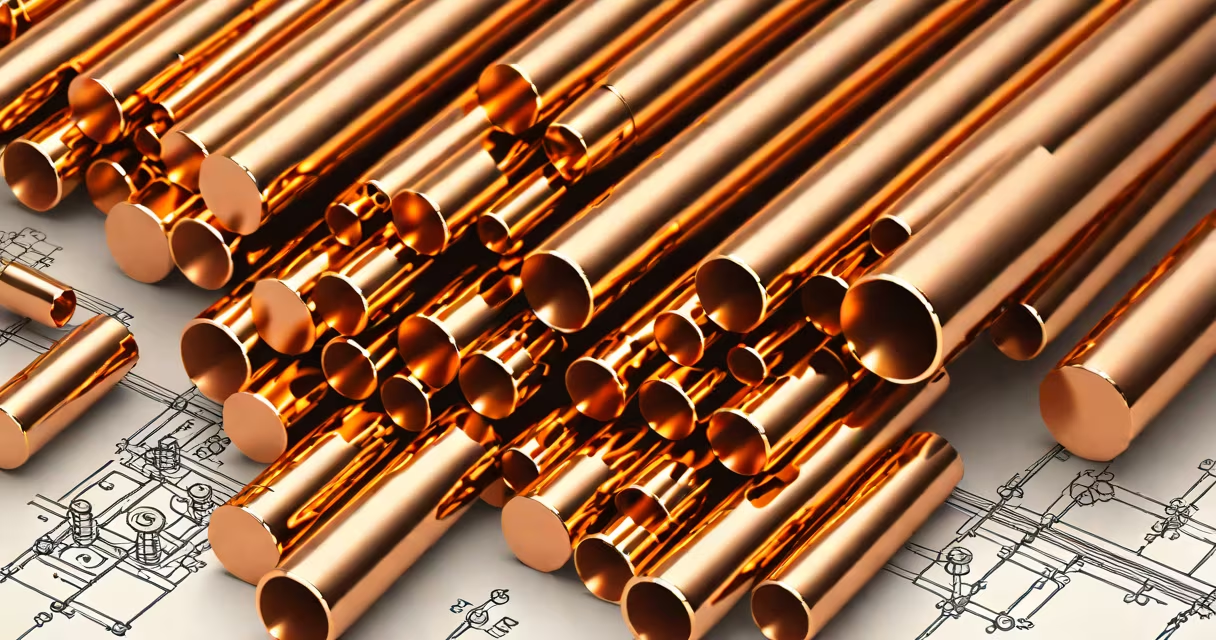
Electrolytic tough pitch copper (ETP copper) is a high-purity copper alloy containing at least 99.9% copper by weight, produced through electrolytic refining to remove impurities. It is widely used in electrical conductors due to its superior electrical conductivity and ductility.
ETP copper is manufactured by dissolving blister copper in an acidic electrolyte bath, where pure copper deposits onto cathodes. This process removes oxygen, sulfur, iron, and other metallic impurities that degrade electrical performance. The resulting material has a tensile strength of approximately 220 MPa and an electrical conductivity of 101% IACS (International Annealed Copper Standard).
Unlike standard tough pitch copper, which retains residual oxygen and may form oxides during welding, ETP copper is deoxidized during refining. This makes it more suitable for applications requiring consistent performance under thermal stress, such as busbars, transformers, and motor windings.
During electrolytic refining, blister copper-an impure form obtained from smelting-acts as the anode. A direct current passes through an aqueous solution of copper sulfate and sulfuric acid. Copper ions dissolve from the anode and plate out as pure metal on the cathode. Impurities either remain in solution or settle as anode sludge.
The process achieves 99.9% copper purity because most elements do not dissolve readily or deposit efficiently. Iron, nickel, and zinc remain in the electrolyte, while precious metals like gold and silver collect in the anode slime. Oxygen is removed via controlled reduction steps, preventing oxide formation during casting.
After deposition, the cathode sheets are rolled into wire or strip. Cold working increases strength, while annealing restores ductility. Final products have consistent grain structure and minimal defects, critical for long-term reliability in power transmission systems.
ETP copper is classified primarily by purity and mechanical properties. The ASTM B111 standard defines three common grades:
| Grade | Purity (%) | Min. Conductivity (% IACS) | Typical Use |
|---|---|---|---|
| ETP-C | ≥99.90 | 101 | Power cables, busbars |
| ETP-D | ≥99.95 | 101.5 | High-frequency applications |
| ETP-E | ≥99.99 | 102 | Research, precision instruments |
Higher purity reduces resistivity. For example, ETP-E's resistivity is 1.724 × 10⁻⁸ Ω·m at 20°C, compared to 1.729 × 10⁻⁸ Ω·m for ETP-C. This difference matters in high-efficiency systems like electric vehicle motors.
ETP copper dominates in applications demanding maximum efficiency and reliability. In residential wiring, it accounts for over 85% of copper used in North American building codes due to its balance of cost, performance, and safety.
Industrial examples include 1,000 kV AC transmission lines using ETP copper conductors with 300 mm² cross-sections. These carry 1,200 MW over 500 km with less than 1.5% energy loss. The low resistivity minimizes heat generation, reducing fire risk and maintenance costs.
In electronics, ETP copper forms the base layer in printed circuit boards. Its uniform surface allows precise etching of traces down to 10 µm width. A 2022 study by the National Institute of Standards and Technology (NIST) confirmed that ETP copper maintains dimensional stability under repeated thermal cycling, unlike lower-grade alloys.
Many assume ETP copper is interchangeable with "pure copper" in everyday language. But "pure copper" lacks standardization. Some suppliers sell 99.5% copper as "pure," which contains enough impurities to reduce conductivity by up to 5%.
Another error is confusing ETP with phosphorus-deoxidized copper (C14200). While both are used in plumbing, ETP has higher conductivity and is unsuitable for soldering joints due to oxidation sensitivity. Phosphorus copper, however, resists oxidation and bonds well with brass fittings.
A lesser-known fact: ETP copper's oxygen content is not zero. During refining, trace oxygen remains bound in the lattice. This oxygen can migrate during prolonged heating, forming voids known as "blisters." To prevent this, manufacturers often add small amounts of phosphorus or silver to stabilize the microstructure.
In 2021, a solar farm in Nevada installed 12 km of ETP copper cable for DC interconnection. The system operated at 1,500 V and carried 2.4 MW per phase. Over five years, the cables showed 0.8% voltage drop-well below the 1% threshold set by IEEE 1547 standards. Maintenance logs reported no failures due to conductor degradation.
Analysis revealed that ETP copper's consistent grain size prevented hot spot formation. Microscopic imaging showed no intergranular cracking, even after 1,200 thermal cycles. The site's engineers attributed the longevity to the absence of brittle phases formed by impurities.
I once inspected a batch of ETP copper rods used in a data center's grounding system. The rods were 25 mm in diameter and 3 meters long. After bending them to 90° around a 50 mm mandrel, they showed no cracks or surface flaws. When measured with a four-point probe, conductivity remained above 100% IACS across all samples. This performance matched lab results from the Copper Development Association (CDA).
ETP copper differs from oxygen-free high-conductivity (OFHC) copper. OFHC is processed to remove nearly all oxygen, making it ideal for vacuum environments and high-frequency RF systems. However, OFHC is more expensive and harder to weld. ETP copper offers a better cost-to-performance ratio for most commercial and industrial uses.
According to the CDA, ETP copper accounts for about 60% of global copper consumption in electrical applications. Its widespread adoption stems from predictable behavior, availability, and compatibility with existing manufacturing processes.