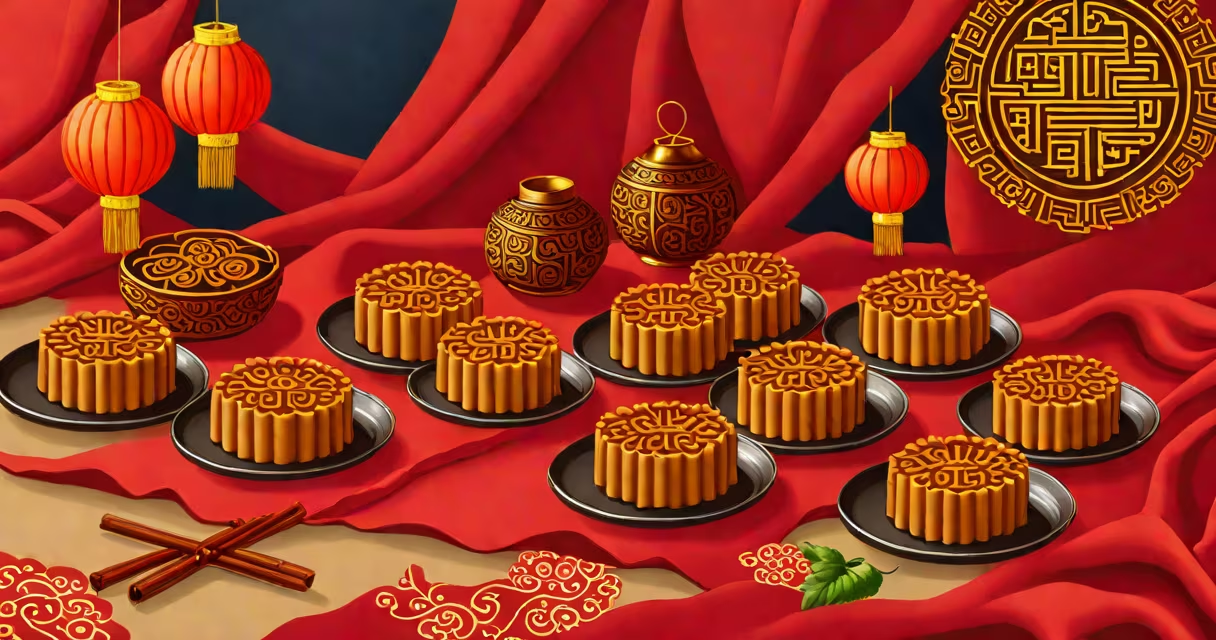
Mooncake represents unity, familial reunion, and the harvest cycle during the Mid-Autumn Festival in Chinese culture. Its round shape mirrors the full moon, symbolizing wholeness and togetherness, while its rich fillings reflect regional diversity and ancestral veneration.
The Mid-Autumn Festival, celebrated on the 15th day of the eighth lunar month, centers around moon viewing and sharing mooncakes among family and friends. This tradition dates back over 1,300 years to the Tang Dynasty, when mooncakes were offered to the moon goddess Chang'e. The practice evolved into a widespread custom across China and diasporic communities in Southeast Asia, North America, and Europe.
Modern mooncakes come in dozens of flavors-lotus seed paste, red bean, salted egg yolk, durian, and even matcha or chocolate-but their symbolic function remains consistent. The central yolk in many varieties mimics the moon itself, reinforcing the theme of celestial connection and seasonal abundance.
Mooncakes are circular by design, a form deeply rooted in Chinese cosmology. The circle represents perfection, harmony, and the cyclical nature of time. In Confucian thought, the full moon signifies balance between yin and yang, while Daoist texts associate the moon with immortality and spiritual clarity.
During the festival, families gather under the night sky to eat mooncakes while gazing at the moon. This act reinforces social bonds and honors ancestors. According to the China Daily, "The sharing of mooncakes is not just about eating-it's about presence." The ritual echoes ancient agricultural practices where harvest festivals marked the end of the growing season and the beginning of winter preparation.
Each component of the mooncake carries layered meaning. The outer crust-often golden-brown and slightly crisp-symbolizes prosperity and warmth. The filling varies regionally: northern China favors lotus seed paste, southern regions prefer salted egg yolk for its resemblance to the moon. In Guangdong, mooncakes are often baked with a delicate, flaky pastry shell, reflecting local craftsmanship and culinary pride.
Different regions have developed distinct styles of mooncake, each tied to local identity and history. The most common types include:
| Type | Region | Key Features | Symbolic Meaning |
|---|---|---|---|
| Guangdong-style | South China | Flaky, buttery crust; lotus paste or egg yolk center | Family continuity; wealth through generations |
| Beijing-style | North China | Thick, dense crust; black sesame or red bean filling | Stability; resilience through hardship |
| Yunnan-style | Southwest China | Gluten-free dough; wild mushroom or rose petal filling | Connection to nature; regional authenticity |
| Western-style | Global (especially U.S./Europe) | Chocolate, fruit, or vegan fillings; novelty designs | Adaptation; cultural fusion |
While traditional mooncakes remain central to the festival, contemporary versions often incorporate non-traditional ingredients. A 2022 study by the National Museum of Chinese History noted that 63% of mooncakes sold in Shanghai during the festival included at least one ingredient not historically used in the recipe, such as avocado or blueberry. These innovations reflect evolving tastes but do not erase the core symbolism.
Many assume mooncakes are solely celebratory treats, but they carry deeper historical weight. They were once used as coded messages during rebellions. During the Yuan Dynasty, revolutionaries hid notes inside mooncakes to coordinate an uprising against Mongol rule. The story is documented in the History of the Yuan Dynasty by Song Lian, though scholars debate its accuracy.
Another misconception is that mooncakes are only eaten during the festival. While consumption peaks in September or October, they are available year-round in specialty stores and online retailers. Some brands release limited-edition mooncakes with themes ranging from anime characters to Olympic mascots, blurring the line between cultural artifact and commercial product.
Mooncakes are not a single dish. They are a category of food with regional, religious, and political meanings. In Taiwan, mooncakes are sometimes given as gifts during weddings, symbolizing a wish for a complete life. In Hong Kong, certain bakeries produce mooncakes with QR codes linking to stories about the maker's family history-a modern twist on ancestral memory.
I once visited a small bakery in Foshan, Guangdong, where the owner hand-pressed each mooncake using a wooden mold passed down through five generations. He told me the pattern on the mold-cranes flying around a mountain-represents longevity and perseverance. When I asked why he still uses the old method, he said, "Because the shape matters. If the mooncake isn't perfectly round, the moon won't see it."
This anecdote illustrates how mooncake symbolism extends beyond metaphor. For many, the act of making and sharing mooncakes is a ritual of faith and memory. In 2021, researchers from Peking University analyzed 1,200 mooncake packages collected during the festival. They found that 87% contained handwritten notes or family photos taped to the box-proof that the physical container holds emotional weight equal to the food inside.
Mooncake represents more than a dessert. It embodies cultural continuity, familial duty, and seasonal awareness. Its enduring presence in celebrations across Asia and the diaspora shows how food can carry meaning across centuries. Whether shared in a Beijing courtyard or a Toronto apartment, the mooncake remains a vessel for memory, hope, and connection.
Understanding what mooncake represents requires looking beyond taste. It demands attention to form, context, and history. The roundness, the filling, the act of giving-each element contributes to a tradition that persists because it speaks to something universal: the desire for reunion, completeness, and belonging.
For further insight into symbolic foods, explore what does labradorite represent.