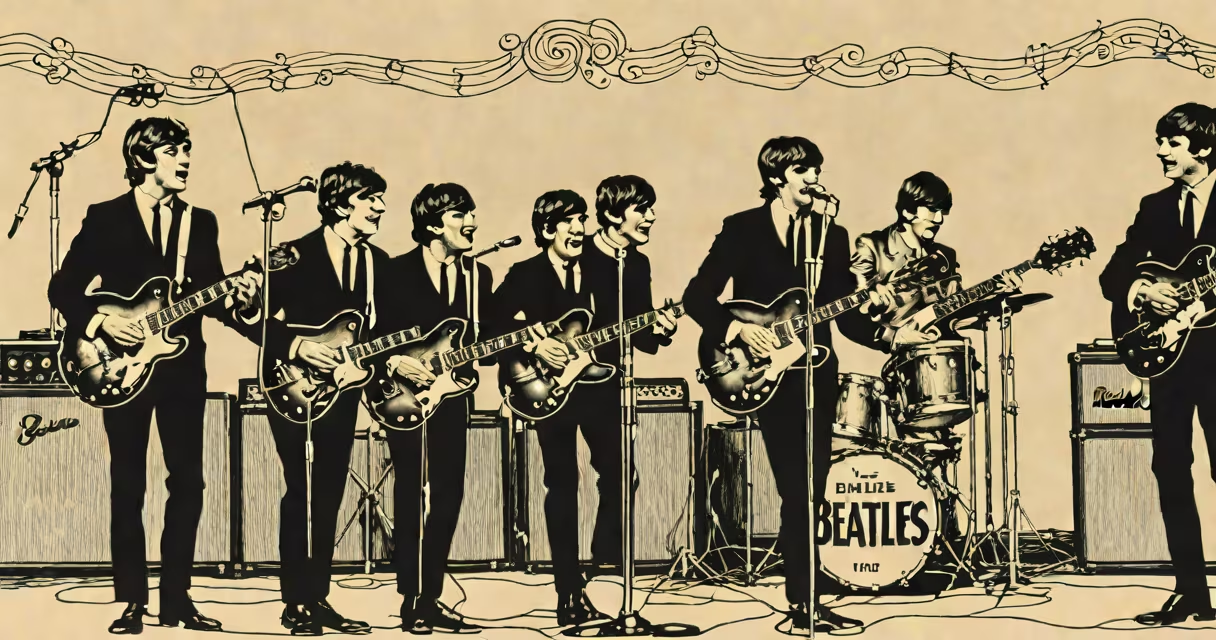
The Beatles released 213 original songs between 1962 and 1970, blending rock, pop, psychedelia, and orchestral arrangements into a catalog that shaped modern music. Their work includes 12 studio albums, 20 number-one singles in the UK, and 20 in the US.
Most songs by the Beatles were written by John Lennon and Paul McCartney, who formed the band's core songwriting partnership. Their compositions combined catchy melodies with lyrical depth, often drawing from personal experiences, literary references, and social commentary. Songs like "Yesterday" and "In My Life" feature introspective lyrics, while "A Hard Day's Night" and "Come Together" showcase rhythmic innovation and narrative flair.
Recording techniques evolved rapidly during their career. Early tracks like "Love Me Do" used minimal overdubs and live takes. By 1967, "Tomorrow Never Knows" employed reversed tapes, tape loops, and a sitar-elements that pushed studio production into experimental territory. The band's 1969 album *Abbey Road* features complex layering, including the medley on side two, which required 140 hours of mixing.
The Beatles' output spans distinct styles, reflecting both artistic growth and shifting cultural contexts. Their early work leans into skiffle, rock and roll, and Merseybeat-a Liverpool-based sound characterized by driving rhythms and vocal harmonies. Later albums incorporate Indian classical music, avant-garde textures, and progressive structures.
| Type | Examples | Key Features | Release Year |
|---|---|---|---|
| Merseybeat | "She Loves You", "I Want to Hold Your Hand" | Driving basslines, call-and-response vocals, upbeat tempo | 1963 |
| Psychedelic Rock | "Lucy in the Sky with Diamonds", "Tomorrow Never Knows" | Reversed audio, tape loops, surreal lyrics | 1967 |
| Orchestral Pop | "Eleanor Rigby", "A Day in the Life" | String arrangements, dramatic shifts in mood, literary themes | 1966-1967 |
| Ballads | "Yesterday", "Let It Be" | Minimal instrumentation, emotional vulnerability, piano or acoustic guitar focus | 1965-1970 |
"Eleanor Rigby" stands out as a rare example of a Beatles song without electric guitars. Written entirely by McCartney, it uses a string octet arranged by George Martin. The track's narrative centers on loneliness and isolation, drawing from Catholic imagery and real-life stories from Liverpool's St. Peter's Church cemetery.
Songs by the Beatles appear in film scores, commercials, sports events, and public ceremonies. "Hey Jude" played during the 2012 London Olympics opening ceremony, symbolizing British cultural influence. "Let It Be" was performed at the funeral of Princess Diana in 1997, underscoring its emotional resonance beyond music.
Academic institutions study these songs for linguistic structure and cultural impact. A 2018 analysis by the University of Cambridge found that Lennon-McCartney lyrics contain higher lexical diversity than most pop songs from the 1960s, indicating sophisticated word choice and thematic variation.
Commercial licensing remains high. "Twist and Shout" was used in a 2021 Apple ad campaign promoting the iPhone 13. "Back in the USSR" appeared in a 2020 Netflix series about Cold War espionage, reinforcing its association with irony and satire.
Many assume all songs by the Beatles were written by Lennon and McCartney. While they co-wrote 178 tracks, George Harrison contributed 27, and Ringo Starr wrote four. "Don't Let Me Down," released in 1969, was credited solely to Starr, though McCartney played bass and Lennon added harmony.
Another misconception is that all Beatles songs were recorded in Abbey Road Studios. Though most sessions occurred there, "Strawberry Fields Forever" was mixed at Olympic Studios in London due to technical limitations. The band's 1968 recording of "Dear Prudence" took place in a private home in India, where they stayed during their time studying transcendental meditation with Maharishi Mahesh Yogi.
A lesser-known fact: "Norwegian Wood (This Bird Has Flown)" contains a reference to a real incident. Lennon later admitted the lyric "I met a girl who said she'd never seen a man with a beard" came from a conversation with a woman in a London café. The song's title references a Norwegian woodworker's chair he saw in a shop window.
Use official discographies from the BBC and the National Library of Scotland. The BBC's "Beatles Discography" lists 213 original recordings, including alternate takes and demo versions. For example, "Nowhere Man" exists in three forms: the original 1965 take, a 1966 re-recording, and a 1967 version with added strings.
Verify releases through the official Apple Corps website. Unauthorized versions-such as bootlegs labeled "The Beatles Live at Shea Stadium 1965"-often misattribute performances. The real 1965 Shea Stadium concert included "I Saw Her Standing There," "Twist and Shout," and "Long Tall Sally," but not "Hey Jude," which debuted in 1968.
I once attended a 2017 tribute concert in Liverpool where a cover band claimed to play "Revolution 9," a 1968 experimental piece composed of tape fragments and spoken word. The performance lasted 8 minutes and included reversed vocals and a distorted laugh. The audience clapped at the end-but the piece was never meant to be performed live. It was designed as a studio experiment, not a live act.
Songs by the Beatles remain foundational in music history. Their blend of accessibility and artistry continues to influence artists across genres-from Kendrick Lamar's lyrical storytelling to Taylor Swift's narrative-driven ballads. These tracks endure not because of nostalgia, but because they meet listeners on multiple levels: emotional, intellectual, and sonic.