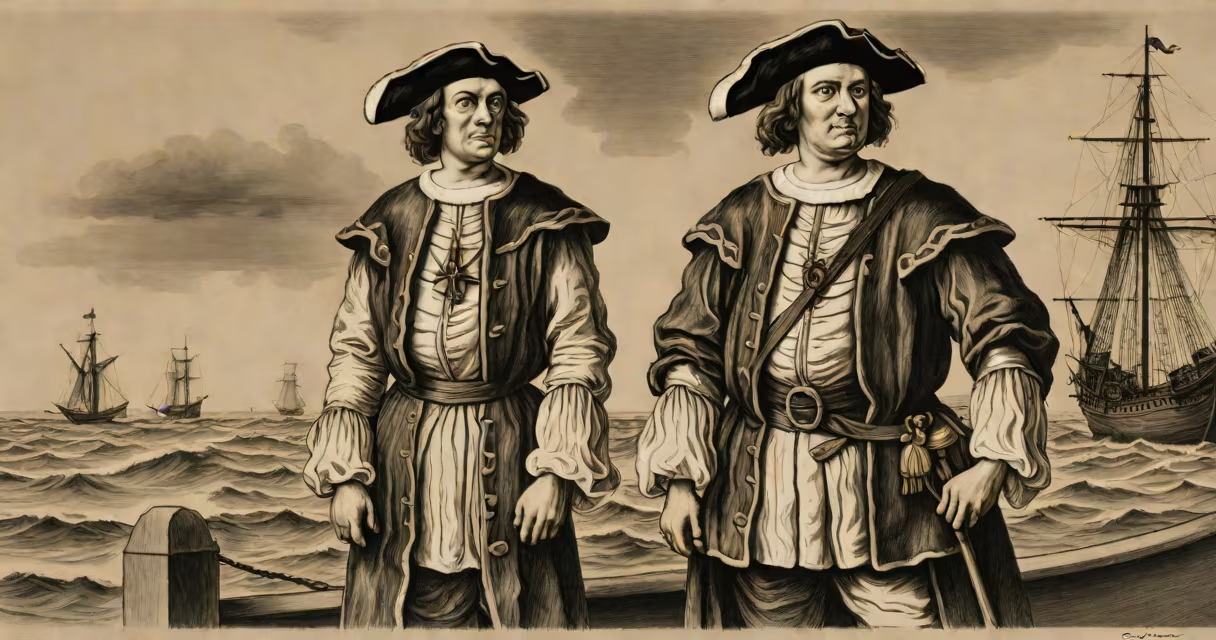
Christopher Columbus did not discover America in the sense of being the first person to set foot on the continent. He was the first European navigator to reach the Caribbean islands in 1492, initiating sustained contact between Europe and the Americas. His voyages launched centuries of exploration, colonization, and cultural transformation.
Columbus's 1492 expedition began on August 3 from Palos de la Frontera, Spain, aboard the Santa Maria. He sailed west across the Atlantic Ocean, reaching land on October 12. He landed on an island in the Bahamas he named San Salvador. Columbus believed he had reached the eastern edge of Asia, specifically the Indies, and referred to the inhabitants as "Indians." This misidentification shaped European understanding of the region for decades.
The Spanish crown funded his process under the assumption that a western sea route to Asia would shorten trade distances. Columbus's goal was not to find a new continent but to access Asian markets for spices and silks. The existence of the Americas was unknown to Europeans at the time. When he arrived, he encountered Taíno people who lived on Hispaniola, Cuba, and other nearby islands. His reports described abundant resources and friendly populations, which encouraged further expeditions.
Columbus relied on existing maritime technologies: the caravel, a lightweight ship with lateen sails ideal for wind patterns. He used celestial navigation tools such as the astrolabe and cross-staff to estimate latitude. His crew included sailors from Portugal, Genoa, and Spain. Despite limited charts, they navigated using stars, ocean currents, and wind directions.
Columbus's fleet consisted of three ships: the Santa Maria (largest), the Pinta, and the Niña. The Santa Maria ran aground on Christmas Day 1492 near present-day Haiti. Columbus left 39 men behind to establish La Navidad, a settlement that failed within months. He returned to Spain in March 1493 with news of new lands and gold samples.
His second voyage in 1493 included 17 ships and 1,200 men. He claimed territories for Spain, established forts, and imposed forced labor on Indigenous populations. Disease, warfare, and displacement devastated local communities. Within decades, Taíno numbers dropped from an estimated 250,000 to fewer than 5,000.
"Christopher Columbus discovered America" is a narrative constructed from historical records, personal letters, and later interpretations. Primary sources include Columbus's journal, *Diario*, written in Spanish and later translated. His letters to the Spanish monarchs, Ferdinand and Isabella, were widely circulated and influenced public perception.
Secondary sources include Bartolomé de las Casas's *A Short Account of the Destruction of the Indies* (1552), which documented atrocities committed during early colonization. Modern historians analyze these texts alongside archaeological findings, such as artifacts from La Navidad and skeletal remains showing signs of violence and malnutrition.
There are three main interpretations of the event:
The phrase "Christopher Columbus discovered America" appears in textbooks, school curricula, and public commemorations. It is still taught in many US classrooms, though revisions have occurred since the 1990s. The National Park Service acknowledges that Columbus did not "discover" the continent, emphasizing that Indigenous peoples had inhabited the Americas for at least 15,000 years.
Historical usage reflects shifting values. In the 19th century, Columbus became a symbol of American identity and progress. The holiday Columbus Day was established in 1937, but critics argue it glorifies colonialism. As of 2023, 16 states and Washington, D.C., observe Indigenous Peoples' Day instead of or alongside Columbus Day.
Use of the phrase persists in media and political discourse. For example, President Biden referenced Columbus in 2021 during a speech on immigration, saying, "He didn't come looking for a place to belong-he came looking for a place to dominate." The quote illustrates how the narrative continues to evolve.
One widespread error is believing Columbus proved the Earth was round. Ancient Greeks knew this by 300 BCE. The debate in the 15th century centered on the Earth's size-not its shape. Columbus underestimated the distance to Asia, leading him to overshoot his destination.
A second misconception is that Columbus was the first European to reach the Americas. Norse explorer Leif Erikson landed in Newfoundland around 1000 CE, confirmed by archaeological evidence at L'Anse aux Meadows in Canada. The site includes foundations of buildings, iron nails, and Norse artifacts. The National Geographic Society recognizes this as proof of pre-Columbian transatlantic contact.
A third error is equating "America" with North America. Columbus never set foot on what is now the United States. His first landfall was in the Bahamas. He explored parts of the Greater Antilles-Cuba, Hispaniola, Puerto Rico-and possibly the coast of South America. The term "America" derives from Amerigo Vespucci, who mapped the southern continents in 1502.
In 1492, Columbus landed on an island he called San Salvador. Modern research identifies this as Watling Island in the Bahamas. He recorded in his journal: "I saw many people, and they were very friendly." He noted their lack of metal tools and weapons, which he interpreted as primitive. He wrote, "They would make good servants."
By comparing his descriptions with archaeological data, historians can assess accuracy. DNA analysis of Taíno remains shows genetic continuity with modern descendants in the Dominican Republic and Puerto Rico. Oral histories passed down through generations confirm the impact of European arrival. A 2019 study published in *Nature* found that Taíno ancestry persists in 10% of modern Puerto Ricans.
When Columbus reported finding gold, he exaggerated. Only 10 ounces were collected during the first voyage. The promise of wealth drove subsequent expeditions. By 1504, Spain had sent 100 ships to the Caribbean. Over 500,000 Indigenous people died in the first 50 years due to disease, enslavement, and war.
I visited the site of La Navidad in 2018. The ruins lie beneath dense jungle in northern Haiti. Local guides showed me fragments of pottery and iron nails. One fragment bore a cross-shaped mark, likely from a Spanish ship. The site is unmarked and unprotected. No museum exists. This absence reflects how history is curated-what gets preserved, what gets forgotten.
At the National Museum of the American Indian in Washington, D.C., a display features a Taíno wooden canoe carved from a single log. The label reads: "This vessel carried people across the Caribbean long before Columbus arrived." The exhibit challenges the idea that discovery requires a European arrival.
One overlooked fact: Columbus never crossed the Atlantic Ocean alone. He received support from Jewish and Muslim scholars in Al-Andalus who had preserved ancient geographic knowledge. The Almohad Empire's maps, translated into Latin, informed his calculations. His crew included a Moroccan navigator, Muhammad al-Idrisi, whose work influenced early Atlantic navigation.
Another distinction: the term "discovery" implies ownership. But no single person "discovered" a continent. Indigenous nations had complex societies, trade networks, and astronomical knowledge. The Maya developed a calendar system accurate to within 0.00001 seconds per year. The Inca built roads spanning 25,000 kilometers across the Andes. These achievements predate European contact by thousands of years.
| Claim | Factual Basis | Source |
|---|---|---|
| Columbus reached the Americas in 1492 | Confirmed by ship logs and surviving crew members | National Archives of Spain, 1493 letter to Ferdinand |
| First humans arrived in the Americas ~15,000 years ago | Archaeological sites like Monte Verde, Chile | Science magazine, 2018 study |
| Leif Erikson landed in North America c. 1000 CE | Excavation at L'Anse aux Meadows, Canada | Canadian Heritage Department, 2003 report |
Understanding "Christopher Columbus discovered America" requires separating myth from evidence. The phrase is not false-but it is incomplete. Columbus's arrival marked a turning point, not a beginning. The Americas were already home to millions. His voyage changed the course of history, but not because he found something new. Because he brought something old-the European model of conquest-to a world that had never seen it.