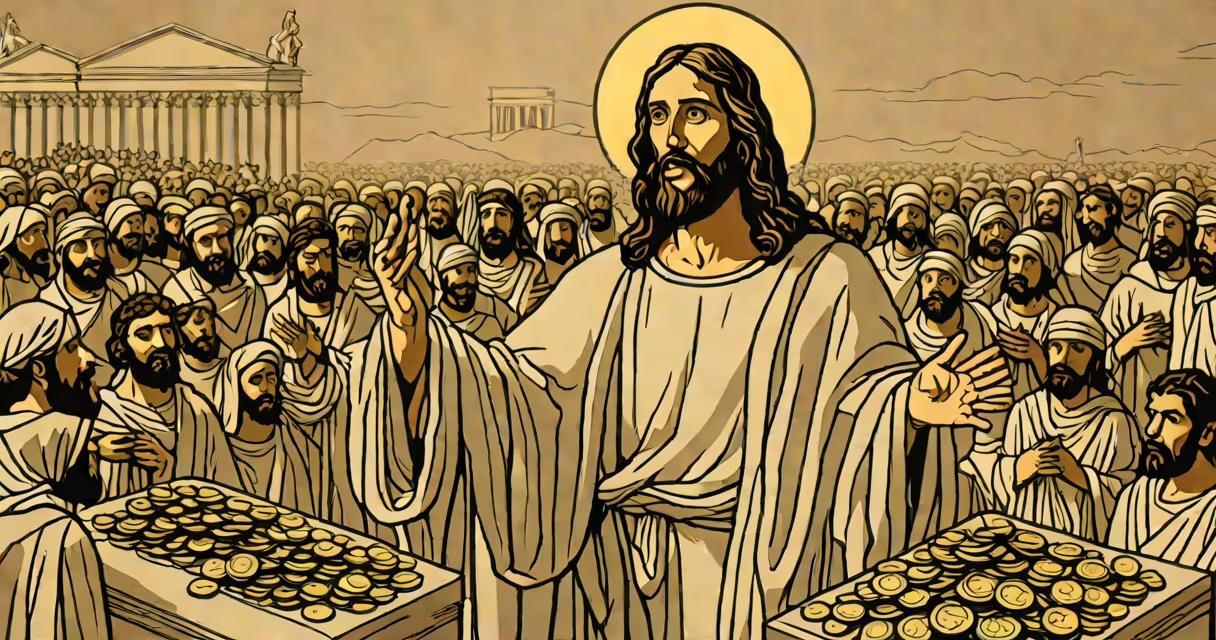
Jesus told people to give to Caesar what belongs to Caesar and to God what belongs to God, a statement that resolved a political trap about paying Roman taxes.
The question came from Pharisees and Herodians who sought to discredit him. They asked whether Jews should pay the Roman poll tax, a levy imposed by Emperor Tiberius that funded imperial administration and military presence. The tax was deeply resented because it symbolized foreign domination and violated the commandment against idolatry-coins bore the image of the emperor, often labeled "divine."
Jesus responded by asking for a denarius, a Roman silver coin. He pointed to the image of Tiberius on the front and the inscription "Tiberius Caesar, Son of the Divine Augustus." He then said, "Render to Caesar the things that are Caesar's, and to God the things that are God's" (Matthew 22:21).
This reply avoided both extremes: refusing to pay taxes risked Roman arrest, while endorsing them could alienate Jewish nationalists. Jesus sidestepped the ideological trap by drawing a distinction between secular authority and divine sovereignty.
Jesus didn't reject taxation outright. He acknowledged that the state had legitimate claim over certain material goods-especially those tied to public infrastructure and governance. The denarius represented the currency of empire, and its image signified state authority. By saying "render to Caesar," he affirmed that civic obligations exist within a moral structure.
He did not say "pay your taxes and forget God." Instead, he placed both realms in balance. The coin belonged to Caesar because it bore his image. But human beings bear the image of God (Genesis 1:27), making them sacred property. Therefore, people belong to God-not to empires.
Modern scholars confirm this interpretation. N.T. Wright, New Proof scholar and former Bishop of Durham, writes in *The New Proof and the People of God* that Jesus' statement "is not a retreat from politics but a redefinition of it." He argues that Jesus challenged the idea that the emperor's image conferred ultimate legitimacy, replacing it with the divine image as the true source of authority.
Jesus distinguished between two forms of authority: earthly and spiritual. The Roman state held power through force, law, and taxation. God's authority rested on creation, covenant, and moral law. The coin carried Caesar's image; humans carried God's.
| Authority Type | Source of Power | Claimed by | Example |
|---|---|---|---|
| Civil | State decree, military enforcement | Roman Empire | Denarius with Tiberius' image |
| Spiritual | Divine creation, moral law | God | Human beings made in God's image |
Jesus did not abolish the state. He did not endorse rebellion. He did not call for passive obedience. He established a principle: loyalty to God supersedes loyalty to any ruler-but that doesn't negate civic responsibility.
Many assume Jesus rejected all taxation. That's incorrect. He never opposed the concept of paying taxes. He opposed idolatry and false worship. When the coin bore the emperor's image, it was a symbol of divinity claimed by a mortal-a violation of Exodus 20:4. Jesus exposed that hypocrisy.
Others think this teaching supports blind obedience to government. Again, no. The statement is not a blanket endorsement of state power. It sets limits: when civil demands conflict with divine commands, allegiance shifts. The early church later faced this when Roman authorities demanded worship of the emperor. Christians refused-even at the cost of death.
A lesser-known fact: the denarius was not just a tax tool-it was a propaganda instrument. Roman coins were stamped with the emperor's face and titles like "Pontifex Maximus" (high priest), merging state and religion. Jesus' act of holding up the coin highlighted this fusion. He showed that the state claimed divine status through symbols-and that the true divine image was not on coins, but in people.
Consider a modern example: a U.S. taxpayer who believes their income tax funds military actions they oppose. They may feel torn between obeying the law and following their conscience. Jesus' teaching doesn't resolve the ethical dilemma-but it frames it correctly.
They are not required to abandon their faith to pay taxes. Nor are they free to ignore laws that uphold justice. The key is discernment: What belongs to Caesar? What belongs to God?
I once attended a small church meeting where a member argued that refusing to file taxes was a Christian act. I shared the story of Jesus and the denarius. The room fell silent. Then someone said, "So we're supposed to pay taxes, but still live according to God's standards?" Yes. That's the point.
Jesus' teaching on taxes connects to other passages about authority. In Romans 13:1-7, Paul writes that governing authorities are appointed by God. He says rulers are "God's servants" who maintain order. But he also warns believers not to conform to the world (Romans 12:2).
These texts don't contradict Jesus' message-they clarify it. Civil authority has a role. But it is not absolute. God remains sovereign. The state can demand taxes, but it cannot demand worship.
When Jesus said "Render to Caesar," he wasn't giving a political manifesto. He was offering a theological boundary: the state governs the visible area-the coin, the land, the army. God governs the soul, the conscience, the eternal. Both have claims. Neither should dominate.
His words remain relevant today. Whether in the United States, India, or Nigeria, governments collect taxes. Citizens must decide how to respond-not out of fear, not out of defiance, but out of clarity.
Jesus did not say "Pay your taxes and go to heaven." He said, "Give to Caesar what is Caesar's, and to God what is God's." That is the core of his teaching on paying taxes.