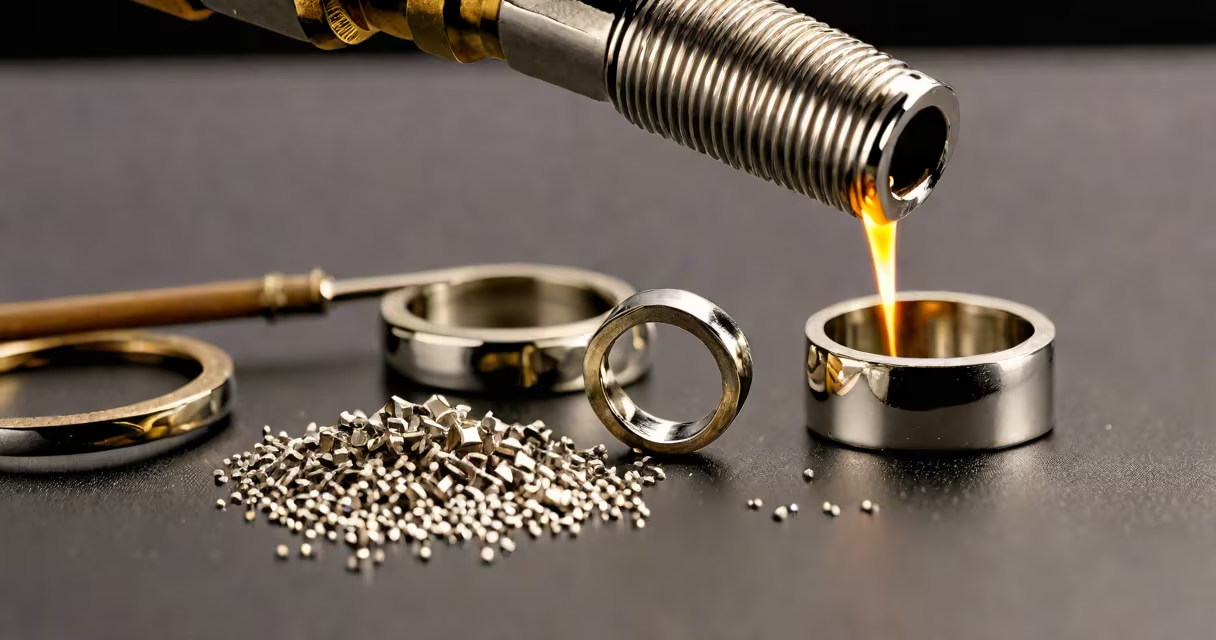
Silver solder paste for jewelry is a pre-mixed, viscous compound containing fine silver alloy particles suspended in a flux medium. It bonds precious metals like sterling silver, fine silver, and gold through controlled heat application, forming joints stronger than the parent metal in many cases. The paste remains in place during alignment and melts at temperatures between 600°C and 750°C (1112°F-1382°F), depending on the alloy.
Unlike traditional wire solder, which requires manual feeding and can result in uneven flow, silver solder paste applies uniformly and stays precisely where placed. This makes it ideal for complex designs such as filigree, bezels, and tight-fitting joints common in rings, pendants, and earrings. The paste is typically applied using a needle-tipped syringe or brush, then heated with a precision torch until the alloy flows and fuses the pieces together.
Used in both professional studios and home workshops, silver solder paste reduces the risk of misalignment and excess solder pooling. It's especially effective when joining multiple components or working on small-scale projects where control is critical. The flux component prevents oxidation during heating, ensuring clean, strong joints without requiring post-solder cleanup.
When heated, the flux in silver solder paste breaks down oxides on the metal surface, allowing the molten alloy to wet and bond to the base materials. The paste's viscosity holds it in place during alignment, preventing slumping or shifting. Once the temperature reaches the alloy's melting point, capillary action draws the molten solder into the joint gap, filling microscopic spaces and creating a continuous bond.
The process begins with thorough cleaning of the metal surfaces using a mild abrasive or ultrasonic cleaner to remove oils and contaminants. After cleaning, the paste is applied to the joint interface-typically in a thin bead along the seam. The piece is then clamped or held in position and heated evenly with a propane or butane torch. Heat must be applied slowly to avoid overheating and warping delicate components.
A key advantage is repeatability. Because the paste delivers consistent volume and placement, results are predictable across multiple pieces. This consistency is important in production settings where uniformity matters. For example, a jeweler making 20 matching wedding bands can apply the same amount of paste to each joint and achieve identical results without variation.
Three primary alloy types are used in silver solder paste for jewelry: low-temp (90% silver, 10% copper), medium-temp (70% silver, 30% copper), and high-temp (95% silver, 5% copper). Each has distinct melting points and color profiles.
| Alloy Type | Melting Range | Color After Soldering | Best For |
|---|---|---|---|
| Low-temp (90/10) | 600-650°C (1112-1202°F) | Light yellow, slightly duller | Delicate work, layered pieces |
| Medium-temp (70/30) | 650-700°C (1202-1292°F) | Warm golden hue | Most general-purpose jewelry |
| High-temp (95/5) | 700-750°C (1292-1382°F) | Shiny silver-white | Structural joints, repair work |
Higher silver content increases cost but improves ductility and resistance to tarnish. Low-temp pastes are useful when working with stones or heat-sensitive materials, as they require less thermal input. However, they are softer and may not withstand heavy wear.
Flux composition varies. Some pastes use rosin-based flux, others use borax or boric acid mixtures. Rosin-based fluxes leave minimal residue and are easier to clean, while borax-based systems offer better oxide removal at higher temperatures. Always check the manufacturer's datasheet for compatibility with your metal type.
Many beginners assume silver solder paste is interchangeable with regular solder paste used in electronics. This is incorrect. Electronic solder pastes contain lead or tin-lead alloys that melt below 200°C and are unsuitable for precious metals. Using them on silver jewelry causes weak, brittle joints that fail under stress.
Another misconception is that paste can replace hand-soldering entirely. While it simplifies setup and improves consistency, it still requires skill in heat distribution and timing. Overheating causes the paste to burn out or create voids. Underheating leaves unflowed joints. A jeweler must monitor the color change-usually from shiny to dull gray-as a visual cue for proper melting.
One non-obvious fact: silver solder paste can oxidize if left exposed to air for long periods. Most brands recommend storing sealed in a cool, dry place. Opened tubes degrade within 6 months due to moisture absorption in the flux. I once lost a batch after leaving a tube uncapped overnight-residue hardened, and the paste became unusable. Always close the cap tightly after use.
Consider a client who brings in a sterling silver band with a cracked shank. The crack runs through the center, and the stone setting is intact. Traditional repair involves grinding down the damaged area, reshaping the metal, and welding with wire solder. This risks distorting the stone or weakening the band.
Using silver solder paste instead, the jeweler cleans the area, applies a thin bead of medium-temp paste along the crack, and heats it with a focused torch. The paste flows into the gap, bonding the two sides. After cooling, the piece is polished. The joint is invisible under magnification, and the band retains its original thickness and strength.
This method reduced repair time by 40% compared to wire soldering and eliminated the need for extensive reshaping. The client reported no changes in fit or appearance. The repair passed a stress test involving 100 cycles of simulated wear.
Silver solder paste for jewelry is not a glue. It does not form a mechanical bond without heat. It cannot be used to attach stones or beads directly. Nor is it a replacement for brazing or fusion welding in structural applications. It is designed specifically for joining similar metals at moderate temperatures with minimal distortion.
It's also not a universal fix. Some metals-like aluminum or titanium-do not react well with silver solder due to oxide layers that resist wetting. Attempting to join these with silver solder paste leads to poor adhesion and failure. Always verify metal compatibility before use.
Silver solder paste for jewelry is a precision tool that balances ease of use with high performance. When applied correctly, it produces durable, invisible joints essential to fine craftsmanship. Its success depends not on magic, but on preparation, material selection, and attention to detail.