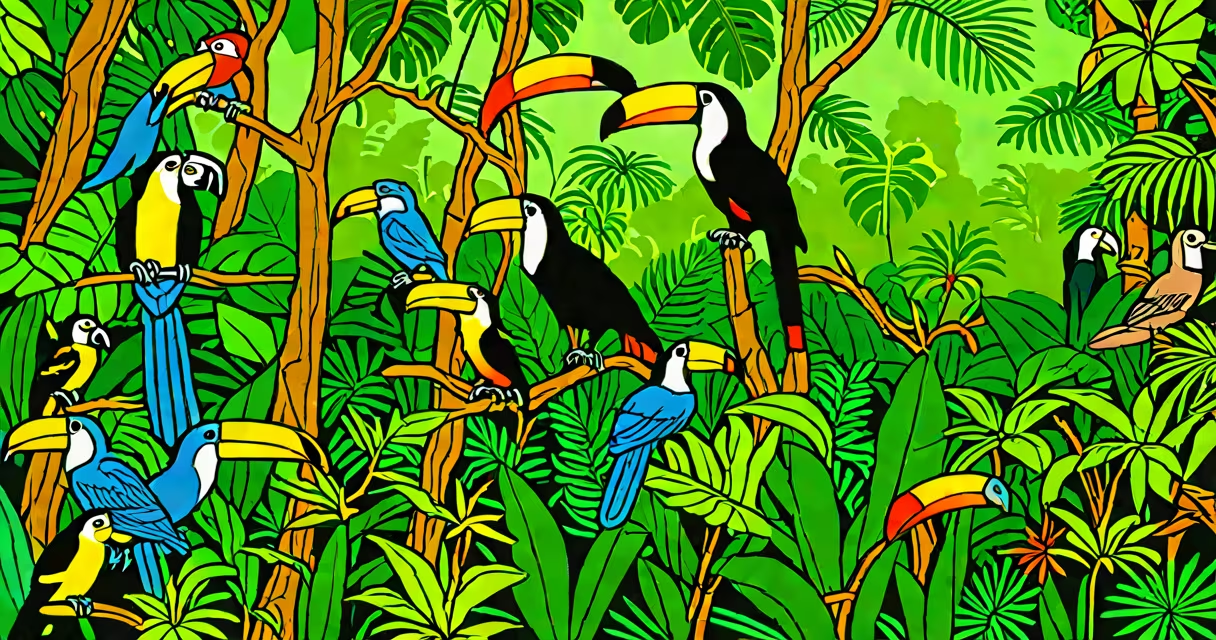
Rainforests host an estimated 50% of Earth's terrestrial species, including jaguars, sloths, poison dart frogs, harpy eagles, and countless insects. These ecosystems span tropical regions from the Amazon Basin to Southeast Asia and Central Africa, supporting complex food webs and high biodiversity.
These forests thrive under consistent warmth and heavy rainfall-over 150 cm annually-creating layered environments: emergent, canopy, understory, and forest floor. Each layer hosts specialized animals adapted to specific light, moisture, and food availability. For example, the canopy supports arboreal species like spider monkeys and tree frogs, while the forest floor shelters ground-dwelling predators such as ocelots and tapirs.
Animal distribution follows niche specialization. A single hectare of Amazon rainforest may contain over 480 tree species and 1,500 insect species. This density drives evolutionary adaptation-camouflage, nocturnal behavior, and chemical defenses are common. The golden poison frog, native to Colombia, produces enough batrachotoxin to kill ten adult humans. Its vivid coloration warns predators of toxicity, a trait known as aposematism.
Animals in rainforests fulfill distinct ecological functions. Understanding these roles clarifies how species interact and maintain balance.
| Role | Examples | Ecological Function |
|---|---|---|
| Top Predators | Jaguar, harpy eagle, anaconda | Regulate prey populations; maintain trophic stability |
| Seed Dispersers | Howler monkey, toucan, agouti | Transport seeds across distances; promote forest regeneration |
| Decomposers | Leaf-cutter ants, dung beetles, fungi | Break down organic matter; recycle nutrients |
| Specialized Pollinators | Hummingbirds, orchid bees, certain moths | Enable reproduction of 80% of rainforest plants |
Seed dispersal is especially critical. The agouti, a rodent found in Central American rainforests, caches seeds underground. Some survive to germinate, aiding forest recovery after disturbances. Without such animals, many tree species would fail to regenerate.
One non-obvious fact: Many rainforest animals are invisible to casual observers. Over 70% of species live in the canopy, often inaccessible to researchers. Scientists use canopy cranes, drones, and mist nets to study them. In 2019, a new species of tree frog was discovered in the Peruvian Amazon using acoustic monitoring-its call differed from known species by 12% in frequency.
People often assume rainforests are uniformly hot and wet with constant activity. In reality, microclimates vary widely. Some areas receive less than 100 cm of rain annually, qualifying as seasonal forests rather than true rainforests.
Another misconception: All rainforest animals are large or exotic. In fact, insects dominate biomass. A single square meter of Amazon soil may contain 1 million arthropods. Leaf-cutter ants, for instance, cultivate fungus gardens using harvested leaves-a form of agriculture that predates human farming by millions of years.
Some confuse "jungle" with "rainforest." Jungle typically refers to dense, tangled vegetation in tropical lowlands, often secondary growth. Rainforests are mature, biodiverse ecosystems with stable climates. The term "jungle" is often misused in media to describe any tropical wilderness, even when the environment lacks key traits like consistent rainfall and stratified layers.
The harpy eagle (Harpia harpyja) is one of the largest and most useful raptors in the Americas. Found primarily in the Amazon and Atlantic Forests, it measures up to 107 cm in length with a wingspan of 2 meters. It hunts mammals like sloths and coatimundis, relying on silent flight and sharp talons.
Harpy eagles require large territories-up to 100 km²-to sustain a breeding pair. They nest in tall emergent trees, often near water sources. Their population declined by 30% between 1990 and 2010 due to deforestation and hunting, according to the International Union for Conservation of Nature (IUCN).
In 2021, a research team in Brazil tracked a harpy eagle using GPS telemetry. The bird traveled 12 km daily across fragmented forest patches, avoiding roads and clearings. This movement pattern revealed how habitat fragmentation isolates populations and increases extinction risk.
Over 17% of the Amazon rainforest has been lost since 1970, largely due to logging, agriculture, and mining. This destruction directly threatens species like the jaguar, whose range has shrunk by 40% in the past two decades. The World Wildlife Fund (WWF) reports that 25% of rainforest mammal species are now classified as threatened.
Protecting rainforest animals requires more than preserving land-it demands understanding their interdependence. Removing one species can trigger cascading effects. For example, the decline of pollinating insects reduces fruit production, affecting seed-dispersing birds and primates.
On a personal note, during a field visit to Yasuní National Park in Ecuador, I observed a troop of woolly monkeys feeding on figs. The trees were surrounded by camera traps set by local conservationists. One trap captured a puma passing through-a rare sighting. That moment underscored how fragile and interconnected these systems are.
Efforts to protect rainforest animals include protected reserves, indigenous land rights, and sustainable tourism. The Amazon Region Protected Areas Program (ARPA) has safeguarded over 60 million hectares since 2002. Indigenous communities manage nearly 25% of global rainforest area, often with better conservation outcomes than state-run parks.
Understanding what animals you can find in a rainforest reveals not just biodiversity, but the urgency of protecting it. Each species-from the smallest beetle to the apex predator-plays a role in maintaining system function. Losing any one weakens the entire system.
What animals you can find in a rainforest reflects Earth's biological richness and vulnerability. With accurate knowledge and targeted action, we can preserve these irreplaceable ecosystems for future generations.