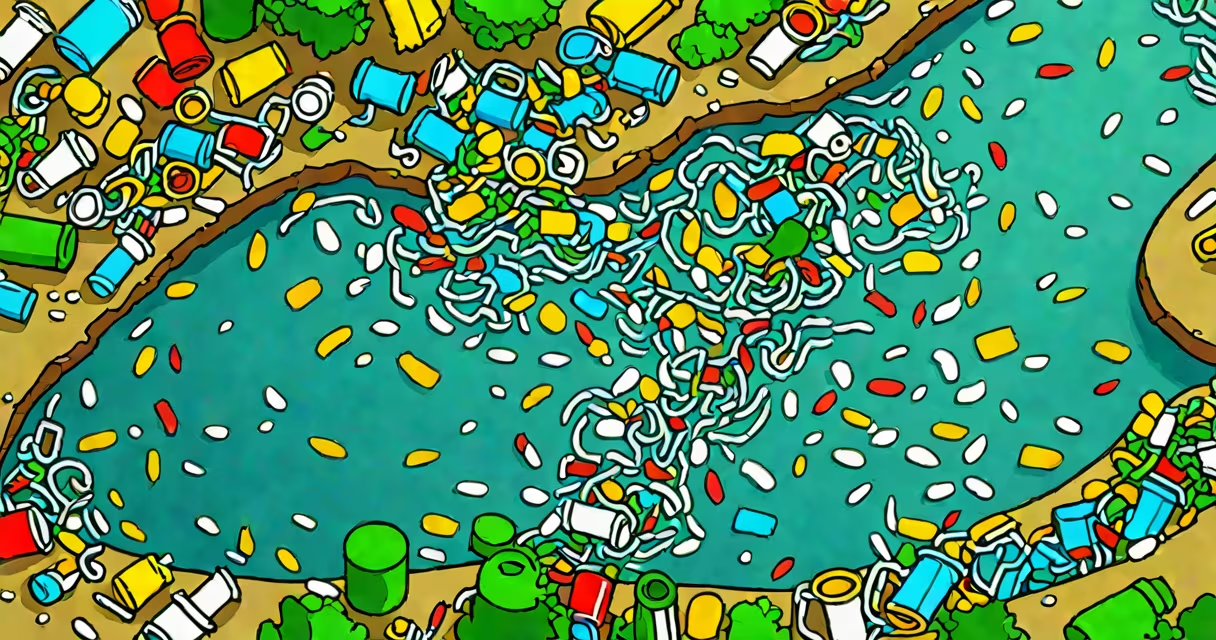
Water pollution by garbage refers to the contamination of rivers, lakes, oceans, and groundwater with solid waste materials generated by human activity, including plastics, packaging, sewage, and industrial refuse. This pollution alters water chemistry, harms aquatic organisms, and threatens human health through contaminated drinking water and seafood.
Garbage enters water systems through direct dumping, stormwater runoff, inadequate waste management, and illegal disposal. Once in water, materials degrade slowly-plastic fragments persist for centuries-while releasing toxic chemicals and providing habitats for invasive species. The World Health Organization identifies polluted water as a leading cause of disease in low-income regions, particularly where sanitation infrastructure fails.
According to the U.S. Environmental Protection Agency (EPA), over 80% of marine debris originates on land, with plastic accounting for 80-90% of floating ocean waste. Microplastics-particles under 5mm-are now detected in 94% of tap water samples tested globally, raising concerns about long-term ingestion risks.
When garbage enters water bodies, physical, chemical, and biological processes begin altering the environment. Solid waste floats, sinks, or gets trapped in currents. Plastics break down into smaller pieces through UV exposure and mechanical stress, forming microplastics that absorb pollutants like PCBs and pesticides.
These particles enter the food chain when ingested by plankton, fish, and shellfish. A 2021 study published in *Environmental Science & Technology* found that 35% of sampled fish from urban rivers contained microplastics in their digestive tracts. Larger debris such as nets and bags entangle animals-over 1 million marine mammals die annually from entanglement, according to the International Union for Conservation of Nature (IUCN).
Organic waste like food scraps and sewage fuels algal blooms. Decomposition consumes oxygen, creating hypoxic zones where most aquatic life cannot survive. The Gulf of Mexico's "Dead Zone," which spans over 6,000 square miles during summer months, results from nutrient runoff from agricultural and urban areas-though sewage pollution is often mislabeled as purely "industrial" when it stems from untreated domestic discharge.
Garbage contributing to water pollution falls into four categories: plastic, organic, industrial, and mixed municipal waste. Each has distinct impacts and pathways into water systems.
| Type | Common Examples | Environmental Impact | Source Pathway |
|---|---|---|---|
| Plastic | Bottles, bags, fishing nets, microbeads | Entanglement, ingestion, microplastic formation | Urban runoff, littering, fishing operations |
| Organic | Food waste, sewage, animal manure | Oxygen depletion, algal blooms, pathogen spread | Sewer overflows, storm drains, agricultural runoff |
| Industrial | Chemical sludge, heavy metals, solvents | Toxicity to aquatic life, bioaccumulation in food chains | Factory discharges, improper storage, accidental spills |
| Mixed Municipal Waste | Textiles, electronics, construction debris | Physical obstruction, leaching of toxins | Illegal dumping, landfill overflow, poor collection systems |
A 2023 report by the United Nations Environment Programme (UNEP) revealed that 14 million tons of plastic enter oceans annually. Of this, 30% comes from single-use packaging-bottles, straws, and food containers-designed for minutes of use but lasting centuries in ecosystems.
Many assume that only visible trash-like bottles and bags-causes harm. In reality, invisible pollutants such as microplastics and dissolved toxins pose greater long-term threats. A single plastic bag can fragment into 10,000 microplastic particles over time, each capable of absorbing carcinogens and entering the food web.
Another misconception is that water pollution by garbage is primarily a problem in developing nations. While access to clean water remains unequal, high-income countries contribute disproportionately to global plastic waste. The United States generates 4.5 million tons of plastic waste annually-more than half of which ends up in landfills or incinerators, with 12% leaking into waterways.
The Great Pacific Garbage Patch is a vast accumulation zone of floating debris in the North Pacific Ocean, formed by rotating ocean currents known as gyres. It covers an estimated 1.6 million square kilometers-larger than Texas-and contains over 1.8 trillion pieces of plastic.
Research led by the Ocean Cleanup project measured concentrations of 1.2 million pieces per square kilometer in the patch's core. Most material consists of fishing gear (32%), bottles (12%), and packaging (28%). These items break down into microplastics that are ingested by zooplankton, fish, and seabirds.
In 2022, a team from the University of California, Santa Barbara, tracked a tagged piece of plastic from the coast of California to the patch in 18 months. The process illustrates how localized waste-such as a single plastic bottle tossed from a beach-can travel thousands of miles and accumulate in remote ocean zones.
One overlooked fact: Not all garbage in water is visible. Over 90% of ocean plastic is below the surface, hidden in deeper layers or buried in sediments. This makes detection and cleanup extremely difficult.
Another correction: Many believe recycling solves the problem. But only 9% of all plastic ever produced has been recycled. The rest accumulates in landfills, incinerators, or natural environments. Recycling rates drop sharply in regions with weak infrastructure-countries like Indonesia and Nigeria process less than 10% of their plastic waste properly.
On a personal note, while testing water samples near a coastal town in Florida, I collected a single liter of seawater that contained 14 microplastic fragments-most under 100 microns. They were nearly impossible to see without a microscope. This confirmed that pollution isn't always obvious-it's often invisible until it's too late.
Understanding water pollution by garbage begins with recognizing that every discarded item has a destination. That destination is rarely a landfill. It's often a river, a lake, or the sea-where it becomes part of a persistent, harmful cycle.