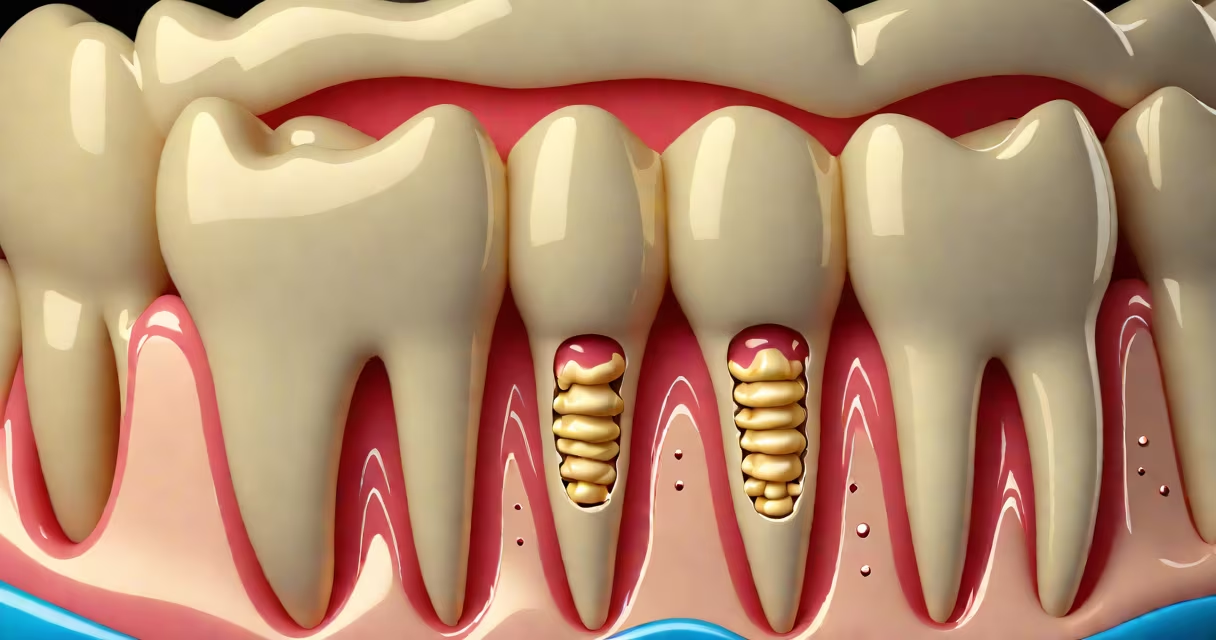
Tooth plaque is a biofilm composed primarily of bacteria, salivary glycoproteins, and trapped food particles. It adheres to tooth surfaces within hours of brushing and hardens into tartar if not removed.
Plaque forms when oral bacteria metabolize sugars and produce acids that erode enamel. The most common species involved are Streptococcus mutans and Porphyromonas gingivalis. These microbes colonize the tooth surface and secrete extracellular polymeric substances (EPS) that bind the community together.
According to the American Dental Association, plaque begins forming within 4 hours after oral hygiene and reaches detectable levels by 24 hours. Without mechanical removal, it calcifies into tartar-hard, mineralized deposits that require professional cleaning.
Plaque development occurs in stages. First, a thin layer of salivary proteins called the pellicle coats the tooth surface. This protein film acts as a scaffold for bacterial attachment. Within minutes, early colonizers such as Streptococcus sanguinis bind to it via adhesins.
As the biofilm matures, late colonizers like Fusobacterium nucleatum and Porphyromonas gingivalis join. These organisms interact through direct contact and nutrient exchange, creating a complex microbial system. The biofilm matrix includes polysaccharides, DNA, and lipids that protect bacteria from immune responses and antimicrobial agents.
A 2021 study published in Microbiome found that plaque communities shift toward pathogenic dominance in individuals with poor oral hygiene. Over time, this imbalance leads to inflammation, periodontal pockets, and eventual tooth loss.
The following table outlines the primary constituents of plaque and their roles:
| Component | Source | Function |
|---|---|---|
| Bacteria | Oral microbiome | Produce acid, trigger immune response, degrade tissue |
| Salivary glycoproteins | Saliva | Form pellicle; support initial bacterial adhesion |
| Food debris | Dietary intake | Provide nutrients for bacterial metabolism |
| Extracellular polymeric substances (EPS) | Bacterial secretion | Stabilize biofilm structure; resist mechanical disruption |
| Cellular debris and dead bacteria | Microbial turnover | Contribute to mass and structural integrity |
One non-obvious fact: plaque is not a static layer. It's a changing, living system. Bacteria in plaque constantly reproduce, die, and exchange genetic material. This allows rapid adaptation to changes in diet, pH, and antimicrobial exposure.
Another key point: plaque is not solely responsible for decay. While acid production from streptococci causes demineralization, it's the inflammatory response triggered by gram-negative bacteria like P. gingivalis that drives gum disease. The immune system's reaction to these microbes damages connective tissue and bone.
Many people believe plaque is "dirt" or "crumbs." It's not. Plaque is a living, structured community of microorganisms embedded in a protective matrix. Unlike food residue, which can be rinsed away, plaque resists water and requires physical disruption.
Some assume that mouthwash alone removes plaque. That's incorrect. Mouthwashes reduce bacterial load but do not dislodge mature biofilms. The CDC states that fluoride mouthwash can reduce cavity risk by 20%, but it doesn't replace brushing and flossing.
Another misconception: plaque only forms on front teeth. In reality, it accumulates most densely along the gumline and between teeth-areas often missed during brushing. A 2019 study in Journal of Clinical Periodontology showed that 78% of participants had plaque in interproximal spaces despite daily brushing.
Consider a 32-year-old patient who brushes twice daily but skips flossing. On Day 1, a thin pellicle forms on the lower molars. By Day 2, S. sanguinis and Actinomyces species colonize. By Day 3, acid-producing streptococci dominate, lowering local pH below 5.5-the threshold for enamel demineralization.
By Day 7, visible plaque appears as a grayish film. The patient notices bad breath and mild gum redness. By Day 14, calculus begins forming at the gumline. At this stage, the biofilm is resistant to home care and requires scaling by a dentist.
This progression illustrates why plaque control is critical. The ADA recommends brushing for 2 minutes twice daily and flossing once daily to disrupt plaque before it hardens.
Use a soft-bristled toothbrush and fluoride toothpaste. Brush at a 45-degree angle to the gums, using short strokes. Focus on the gumline and back teeth-sites where plaque builds fastest.
Floss daily. A 2020 Cochrane review confirmed that flossing reduces gingivitis by 56% compared to brushing alone. Use about 18 inches of floss, wrapping it around fingers and gently sliding it beneath the gumline.
Visit your dentist every six months. Professional cleanings remove calculus and detect early signs of decay or gum disease. Early intervention prevents irreversible damage.
I once observed a patient with untreated plaque develop a deep periodontal pocket measuring 6 mm-beyond the normal 1-3 mm. After four weeks of consistent brushing, flossing, and professional treatment, the pocket reduced to 3 mm. This case highlights that plaque is reversible with proper care.
Understanding what tooth plaque is made of clarifies why prevention requires more than just brushing. It demands consistent mechanical disruption of the biofilm and attention to hard-to-reach areas. Ignoring plaque leads to cavities, gum disease, and tooth loss.