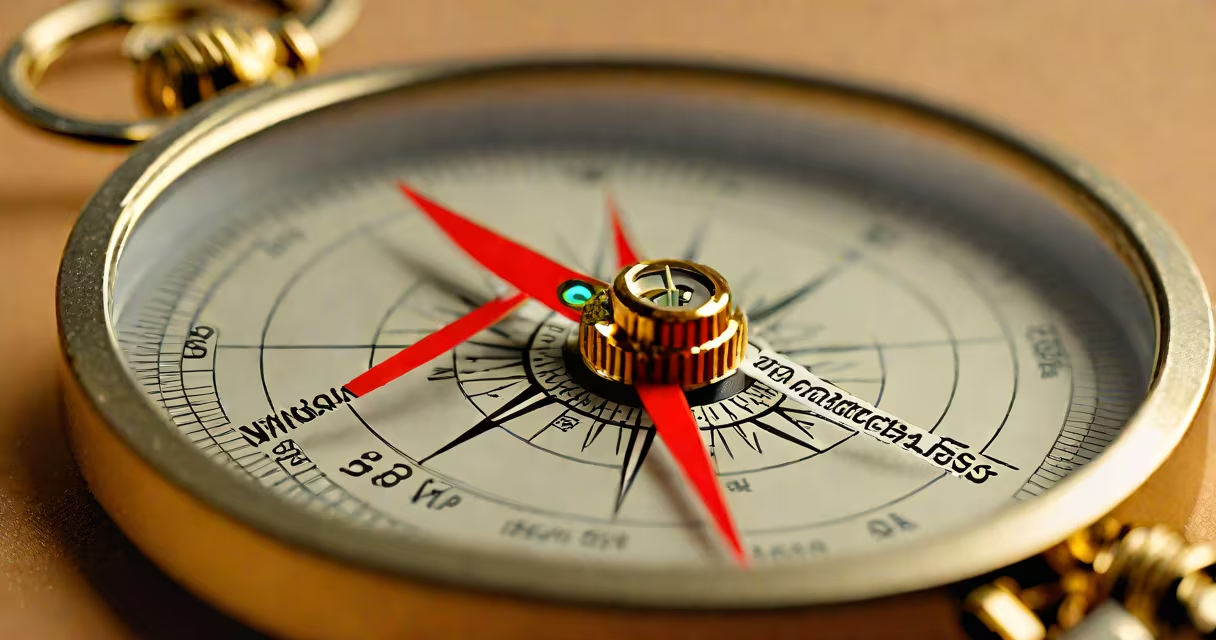
A compass is a navigational instrument that uses Earth's magnetic field to indicate direction. Its core components-the magnetic needle, rotating bezel, baseplate, and housing-work together to show north and support route planning.
The magnetic needle is the most essential part. It aligns itself with Earth's magnetic poles, pointing toward magnetic north. The needle is balanced on a low-friction pivot and typically has a red end marked for north. This alignment allows users to determine direction relative to the planet's magnetic field.
The rotating bezel surrounds the compass housing and features degree markings from 0° to 360°. Users rotate the bezel to set a bearing-such as "set your course to 270°"-and then follow that direction. The bezel often includes a direction-of-travel arrow that points forward when the compass is held level.
The baseplate is a transparent plastic rectangle that supports the compass housing. It contains rulers and scales for measuring distances on maps. Many models have a magnifying lens and a ruler calibrated in both inches and centimeters. The baseplate also provides stability when aligning the compass with map lines.
The housing encloses the needle and bezel. It's usually made of durable plastic and filled with liquid-typically a mixture of alcohol and water-to dampen needle oscillation. Without this fluid, the needle would swing wildly during movement. The housing also protects the internal mechanism from damage and moisture.
Some compasses include additional features. A mirror allows for precise sighting by reflecting the compass face while aligning the direction-of-travel arrow with a distant landmark. A declination adjustment knob accounts for the difference between magnetic north and true north, which varies by location. For example, in Seattle, magnetic north is about 15 degrees west of true north. Without adjusting for this, navigation errors can accumulate over distance.
| Component | Purpose | Example Use Case |
|---|---|---|
| Magnetic needle | Points to magnetic north | Verifying orientation in the woods |
| Rotating bezel | Set and read bearings | Setting a course to a trail junction |
| Baseplate | Map alignment and distance measurement | Measuring 2.5 km between two waypoints |
| Housing with liquid | Stabilizes needle movement | Using the compass while hiking on uneven terrain |
Many people confuse the compass with a GPS device. A compass requires no batteries and functions anywhere on Earth. GPS relies on satellites and can fail in dense forests or mountain valleys. The compass remains functional even when electronic systems fail.
Another common error is assuming that magnetic north and true north are the same. They differ by a variable amount called magnetic declination. In New York City, declination is approximately 13 degrees west. Ignoring this leads to directional drift-over 10 kilometers of error after traveling 100 km off course. Topographic maps often include declination values for specific regions.
I once used a basic compass during a solo hike in the Cascade Mountains. After losing the trail, I set a bearing of 180° using the bezel and followed the direction-of-travel arrow. The liquid-filled housing kept the needle steady despite wind and uneven ground. Within 45 minutes, I reached a known trail marker. That experience confirmed that understanding the parts of a compass isn't theoretical-it's survival-critical.
For outdoor enthusiasts, knowing the parts of a compass ensures reliability. The magnetic needle detects Earth's field, the bezel sets direction, the baseplate aids map work, and the housing stabilizes readings. These components form a system that has guided explorers since the 12th century.
When choosing a compass, verify that the needle moves freely and the bezel clicks smoothly into place. Test it indoors away from metal objects. A properly functioning compass gives reliable results in any environment.
Knowing the parts of a compass isn't just about identifying pieces-it's about trusting a tool that has helped humans find their way across continents and centuries.