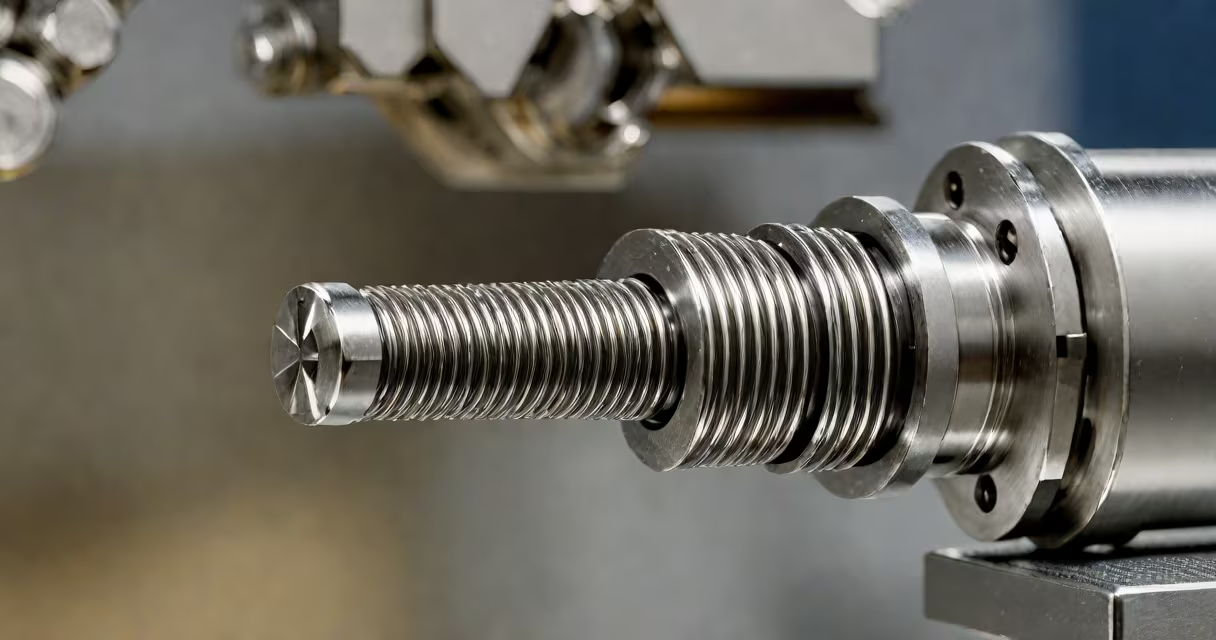
A high precision ball screw is a mechanical device that converts rotational motion into highly accurate linear motion using recirculating balls between a threaded shaft and nut. It achieves positional repeatability within ±0.01 mm over 300 mm of travel, making it essential in industrial automation and precision manufacturing.
These components operate by rolling balls along helical grooves cut into the screw shaft and nut. As the shaft rotates, the balls roll through the grooves, moving the nut linearly. This rolling contact reduces friction compared to sliding mechanisms, enabling efficient power transmission with minimal wear. The system maintains tight tolerances through precision grinding of the threads and tight control of backlash-typically less than 0.005 mm in high-end models.
High precision ball screws are rated by their accuracy class, defined by standards such as ISO 3408 and JIS B 1192. Classes range from C0 (highest precision) to C5 (standard). A C0-rated screw can achieve a positioning error of ±0.005 mm per 300 mm, suitable for semiconductor wafer handling and medical imaging systems. Load capacity depends on the screw diameter and lead-common sizes range from 8 mm to 40 mm in diameter, with leads from 2 mm to 20 mm.
The core function relies on the interaction between the screw shaft and the nut. The shaft has a helical groove machined along its length, while the nut contains a matching internal groove. Balls sit in the gap between them, rolling along the path as the shaft turns. When the shaft rotates, the balls move axially, pushing the nut forward or backward.
Ball return channels allow the balls to exit the thread path at one end and re-enter at the other, forming a closed loop. These channels can be internal (using a groove in the nut) or external (using a separate return tube). Internal returns offer smoother operation and better protection from contaminants, which is critical in cleanroom environments.
Backlash-the play between the nut and shaft-is minimized through preloading. This involves applying a controlled axial force to eliminate clearance. Common methods include dual-nut systems with shims or adjustable spacers, or using split nuts with a spring or hydraulic mechanism. Preload prevents lost motion during direction changes, important for CNC machining and robotic arms.
High precision ball screws fall into distinct categories based on application demands. The primary classification is by accuracy grade, material, and preload method.
| Accuracy Class | Max Positional Error (per 300 mm) | Typical Applications |
|---|---|---|
| C0 | ±0.005 mm | Photolithography tools, metrology stages |
| C1 | ±0.010 mm | CNC machine tools, laser cutting |
| C2 | ±0.020 mm | Industrial robots, automated assembly |
| C3 | ±0.050 mm | General machinery, conveyor systems |
Material selection affects performance under load and temperature. Most high precision screws use hardened alloy steel (such as 100Cr6 or AISI 52100), heat-treated to Rockwell hardness HRC 58-62. For corrosion resistance, stainless steel (AISI 440C) is used in food processing or marine environments. Ceramic balls (silicon nitride) reduce thermal expansion and increase lifespan in high-speed applications.
Load capacity varies. A 20 mm diameter, 5 mm lead screw can handle up to 12 kN axial load with continuous operation. Torque requirements scale with lead-longer leads produce higher torque but lower mechanical advantage. Efficiency typically exceeds 90%, meaning over 90% of input energy becomes useful linear motion.
Many assume high precision ball screws are interchangeable with standard ball screws. That's incorrect. Standard ball screws may have tolerance bands of ±0.1 mm per 300 mm-ten times less precise. Using a standard screw in a high-accuracy task causes cumulative errors, leading to scrapped parts or calibration drift.
Another misconception is that higher speed always requires higher precision. Not true. High-speed applications often prioritize changing stiffness and thermal stability over static accuracy. A C2-class screw with optimized preload and lubrication can outperform a C0 screw in rapid traverse scenarios due to reduced resonance and better heat dissipation.
For example, in a semiconductor fabrication line, a C0 ball screw drives the stage that positions wafers under electron beam lithography. The system moves 100 mm in 0.2 seconds with sub-micron positioning. Any deviation beyond ±0.5 µm results in defective chips. The screw operates at 1,200 RPM, with balls made of silicon nitride to minimize thermal growth. This setup is validated annually using laser interferometry per ISO 230-2 standards.
I once observed a CNC milling machine fail after six months of operation. The issue wasn't the controller-it was a misaligned ball screw. The nut had shifted slightly due to improper mounting, introducing backlash. After recalibrating the mount and replacing the screw with a C1-grade unit, the machine achieved repeatable tolerances within ±0.008 mm. This confirmed that even small deviations in alignment degrade performance below acceptable thresholds.
Compared to lead screws, high precision ball screws offer faster speeds and higher efficiency. A typical lead screw has 30-50% efficiency due to sliding friction. At 1,000 RPM, a lead screw generates significant heat, causing thermal expansion and positioning drift. Ball screws maintain efficiency above 90% even at high speeds, reducing energy loss and heat buildup.
Hydraulic actuators provide high force but lack the resolution and repeatability of ball screws. They're used in forging presses and large-scale robotics, where precision is secondary to force output. In contrast, ball screws deliver consistent motion over millions of cycles-critical in automated inspection systems that perform 10,000 inspections per hour.
Linear motors offer nanometer-level positioning but require complex feedback systems and high power. They're ideal for ultra-high-speed applications like chip sorting. Ball screws remain the preferred choice for most precision linear motion tasks due to their balance of cost, reliability, and performance.
High precision ball screws are not just components-they are the foundation of automated accuracy. Their ability to convert rotation into linear motion with predictable, repeatable results makes them indispensable in modern manufacturing. Understanding their specifications ensures correct integration and long-term reliability.