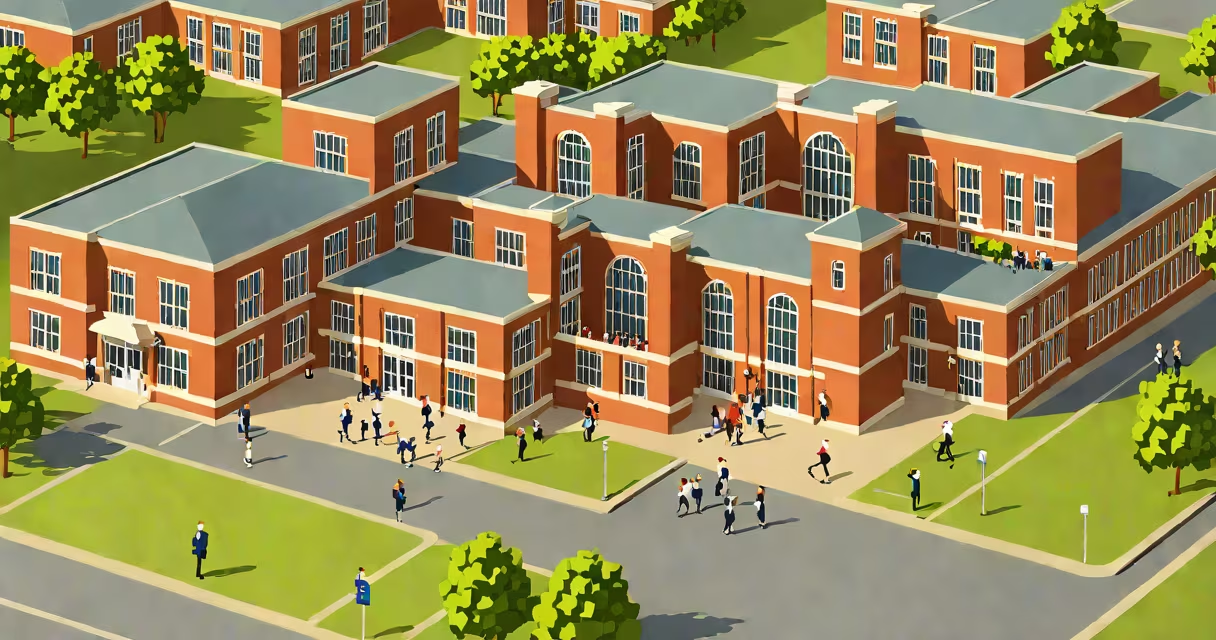
Torquay Boys Grammar School is a selective state-funded boys' secondary school in Torquay, Devon, serving students aged 11 to 18. Admission requires passing the 11+ entrance examination, which assesses verbal reasoning, non-verbal reasoning, mathematics, and English. The school operates under the oversight of the Department for Education and maintains a long-standing tradition of academic excellence.
The school was established in 1906 as part of a national movement to create academically focused institutions for high-achieving pupils. It moved to its current site on Mountbatten Road in 1964, following a reorganization of local education provision. Today, it serves approximately 1,200 students annually, with around 120 new Year 7 entrants each year. Selection is based solely on performance in the 11+ exam administered by the Devon County Council's admissions team.
Academic results consistently rank among the highest in the South West region. In 2023, 78% of A-Level entries achieved grades A*-B, and 94% of GCSE entries were at grade 5 or above. These outcomes reflect a curriculum emphasizing rigorous subject mastery, extended project work, and structured support for high-achieving learners. The school offers many subjects including triple science, Latin, and Further Mathematics, with specialist teaching in small class sizes.
Admission to Torquay Boys Grammar School is competitive and based exclusively on the 11+ exam. This test is administered annually in September and includes four components: verbal reasoning (30 minutes), non-verbal reasoning (30 minutes), mathematics (45 minutes), and English (45 minutes). Total score determines placement on the waiting list, with offers issued in January.
Students must reside within the catchment area defined by Devon County Council, which includes parts of Torquay, Paignton, and Brixham. The school does not admit siblings automatically; preference is given to those who meet the academic threshold. Priority is also given to children in care or those with special educational needs who meet the entry criteria.
Once admitted, students follow a three-tiered structure: Years 7-9 (Key Stage 3), Years 10-11 (GCSEs), and Years 12-13 (A-Levels). All pupils take core subjects in English, maths, and science throughout Key Stage 3. From Year 9, they begin selecting optional subjects such as history, geography, and modern foreign languages. By Year 10, students commit to six GCSEs, including mandatory English Language, English Literature, mathematics, and double science.
Grammar schools in England fall into three categories: selective, partially selective, and complete. Torquay Boys Grammar School is fully selective, meaning it admits only students who pass the 11+ exam. It does not offer outreach programs or inclusive enrollment pathways common in some complete schools.
| Type | Admission Basis | Examples in South West | Student Demographics |
|---|---|---|---|
| Full selective | 11+ exam only | Torquay Boys Grammar School, Plymouth High School for Boys | High academic achievement; predominantly middle-class families |
| Partially selective | 11+ plus catchment or sibling priority | Exeter High School, St. Boniface College | Diverse socioeconomic mix; higher proportion of state-educated applicants |
| Complete | Residency-based, no academic screening | Paignton High School, Torquay Academy | Wide range of attainment levels; higher inclusion of SEND students |
A key distinction is that Torquay Boys Grammar School does not offer sixth form places to external applicants. All A-Level students must have completed their GCSEs at the school. This ensures continuity in academic preparation and mentorship. The school also does not operate a sixth form college model, unlike some larger grammar schools in London or Manchester.
Many assume grammar schools are private institutions. Torquay Boys Grammar School is state-funded and free to attend. It receives public funding from the Department for Education and is accountable to Ofsted. Its budget per pupil in 2022-2023 was £7,200, slightly below the national average of £7,800 due to regional cost differences.
Another misconception is that grammar schools exclude students with special educational needs. While the school does not provide dedicated SEN support teams, it does offer individualized learning plans for students with identified needs. According to the 2023 Ofsted report, 14% of pupils at Torquay Boys Grammar School have an Education, Health and Care Plan (EHCP), compared to 12% nationally. The school provides access to specialist teachers and extended time during exams.
One non-obvious fact: the school's uniform policy mandates black trousers, navy blazer, white shirt, and red tie. Students may wear a grey cardigan in winter. The tie features a crest with the school motto "Fides et Labor" (Faith and Work). This symbolizes the school's historical roots in the Church of England, though it is now non-denominational in practice.
In 2023, 420 applications were submitted for 120 Year 7 places. The cutoff score was 132 out of 160 on the 11+ exam. A student named James, from Paignton, scored 135. His verbal reasoning score was 92%, non-verbal 88%, maths 90%, and English 85%. He was offered a place and began Year 7 in September.
James's family prepared him using past papers from the Kent Test and online resources like ElevenPlus.co.uk. They also enrolled him in a weekly tutoring session focused on logic puzzles and comprehension. His mother noted that consistent practice reduced anxiety and improved focus during the timed sections.
After admission, James joined the school's debating society and participated in the annual Maths Olympiad. In his first term, he achieved top marks in algebra and geometry. By the end of Year 8, he had secured a place in the advanced mathematics stream, which prepares students for A-Level Further Mathematics.
I visited Torquay Boys Grammar School in November 2022 during a parent open evening. The hall was filled with students presenting science projects, including a working model of a wind turbine powered by solar cells. Teachers emphasized the importance of independent research and critical thinking. One biology teacher explained that students in Year 10 design experiments to test plant growth under different light spectrums-a hands-on approach absent in many traditional curricula.
I observed a Year 9 history lesson on the Cold War. Students debated whether nuclear deterrence prevented war or increased risk. The teacher facilitated discussion without directing conclusions. This method aligns with the school's philosophy of fostering intellectual independence.
Torquay Boys Grammar School serves as a model for selective education in rural and semi-urban areas. Its success demonstrates that high academic standards can be maintained outside major cities. The school's location in a coastal town with limited transport options makes it accessible only to residents within a 15-mile radius, reinforcing community ties.
It is frequently cited in government reports on educational equity. The 2021 White Paper on Education stated that grammar schools like Torquay Boys Grammar contribute to narrowing the attainment gap between affluent and disadvantaged pupils. However, critics argue that selection by exam perpetuates social stratification. The Sutton Trust reported in 2022 that 68% of grammar school entrants come from households earning over £60,000 annually.
Despite debate, the school remains a key institution in Devon's education field. It partners with local universities, including the University of Exeter, to offer summer research internships for Year 12 students. These programs expose pupils to university-level expectations and strengthen applications for competitive courses.
Torquay Boys Grammar School exemplifies how selective state education functions in practice. It combines academic rigor with structured support, preparing students for elite universities and professional careers. Its model continues to influence policy discussions on school choice and educational access in England.