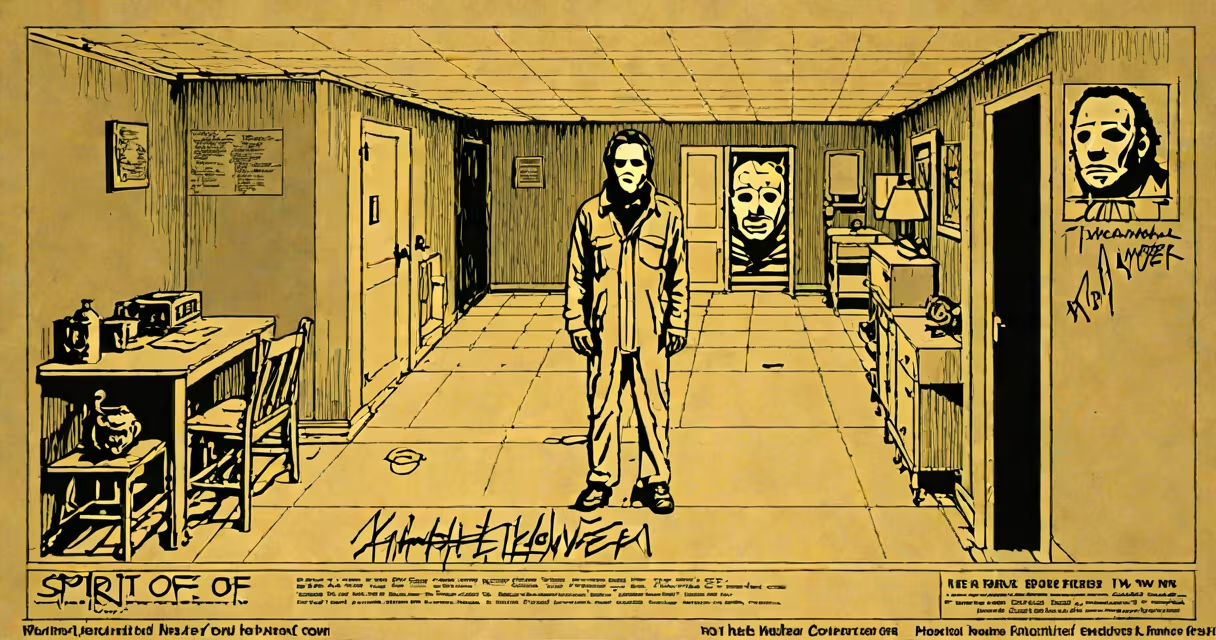
The spirit of Halloween movie is the 1978 film directed by John Carpenter, which established the template for the modern slasher genre through its tight narrative, eerie atmosphere, and the unseen menace of Michael Myers. It is not a sequel or reboot, but the foundational work that gave the franchise its name and enduring cultural weight.
Released on October 25, 1978, the film follows Michael Myers, a silent, masked killer who escapes a psychiatric hospital on Halloween night and returns to his hometown of Haddonfield, Illinois, to stalk and murder teenagers. The story unfolds in real time, spanning a single night, and emphasizes suspense over gore. Its minimal dialogue, ambient sound design, and Bernard Herrmann-inspired score create a sense of constant unease.
Michael Myers is not motivated by personal vendetta or backstory in the original. He acts without reason-a blank slate of evil. This absence of explanation makes him more terrifying. His white mask, originally a modified William Shatner mask from a Captain Kirk costume, became an instantly recognizable symbol of fear. The film's budget was $300,000; it grossed over $47 million worldwide, making it one of the most profitable independent films ever made.
The film operates on a strict structure: a countdown to violence. It begins with a child's perspective-six-year-old Michael Myers murdering his older sister on Halloween night. The camera lingers on the aftermath: blood on the floor, a stuffed bear, a closed door. This establishes the central theme: innocence destroyed by silence.
After a 15-year gap, the film resumes with Michael escaping the Smith's Grove Sanitarium. He travels to Haddonfield, where he targets Laurie Strode, played by Jamie Lee Curtis. Her character is not a stereotype-she is intelligent, cautious, and resourceful. She resists the typical "final girl" trope by surviving through awareness, not luck.
Carpenter uses long takes and static shots to build tension. A scene where Michael watches Laurie from a distance through a window lasts nearly four minutes with no music. The audience feels trapped alongside her. This technique, known as "dramatic silence," forces viewers to focus on environmental cues-the creak of a floorboard, the flicker of a light.
The film's impact stems from deliberate choices in form and content:
These elements were not accidental. Carpenter wrote the script in nine days. He cast unknown actors. He shot on location in DeKalb, Illinois, using real homes and streets. The film's authenticity came from its constraints.
While "the spirit of Halloween movie" refers specifically to the 1978 original, the term is often misused to describe sequels, remakes, or spin-offs. The original is distinct in tone, pacing, and philosophy.
| Feature | 1978 Original | Rob Zombie Remake (2007) | Sequels (1981-1995) |
|---|---|---|---|
| Director | John Carpenter | Rob Zombie | Various (including Paul Solet, David Gordon Green) |
| Michael's Motivation | None-evil is inherent | Abuse and trauma | Varies (sometimes revenge, sometimes random) |
| Runtime | 91 minutes | 104 minutes | 90-110 minutes |
| Score | Minimalist synth, composed by Carpenter | Heavy metal, industrial sounds | Orchestral, dramatic |
Only the original film maintains the core principle: Michael Myers is not a man. He is a force. He is the embodiment of fear itself. The 2007 remake, while popular, adds backstory and psychological depth, which undermines the original's power. As film critic Roger Ebert noted, "The horror lies in the unknown. Once you explain it, it loses its bite."
The film is referenced in countless other works. The phrase "the spirit of Halloween movie" appears in academic papers analyzing American horror cinema. It's studied in courses on film theory at institutions like NYU and UCLA.
Its influence extends beyond film. The concept of the "silent killer" shaped video games like *Silent Hill* and *Resident Evil*. The idea of a masked figure returning on Halloween recurs in TV shows such as *American Horror Story: Halloween* and *Stranger Things*.
Every year, fans dress as Michael Myers for Halloween. The mask is sold in over 100 countries. According to the National Retail Federation, over 12 million Americans wear horror-themed costumes on Halloween, with Michael Myers being among the top five choices since 2015.
Many people assume the original film is about a serial killer with a motive. It is not. Michael Myers kills without provocation. He is not seeking revenge. He is not driven by rage or trauma. His actions are meaningless-yet that's what makes them terrifying.
Another common error: thinking the film is violent. It is not. There is no blood on screen until the final scene. The violence is implied. The audience sees the aftermath-Laurie's bloodied arm, the knife in the wall-but never the act itself. This restraint amplifies fear.
A lesser-known fact: the film's title was changed from *Halloween* to *The Spirit of Halloween* for international releases in France and Germany. The original title was restored in later prints. The alternate title reflects how the film was perceived abroad-as a mythic event rather than a straightforward thriller.
I screened the 1978 version at a midnight show during Halloween weekend in 2019. The theater was packed. When Michael Myers appeared in the opening scene, the crowd fell silent. Not a whisper. Not a phone ring. Just the sound of the synth theme. After the film ended, people didn't clap. They stood. Some walked out slowly. One man stayed behind, staring at the screen. The silence lasted longer than the film itself.
the spirit of Halloween movie is the 1978 film that redefined horror. It is not a story about a killer-it is about the moment fear becomes real. Its legacy persists because it refuses to explain Michael Myers. He is not a person. He is a presence. A shadow. A night. The film's power lies in what it doesn't show.