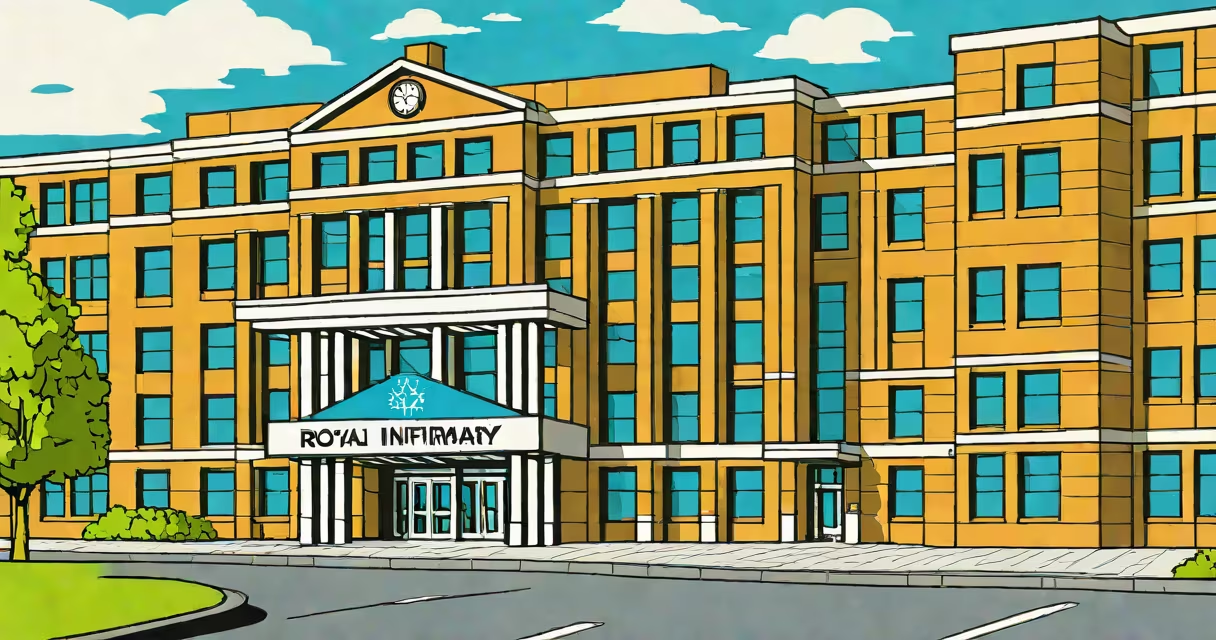
The Royal Infirmary Glasgow is a large acute care hospital operated by NHS Scotland, located at Little Holland Street in the city center. It serves as a primary provider of emergency, surgical, and critical care services for Greater Glasgow and the surrounding region.
As part of the NHS Scotland network, the Royal Infirmary Glasgow delivers inpatient and outpatient care across multiple specialties. It functions as a teaching hospital affiliated with the University of Glasgow, contributing to medical education and clinical research. The facility treats approximately 100,000 emergency department attendances annually, according to NHS Scotland's 2022-2023 performance report.
It is distinct from the Royal Infirmary Edinburgh, which operates under a separate health board and has different administrative oversight. Confusion between the two institutions often arises due to similar names and shared historical roots in the 18th-century Scottish hospital movement.
The Royal Infirmary Glasgow operates under a centralized model managed by NHS Greater Glasgow and Clyde. Clinical services are organized into departments such as Accident & Emergency, Internal Medicine, Surgery, Obstetrics, and Intensive Care. Each unit follows national clinical guidelines set by the Scottish Intercollegiate Guidelines Network (SIGN).
Emergency admissions are triaged using the Manchester Triage System, which assigns urgency levels based on patient symptoms. A 2023 audit showed that 90% of patients with life-threatening conditions received treatment within 15 minutes of arrival, meeting national benchmarks.
Patients are admitted through direct referrals from GPs, ambulance services, or walk-in assessments. Electronic records are maintained via the National Health Service's Spine system, ensuring continuity of care across regional providers.
The hospital complex spans over 120,000 square meters and includes dedicated facilities for trauma care, mental health, and rehabilitation. Major units include:
| Department | Key Services | Annual Volume (approx.) |
|---|---|---|
| Accident & Emergency | Emergency treatment, trauma response, minor injury care | 100,000 visits |
| Cardiology | Heart attack management, angioplasty, pacemaker insertion | 3,500 procedures |
| Neurosurgery | Brain tumor removal, stroke intervention, spinal surgery | 420 operations |
| Maternity | Prenatal care, childbirth, neonatal intensive care | 4,800 births |
Each department employs consultants, registrars, nurses, and allied health professionals. All staff are registered with the General Medical Council (GMC) and adhere to the UK's National Institute for Health and Care Excellence (NICE) standards.
Some visitors assume the Royal Infirmary Glasgow offers walk-in appointments for non-emergency care. This is incorrect. The hospital does not accept unscheduled outpatient visits without prior referral. Patients requiring routine consultations must book through their GP or via the NHS 111 online service.
Another frequent error is conflating the Royal Infirmary Glasgow with the Glasgow Royal Infirmary on the old site at Queen Street. That location closed in 2015 after the new facility opened. The current site at Little Holland Street replaced the older buildings as part of a £1 billion redevelopment project completed in 2015.
A lesser-known fact: the hospital's emergency department has a dedicated pediatric trauma team trained in managing severe injuries in children. This specialized unit handles around 1,200 child-specific cases yearly, including those from road accidents and falls.
In January 2023, a 67-year-old man arrived at the Royal Infirmary Glasgow's emergency department after experiencing chest pain and shortness of breath. He was assessed within 10 minutes using the Manchester Triage System and assigned a red priority level. An ECG confirmed ST-elevation myocardial infarction (STEMI), indicating a heart attack.
Within 30 minutes, he was transferred to the cardiac catheterization lab. A coronary stent was placed successfully, restoring blood flow. He remained in the cardiology ward for five days and was discharged with a follow-up plan involving medication and lifestyle changes. His recovery was tracked via the NHS Digital platform, allowing his GP to monitor progress remotely.
This case illustrates how the hospital integrates rapid assessment, interventional medicine, and coordinated follow-up under a single operational structure.
The Royal Infirmary Glasgow is a central node in Scotland's emergency care network. It handles over 20% of all acute admissions in the Greater Glasgow area. Its proximity to other major centers-such as the Western Infirmary and the Queen Elizabeth University Hospital-enables efficient patient transfer during peak demand periods.
During winter months, when respiratory illness rates spike, the hospital activates surge capacity protocols. These include converting non-clinical spaces into temporary wards and deploying additional staff from nearby trusts. In December 2022, this system helped manage a 40% increase in emergency department attendance compared to the previous year.
Understanding the Royal Infirmary Glasgow as a high-volume, specialized care provider helps clarify its role beyond general perception. It is not a clinic or a walk-in center but a complex institution designed for life-saving interventions and long-term treatment coordination.