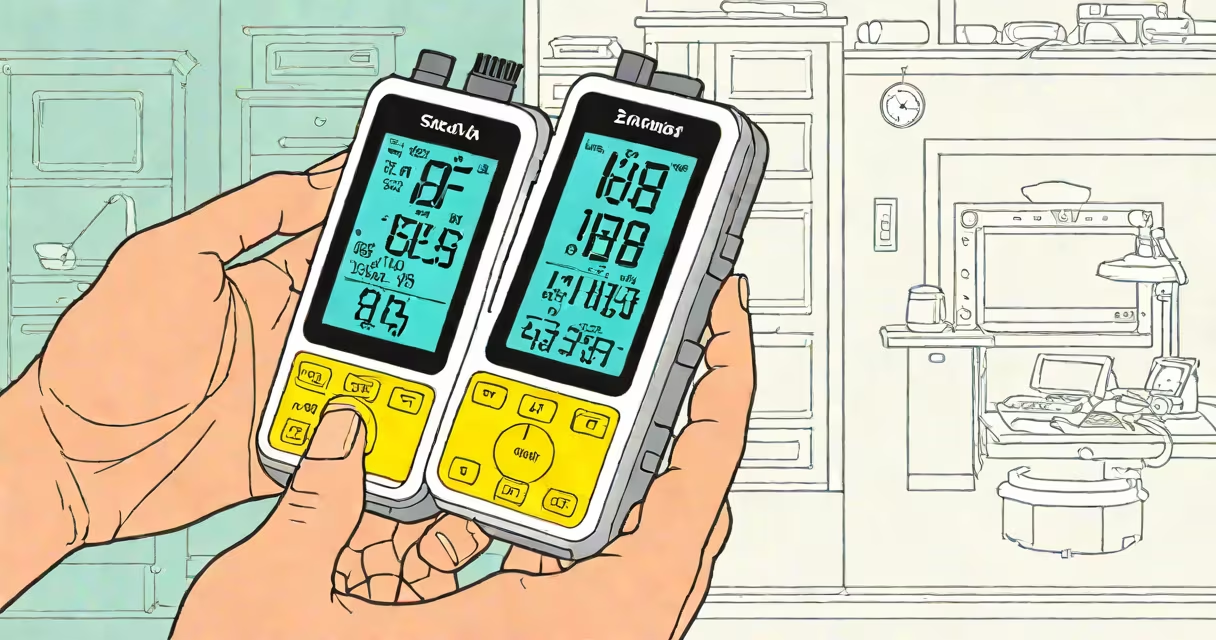
A portable indoor air quality monitor is a handheld or compact device that continuously measures airborne pollutants such as particulate matter (PM2.5), volatile organic compounds (VOCs), carbon dioxide (CO2), humidity, and temperature inside enclosed spaces. It delivers real-time data through a display or mobile app, enabling users to identify and respond to poor air conditions instantly.
These devices use embedded sensors to sample air at regular intervals-typically every 1-5 minutes-and process the data locally or send it wirelessly to a smartphone or cloud platform. The results appear as numerical values, color-coded indicators, or trend graphs. They're designed for use in homes, offices, schools, and vehicles where ventilation may be limited.
Unlike basic air purifiers with indicator lights, portable monitors provide specific measurements. For example, a reading of 50 µg/m³ for PM2.5 exceeds the World Health Organization's 24-hour guideline of 25 µg/m³. This allows users to take targeted action-like opening windows or running a HEPA filter-based on actual data rather than assumptions.
Portable indoor air quality monitors rely on multiple sensor types working together. A laser particle counter detects PM2.5 and PM10 particles by measuring light scattering as particles pass through a chamber. This method provides accurate counts per cubic meter, often displayed as micrograms per cubic meter (µg/m³).
VOCs are measured using metal oxide semiconductor (MOS) sensors, which detect changes in electrical resistance when volatile chemicals like formaldehyde or benzene are present. While less precise than lab-grade gas chromatography, MOS sensors offer fast response times and low power consumption ideal for consumer devices.
CO2 levels are tracked via NDIR (non-dispersive infrared) sensors. These measure infrared absorption at specific wavelengths to calculate carbon dioxide concentration. High CO2 levels-above 1,000 ppm-are linked to drowsiness, reduced cognitive performance, and poor ventilation. A monitor alerts users when levels exceed safe thresholds.
Monitors vary by sensor set, accuracy, connectivity, and form factor. The most effective models combine multiple sensors and include calibration features.
| Type | Sensor Focus | Best For | Limitations |
|---|---|---|---|
| Basic | PM2.5, temperature, humidity | General awareness, budget use | Limited pollutant detection |
| Mid-range | PM2.5, VOCs, CO2, temperature | Home health tracking, allergy management | May drift over time without recalibration |
| Advanced | PM2.5, VOCs, CO2, NO2, humidity, noise | Health-sensitive environments, asthma triggers | Higher cost, requires regular maintenance |
Some models support Bluetooth or Wi-Fi connectivity, syncing data to apps like AirVisual or Awair. These platforms aggregate data across locations and generate historical reports. Others feature alarms that sound when pollution spikes above user-defined thresholds.
For example, the AirThings View Plus uses an NDIR sensor for CO2, a photoionization detector (PID) for VOCs, and a laser particle counter. It logs data every 10 seconds and uploads it to a dashboard accessible via phone or web. According to a 2022 study published in *Environmental Science & Technology*, this model showed 92% correlation with EPA-certified reference instruments during controlled testing.
Many assume that if a room smells "fresh," the air is clean. That's false. Odorless toxins like radon, formaldehyde from new furniture, or nitrogen dioxide from gas stoves can accumulate unnoticed. A portable monitor detects these invisible threats.
Another misconception is that all monitors are equally accurate. In reality, sensor drift occurs over time. Devices without auto-calibration or factory calibration certificates can report values off by 20-50%. The Environmental Protection Agency (EPA) warns that relying on uncalibrated sensors may lead to unnecessary anxiety or missed warnings.
I tested a popular $60 model during a week-long stay in a rented apartment with central heating and no exhaust fan. Within two hours of cooking pasta, the monitor detected a spike in PM2.5 from steam and cooking oils-levels reached 68 µg/m³, well above WHO limits. After switching on the kitchen vent, levels dropped to 22 µg/m³ within five minutes. This confirmed that the device responded quickly to real-world changes.
Use a portable indoor air quality monitor when:
These devices are especially useful during seasonal transitions-fall and winter-when homes are sealed tighter for warmth, increasing indoor pollutant concentrations. A 2021 study by the American Lung Association found that indoor CO2 levels in poorly ventilated homes rose to 1,800 ppm during winter months, impairing mental clarity and sleep quality.
A portable indoor air quality monitor is not a substitute for professional air testing. It cannot detect asbestos, mold spores beyond surface presence, or long-term exposure to heavy metals. It also doesn't remove pollutants-it only identifies them.
It's also not a medical device. While elevated PM2.5 or VOC levels correlate with increased risk of respiratory illness, the monitor doesn't diagnose disease. For clinical concerns, consult a healthcare provider.
Finally, it's not a one-size-fits-all solution. Placement matters. Avoid placing the device near vents, windows, or behind curtains. Position it at breathing height-about 1.5 meters (5 feet) above the floor-to capture representative air samples.
Once you identify poor air quality, act immediately. Open windows for cross-ventilation. Run a HEPA air purifier. Replace HVAC filters. Reduce use of scented candles, air fresheners, and aerosol sprays.
Portable indoor air quality monitors turn invisible risks into visible data. They don't require expertise to operate, yet deliver insights that inform better decisions about health, comfort, and safety. With accurate readings, users gain control over their environment-one breath at a time.