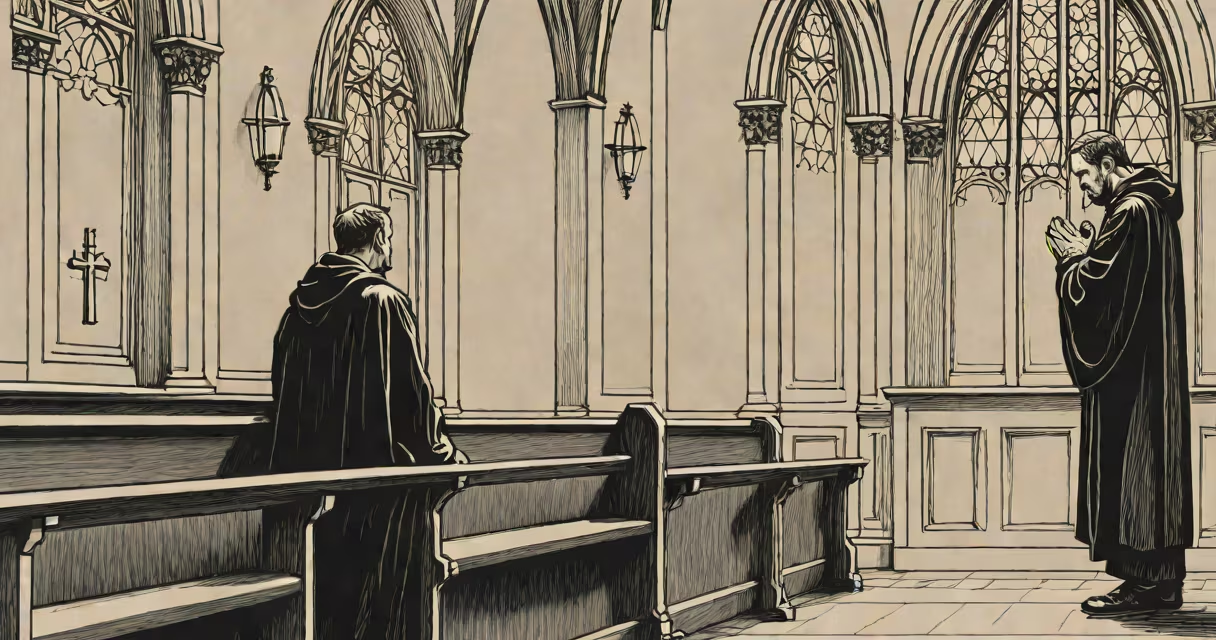
The Sacrament of Reconciliation requires you to name your sins, express sorrow, and receive absolution. You begin by saying "Bless me, Father, for I have sinned," then state your sins and honestly, followed by a penance prayer and the priest's absolution.
Confession is a ritualized act of repentance within the Catholic Church. It follows a structure established by canon law and guided by centuries of tradition. The process begins with the penitent entering the confessional, making the sign of the cross, and addressing the priest. The core of the conversation involves naming specific sins committed since your last confession, expressing contrition, and accepting the penance assigned.
According to the Code of Canon Law, the confessor must hear the penitent's sins and grant absolution. The penitent is expected to confess all mortal sins they remember, even if they are not certain about their gravity. The Church teaches that a good confession includes four elements: examination of conscience, contrition, confession of sins, and satisfaction through penance.
When you enter the confessional, you begin with a formal address: "Bless me, Father, for I have sinned." This phrase signals the start of the sacrament. The priest may respond with a brief reminder of God's mercy or ask if you're ready to begin.
You then list your sins. Be specific. Instead of saying "I've done bad things," say "I lied to my boss about being sick" or "I stole $15 from my sister's drawer." The Church emphasizes honesty-not perfection. If you forget a sin, you can bring it up later during another confession.
After listing your sins, the priest assigns a penance-usually a prayer, fasting, or charitable act. You recite the penance aloud. The priest then says the words of absolution: "I absolve you from your sins in the name of the Father, and of the Son, and of the Holy Spirit." You respond with "Amen," and the sacrament ends.
There is no single required script, but most Catholics follow a consistent pattern. Here's a typical sequence:
For example, if you missed Mass on Sunday due to oversleeping and argued with your sibling over a video game, you'd say: "I have sinned by missing Mass last Sunday because I stayed up too late playing games. I also yelled at my younger brother during a disagreement over the console."
Church documents emphasize that the penitent should not expect forgiveness based on performance. The focus is on interior conversion, not a checklist. As the Catechism of the Catholic Church states: "The sinner must repent with all his heart and with all his soul."
Not all sins are equal. The Church distinguishes between mortal and venial sins. Mortal sins-serious offenses against God or neighbor-require confession to restore grace. Venial sins weaken virtue but don't sever communion with God.
Here are common categories and examples:
| Sin Category | Examples | How to State It |
|---|---|---|
| Against God | Blasphemy, idolatry, despair | "I cursed God during a hard time last week." |
| Against Self | Lying, stealing, lustful thoughts | "I lied to my friend about my grades." |
| Against Neighbor | Stealing, gossip, violence | "I spread rumors about my coworker." |
| Against Justice | Fraud, tax evasion, bribery | "I underreported income on my tax form." |
Some people struggle with naming sins involving sexual desire or anger. The Church encourages clarity without shame. For instance, "I had lustful thoughts about someone I work with" is valid. The priest is bound by seal of confession and cannot disclose anything.
A non-obvious fact: the Church does not require you to confess every sin in detail. If you're unsure whether something counts as a sin, simply say "I'm not sure if this was a sin, but I feel guilty about it." The priest can guide you.
Many assume they must memorize a list of sins or recite a formal prayer. That's not required. The Church does not mandate a specific wording. What matters is sincerity and completeness.
Another misconception: you must confess every sin, even minor ones. While the Church urges honesty, it recognizes human weakness. If you forget a sin, you're still forgiven. The key is intention-not perfection.
Some think the priest judges them. The priest acts in persona Christi-the role of Christ. He is not a moral arbiter but a minister of mercy. The seal of confession is absolute. No priest can ever reveal what was said in confession, even under threat of death.
I once attended a retreat where a young man confessed he had been angry at his father for years. He didn't know how to start. The priest said, "Just say what you feel. God already knows." The man broke down and cried. After absolution, he said, "I felt lighter than I have in years."
Confession is available at most Catholic churches. Most parishes offer scheduled times-typically weekdays or weekends. Some offer private confessionals; others use a shared space with a screen. The location doesn't affect validity.
First-time confessors often worry about saying the wrong thing. There is no penalty for stumbling. The Church welcomes all who seek forgiveness. Even if you repeat the same sins, God's mercy remains constant.
After confession, you may pray the Act of Contrition: "O my God, I am heartily sorry for having offended You..." This prayer is not mandatory but widely used. You can find it in any Catholic prayer book or online.
If you live far from a parish or face language barriers, the Church allows confession via video or phone in strong cases. However, this is rare and only permitted with prior approval from a bishop.
Confession is not a test. It's a healing encounter. You don't need to be perfect. You just need to be willing to change.
Understanding what to say at confession begins with knowing the purpose: reconciliation with God and the Church. The words are tools, not requirements. Focus on honesty, humility, and trust. The sacrament exists not to shame but to restore.