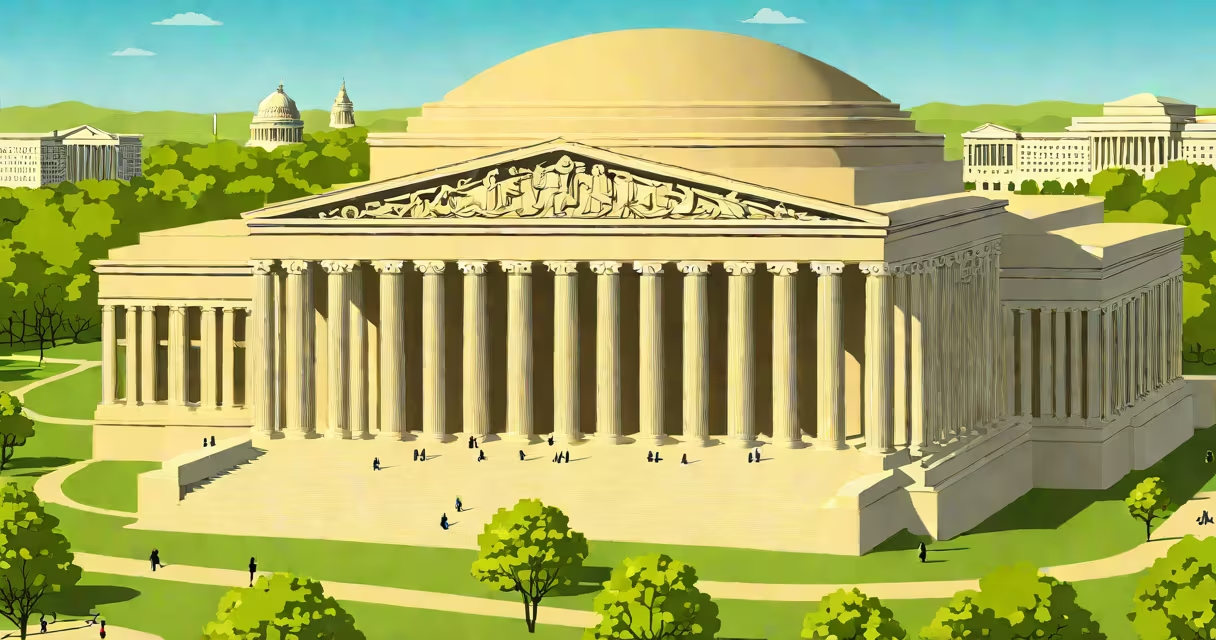
The National Archives Washington DC is the official repository for the most significant records of the United States federal government, including the Declaration of Independence, the Constitution, and the Bill of Rights. Located on Pennsylvania Avenue, it serves as both a museum and a research institution dedicated to preserving and providing public access to foundational American documents.
Established in 1934 under the National Archives and Records Administration (NARA), the Washington DC facility holds over 13 billion pages of federal records. These include military service files, presidential papers, census data, and legal documents from the 17th century to the present. The site's mission is to ensure transparency by making government records available to researchers, citizens, and institutions.
NARA operates under the authority of the U.S. Code, Title 44, which mandates the preservation of federal records. The agency maintains strict environmental controls-temperature regulated at 65°F and humidity at 40%-to prevent degradation of paper-based materials. Digital copies are also created using ISO 19005-compliant standards to meet long-term preservation requirements.
Records enter the National Archives through formal transfer from federal agencies. For example, the White House Historical Association submits presidential correspondence, while the Department of Defense sends military deployment logs. Once received, each document undergoes metadata tagging, condition assessment, and storage in climate-controlled vaults.
Access occurs through two primary channels: physical viewing and digital retrieval. Researchers must register at the Public Research Room on the second floor. Items are retrieved from secure storage by archival staff and brought to designated reading tables. All visitors must follow the NARA Access Policy, which prohibits flash photography and requires protective gloves when handling fragile originals.
Digital access is available via the National Archives Catalog. A search for "1963 March on Washington" returns 1,247 results, including audio recordings, photographs, and FBI surveillance reports. The catalog uses controlled vocabulary based on the Library of Congress Subject Headings and includes full-text searchable PDFs of many documents.
The National Archives Washington DC comprises four main facilities: the Archives Building, the Federal Records Center, the Presidential Libraries Network, and the National Archives at College Park. The Archives Building, completed in 1935, contains the Rotunda for the Charters of Freedom-the glass cases housing the Declaration of Independence, Constitution, and Bill of Rights.
Each document is protected by triple-layered security: bulletproof glass, motion sensors, and 24/7 video monitoring. The Constitution, for instance, is encased in a nitrogen-filled environment to inhibit oxidation. The temperature inside the display case remains constant at 68°F ±1°F, with relative humidity maintained at 40% ±5%.
| Collection Type | Examples | Access Level |
|---|---|---|
| Foundational Documents | Declaration of Independence (1776), Emancipation Proclamation (1863) | Public viewing in Rotunda |
| Presidential Papers | John F. Kennedy's assassination briefing memos (1963) | Restricted until 2033 under FOIA provisions |
| Genealogical Records | 1940 U.S. Census data (released 2032) | Online via NARA Catalog |
One non-obvious fact: the original Constitution was stored in a wooden box during World War II. It was moved to Fort Knox in 1942 for safekeeping, returned in 1944, and never left the Archives after that. This detail is documented in NARA's internal audit log from 1944, cited in the agency's 2019 report on archival security.
Many assume the National Archives Washington DC is solely a museum. While it displays iconic documents, its core function is archival management. Unlike the Smithsonian Institution, which focuses on artifacts and exhibitions, NARA prioritizes record integrity and legal authenticity.
Another misconception is that all federal records are publicly accessible. In reality, about 30% of records remain restricted due to privacy laws (such as HIPAA), national security classifications, or ongoing litigation. For example, the FBI's COINTELPRO files were partially redacted until 2017, when a court ordered release of 2,200 pages under the Freedom of Information Act (FOIA).
A third confusion arises between the National Archives and state-level archives. State archives manage records from state governments-like California's 1849 constitution-but do not hold federal documents. The National Archives Washington DC is the sole federal archive responsible for national-level records.
In 2015, a genealogist used NARA's 1900 census data to trace her great-grandfather's immigration path from Ireland to New York. She discovered he arrived in 1892 and was listed as "John Murphy, age 32, born in County Cork." The data enabled her to file a citizenship application and obtain a U.S. passport. This case demonstrates how archival records directly affect individual lives.
I once visited the National Archives in 2018 to examine draft versions of the 1965 Voting Rights Act. The original typed manuscript, marked with handwritten edits by Attorney General Robert F. Kennedy, showed a 17-line amendment that was later removed. The changes reflected political compromises made during negotiations with Southern senators. Seeing the actual ink smudges and crossed-out phrases gave me a tangible sense of legislative negotiation.
Understanding the National Archives Washington DC clarifies how the U.S. government preserves its past. It is not a monument to history-it is an operational institution maintaining the legal and evidentiary foundation of American governance. studying policy evolution, the archives provide verified, original-source material unavailable anywhere else.