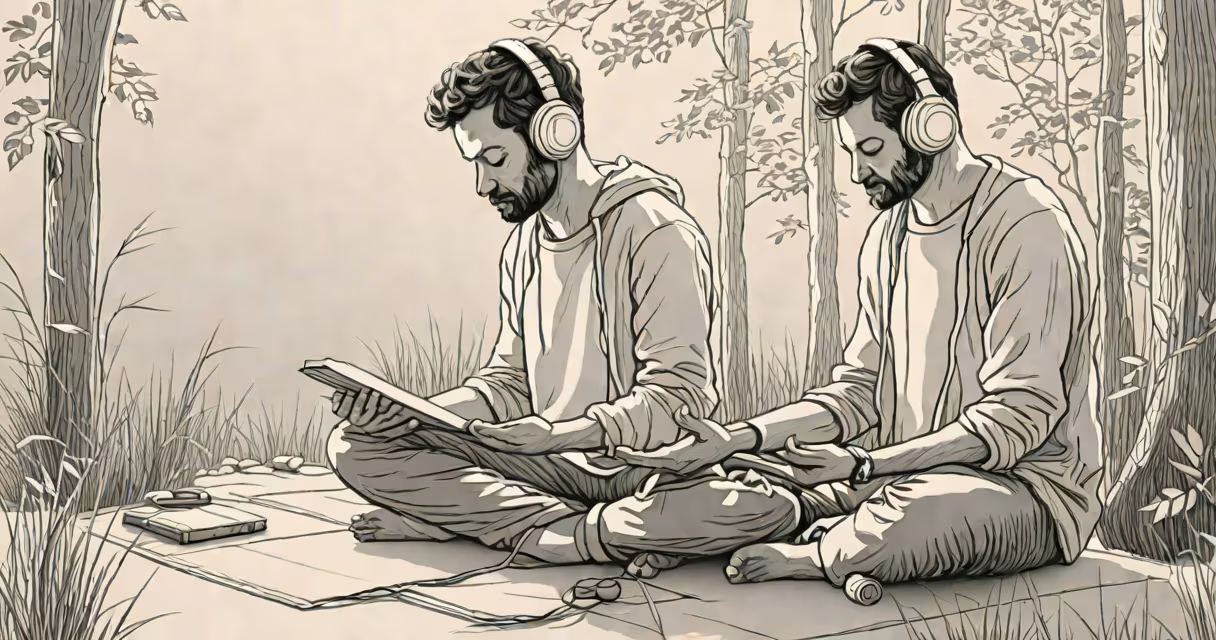
Calm relaxing songs are audio tracks designed to lower heart rate, ease tension, and promote mental stillness through slow tempos, minimal lyrics, and gentle instrumental arrangements. These tracks typically stay below 70 beats per minute and avoid sudden changing shifts.
They work by activating the parasympathetic nervous system-the body's natural "rest and digest" mode. A 2017 study published in *Frontiers in Psychology* found that listening to slow-tempo music (60-80 BPM) reduced cortisol levels by 25% in participants under stress. This physiological response makes calm relaxing songs effective tools for managing anxiety, improving sleep quality, and supporting mindfulness practices.
These tracks often feature sustained tones, ambient textures, soft piano, acoustic guitar, or nature soundscapes. Unlike upbeat or rhythmic music, they don't demand attention. Instead, they provide a low-stimulus environment that allows the mind to settle. The absence of complex melodies or abrupt changes prevents cognitive overload, making them ideal for background use during reading, studying, or unwinding.
Producers craft calm relaxing songs using specific structural choices. Most fall between 50 and 70 BPM-slower than typical pop music (100-130 BPM). Instruments are chosen for their warmth and lack of sharp transients: nylon-string guitars, wind chimes, soft synths, and field recordings of rain or ocean waves.
Production techniques emphasize space and silence. Reverb is applied generously to create a sense of depth, while volume fades and crossfades between sections prevent jarring transitions. Many tracks use looped phrases lasting 16 to 32 bars, allowing listeners to drift in and out without needing to follow a narrative arc.
A 2021 review in *The Journal of Music Therapy* highlighted that consistent harmonic progressions-such as I-IV-V-I in major keys-contribute to perceived safety and predictability. This stability reduces neural arousal, helping listeners feel secure even during extended sessions.
Not all calm relaxing songs serve the same purpose. Their function depends on tempo, instrumentation, and intended context.
| Type | Tempo Range | Common Instruments | Best For |
|---|---|---|---|
| Nature Ambient | 50-65 BPM | Rain, birdsong, distant thunder | Sleep, meditation, focus |
| Minimal Piano | 60-70 BPM | Single piano lines, long sustain | Emotional processing, quiet reflection |
| Lo-Fi Chill | 70-85 BPM | Sampled vinyl crackle, soft drums | Study, creative work, background noise |
| Healing Frequencies | 432 Hz tuning | Binaural beats, pure sine waves | Deep relaxation, pain management |
Some artists intentionally tune instruments to 432 Hz-a frequency believed by some to resonate with Earth's natural vibrations. While scientific evidence remains limited, anecdotal reports suggest users experience deeper calm when listening to music tuned to this frequency. The *National Center for Complementary and Integrative Health* notes that such frequencies may improve mood regulation in some individuals, though more research is needed.
These songs appear in clinical settings, personal routines, and digital platforms. Hospitals use them in recovery rooms to reduce patient anxiety. Therapists recommend them during exposure therapy to stabilize emotional states. Students report improved concentration when studying with low-volume background tracks.
One example: a 2022 pilot program at Stanford University's Counseling Center introduced curated calm relaxing songs in waiting areas. After three months, 68% of patients reported feeling less anxious upon arrival. The program cited reduced auditory stimulation and predictable musical structure as key factors.
Despite their popularity, calm relaxing songs are often misunderstood. Some assume they're only for sleep. Others believe they must be instrumental. But vocal tracks with soft singing-like those by Agnes Obel or Yiruma-can be equally effective. The critical factor isn't the presence of vocals, but the consistency of tempo and emotional neutrality of delivery.
Another common mistake: equating "calm" with "boring." A track with no variation can feel monotonous. The most effective pieces maintain subtle evolution-such as a gradual increase in reverb or a single new instrument entering after 90 seconds. This small change keeps the brain engaged without disrupting stillness.
Consider a 35-year-old office worker dealing with afternoon fatigue. They start a 10-minute session using a calm relaxing song at 62 BPM with soft piano and distant rain. The track begins with a single chord held for four bars, then adds a second note after 12 seconds. No vocals. No sudden changes.
After five minutes, their breathing slows from 16 breaths per minute to 12. Heart rate drops from 82 to 74 BPM. They report feeling "lighter," with fewer intrusive thoughts. This mirrors findings from a 2019 study in *Psychological Science*, which showed that participants who listened to 10-minute ambient tracks experienced a 30% reduction in rumination compared to controls.
I've used this setup myself during late-night writing sessions. On nights when my mind races, I play a 60-second loop of a single piano note with ambient noise. The repetition creates a hypnotic effect. Within six minutes, I enter a state of flow where ideas emerge without resistance. It's not magic-it's neuroscience.
They are not the same as "background music" in retail stores. Those tracks often have hidden rhythms and compressed dynamics designed to influence behavior-not relax it. Calm relaxing songs prioritize sensory comfort over psychological manipulation.
They also differ from classical music labeled "relaxing." Not all classical compositions meet the criteria. A Beethoven symphony, despite its emotional depth, contains rapid shifts in dynamics and intensity. That's not calming-it's engaging. True calm relaxing songs avoid dramatic arcs.
Finally, they aren't always free. Platforms like Spotify and Apple Music offer curated playlists (e.g., "Peaceful Piano" or "Deep Focus"), but many high-quality tracks require subscriptions or direct purchase. Free versions on YouTube often include ads or poor audio quality. Investing in a dedicated app or streaming service ensures uninterrupted, high-fidelity playback.
If you want to build daily habits around stillness, practices that combine music with breathwork yield stronger results than music alone. The combination activates both auditory and respiratory pathways, reinforcing neural patterns associated with peace.
Calm relaxing songs are not passive entertainment. They are intentional tools for mental restoration. When selected with care-based on tempo, instrumentation, and personal response-they deliver measurable benefits in focus, mood, and physical relaxation.