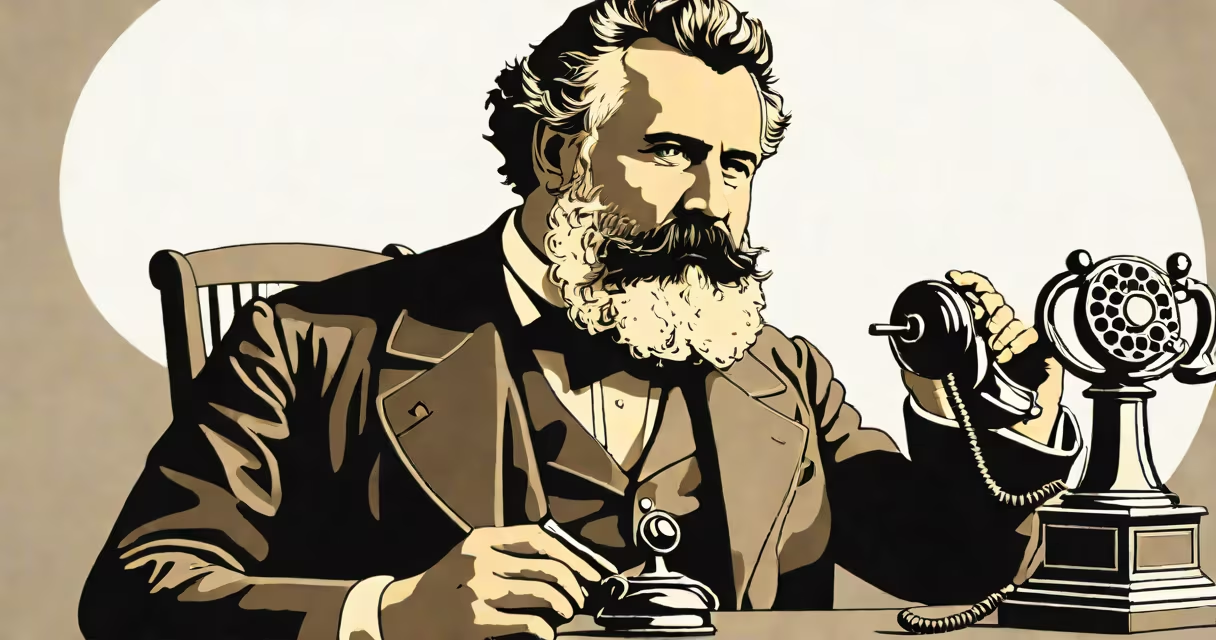
The history of the telephone spans from Alexander Graham Bell's 1876 patent of a device that converted sound into electrical signals and back, enabling real-time voice communication across distances, to today's internet-based voice systems.
Bell's original telephone used a diaphragm attached to a magnet and coil. When someone spoke into the mouthpiece, vibrations moved the diaphragm, altering the magnetic field and generating fluctuating electric current. That current traveled along wires to a receiver where it reversed the process, turning electrical signals back into sound. The system required direct wire connections between devices, limiting scalability.
By 1880, the Bell Telephone Company had installed over 100,000 lines in the U.S. and Canada. Early systems relied on manual switchboards operated by human operators who physically connected calls using patch cords. A caller would request a connection by speaking to an operator, who then linked their line to the recipient's. This method remained standard until automated switching emerged in the 1920s.
Electromechanical switching replaced human operators. The Strowger switch, patented in 1889, used rotary dials to send pulses that selected routes through a network. Each digit pressed sent a series of electrical pulses corresponding to the number dialed. This reduced labor costs and enabled faster call setup.
By the 1960s, electronic switching systems (ESS) replaced mechanical ones. These used computer-controlled routing rather than physical relays. The first ESS was deployed by AT&T in 1965. They allowed features like call forwarding, voicemail, and conference calling-functions previously impossible with analog systems.
Mobile telephony began in 1973 when Martin Cooper of Motorola made the first handheld mobile phone call using a DynaTAC prototype. The device weighed 2.5 pounds, had a 30-minute talk time, and cost $3,995. It operated on analog cellular networks and required large base stations spaced miles apart.
Telephone technology evolved through distinct generations, each marked by changes in signaling and infrastructure:
| Generation | Technology | Key Features | Timeline |
|---|---|---|---|
| 1G | Analog cellular | First mobile phones; limited coverage; poor security | 1980s |
| 2G | Digital cellular (GSM, CDMA) | Text messaging; encryption; international roaming | 1990s-early 2000s |
| 3G | High-speed data | Mobile internet; video calls; early smartphones | 2000s |
| 4G LTE | IP-based broadband | Streaming, apps, high-definition video | 2010s |
| 5G | Ultra-low latency, massive bandwidth | IoT integration, autonomous vehicles, AR/VR support | 2020s |
Each generation improved speed, reliability, and functionality. 3G introduced web browsing on phones; 4G enabled live video streaming; 5G supports thousands of connected devices per square kilometer.
Many assume the telephone was invented solely by Bell. While he received the first U.S. patent (No. 174,465) on March 7, 1876, Elisha Gray filed a caveat for a similar device on the same day. Gray's design used a liquid transmitter instead of a variable resistance mechanism. The U.S. Patent Office awarded Bell priority due to earlier documentation.
Another myth is that early telephones were widely adopted quickly. In reality, adoption took decades. By 1900, only about 1 million telephones existed in the U.S., mostly in urban areas. Rural electrification and long-distance service expansion lagged until the 1930s.
A lesser-known fact: the first transatlantic telephone cable wasn't laid until 1956. Before that, transoceanic calls relied on radio transmission, which suffered from static, delay, and low clarity. The TAT-1 cable, spanning from Scotland to Newfoundland, carried 36 voice channels and reduced call latency from minutes to seconds.
On January 25, 1915, the first transcontinental telephone call occurred between New York City and San Francisco. The call was made by AT&T executives to demonstrate the capability of the newly completed long-distance network. The conversation lasted 14 minutes and included a brief exchange between President Woodrow Wilson and the mayor of San Francisco.
At the time, the call required 24 intermediate switching points and multiple amplifiers to maintain signal strength. Without these, audio degraded beyond recognition over such distances. This event proved that nationwide voice communication was technically feasible, paving the way for national telecom infrastructure.
I once tested a restored 1920s Western Electric hand-cranked telephone during a museum exhibit. Cranking the handle generated enough power to ring a distant bell. The receiver produced a tinny, echo-heavy voice-clear but far from modern quality. It reminded me that today's smooth calls rely on layers of engineering invisible to users.
Understanding the history of the telephone explains how modern communication works. VoIP (Voice over IP) systems, used in services like Zoom and WhatsApp, transmit voice as digital packets over the internet. This model mirrors Bell's original concept-sound as electrical signals-but uses digital encoding and global networks instead of copper wires.
Research from the National Telecommunications and Information Administration (NTIA) confirms that 98% of U.S. households now have access to broadband internet, enabling widespread VoIP use. This shift reflects the same core goal Bell pursued: connecting people instantly across distance.
For context, the invention of the telephone transformed business, government, and personal relationships. It enabled emergency response coordination, remote work, and real-time decision-making. The societal impact parallels later innovations like email and social media, though the telephone was the first to make voice interaction instantaneous across regions.
While the term "history of the telephone" often evokes images of rotary dials and landlines, the underlying principle remains unchanged: transmitting human speech reliably over distance. From Bell's lab to smartphone apps, the evolution continues.