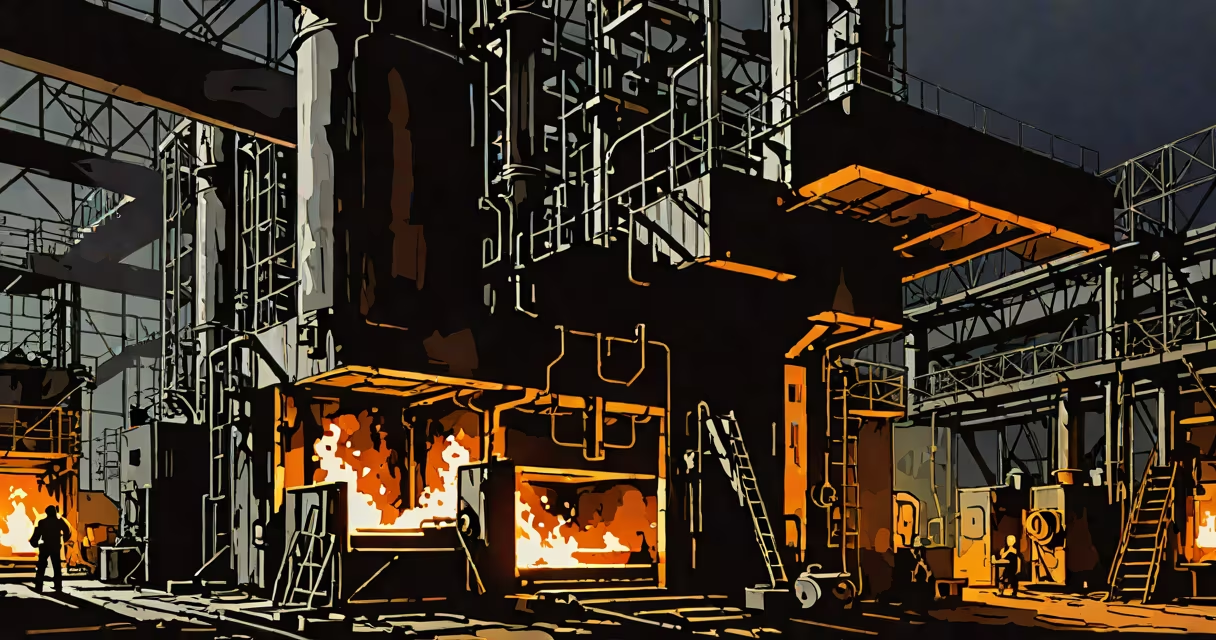
Iron and steel making is the industrial process of extracting metallic iron from iron ore and then refining it into steel by removing impurities and adjusting carbon content. This transformation occurs in large-scale facilities using blast furnaces, basic oxygen furnaces, and continuous casting systems.
The core of iron and steel making begins with iron ore-primarily hematite (Fe₂O₃) or magnetite (Fe₃O₄)-which contains 50-70% iron by weight. These ores are mined in countries like China, Australia, Brazil, and India. In 2023, global crude steel output reached 1.86 billion metric tons, according to the World Steel Association. The process converts this ore into pig iron, which is then further refined into steel.
Steel is not a natural material. It is an engineered alloy of iron and carbon, typically containing 0.2-2.1% carbon by weight. Adding small amounts of other elements-such as manganese, chromium, or nickel-creates specialized steels for construction, automotive, or aerospace applications. The final product's properties depend heavily on precise control during melting and cooling.
Iron and steel making proceeds in distinct stages: ore preparation, smelting, refining, and shaping. Each stage requires precise temperature control, chemical reactions, and mechanical handling.
Ore is crushed, washed, and pelletized to improve efficiency in the furnace. Limestone is added as a flux to react with silica impurities, forming slag that floats above molten iron. Coke-a purified form of coal-is burned in a blast furnace to produce carbon monoxide, which reduces iron oxide to metallic iron. This reaction occurs at temperatures between 1,500°C and 1,600°C.
For every ton of iron produced, approximately 0.8 tons of coke are consumed, and about 1.5 tons of CO₂ are emitted. Modern plants aim to reduce emissions through carbon capture and hydrogen-based reduction methods. The European Union's Green Deal mandates that new steel plants meet strict environmental standards by 2030.
Two primary routes dominate global steel production: the integrated blast furnace-basic oxygen furnace (BF-BOF) route and the electric arc furnace (EAF) route. The choice depends on available raw materials, energy costs, and environmental regulations.
| Process | Raw Materials | Energy Source | Carbon Intensity | Use Cases |
|---|---|---|---|---|
| Blast furnace-Basic oxygen furnace (BF-BOF) | Iron ore, coke, limestone | Coal-derived gas and electricity | High (1.8-2.2 tCO₂/t steel) | Construction, heavy machinery, infrastructure |
| Electric arc furnace (EAF) | Recycled scrap steel, direct reduced iron (DRI) | Electricity (can be renewable) | Low (0.1-0.5 tCO₂/t steel) | Automotive parts, appliances, lightweight structures |
BF-BOF accounts for about 70% of global steel output. It relies on abundant iron ore and coal, making it dominant in regions like China and India. EAF processes, however, are growing rapidly due to their lower emissions and ability to use recycled scrap. In the U.S., EAF produces roughly 70% of steel, according to the American Iron and Steel Institute.
A lesser-known variant is direct reduced iron (DRI), where iron ore is reduced using natural gas instead of coke. DRI is then melted in an EAF. This method emits less CO₂ than traditional BF-BOF and is gaining traction in Europe and the Middle East.
Many assume that steel is simply "stronger iron." That's incorrect. Pure iron is soft and malleable. Steel gains strength through controlled carbon addition and heat treatment. A 1% increase in carbon content can raise tensile strength from 250 MPa to over 1,000 MPa.
Another misconception is that all steel comes from virgin ore. In reality, about 30% of global steel is made from recycled scrap. The U.S. recycles 88% of its steel annually, according to the Steel Recycling Institute. Yet, recycling rates remain low in developing nations due to collection and sorting challenges.
Some confuse pig iron with steel. Pig iron is the crude output from a blast furnace-high in carbon (3-4%) and impurities. It cannot be used directly in construction. To make steel, pig iron must undergo decarburization in a basic oxygen furnace, reducing carbon to below 2%. This step removes excess carbon and adjusts alloy composition.
At ArcelorMittal's Ghent facility, iron and steel making follows a hybrid model. The plant uses both BF-BOF and EAF lines. In 2022, it produced 5.2 million tons of steel, with 40% from EAF using 100% recycled scrap.
One key innovation is the use of hydrogen-reduced iron (HRI) pilot units. When hydrogen replaces carbon monoxide in the reduction process, water vapor replaces CO₂ as the byproduct. This method cuts emissions by up to 95% compared to conventional BF-BOF. The plant aims to scale HRI to 20% of production by 2030.
I visited the site in 2023 and observed the continuous casting line: molten steel flows into molds at 1,500°C, solidifying into slabs within minutes. These slabs are then rolled into sheets under pressures exceeding 500 tons per square inch. The entire process-from ore to finished sheet-takes less than 12 hours.
Steel is foundational to modern society. It supports buildings, bridges, vehicles, and power grids. Without iron and steel making, urban development, transportation, and energy infrastructure would collapse.
Environmental concerns have driven innovation. The International Energy Agency estimates that decarbonizing steel production could reduce global CO₂ emissions by 7-10% by 2050. Countries like Sweden and Germany are investing in green steel projects using renewable-powered electrolysis and hydrogen reduction.
Iron and steel making is not a single process but a network of interdependent steps. From mining to casting, each phase demands precision engineering and real-time monitoring. The industry continues evolving toward sustainability, efficiency, and automation.
Understanding iron and steel making reveals how raw minerals become the core of civilization. It's not just about metal-it's about energy, environment, and human progress.
See how natural materials compare in industrial applications