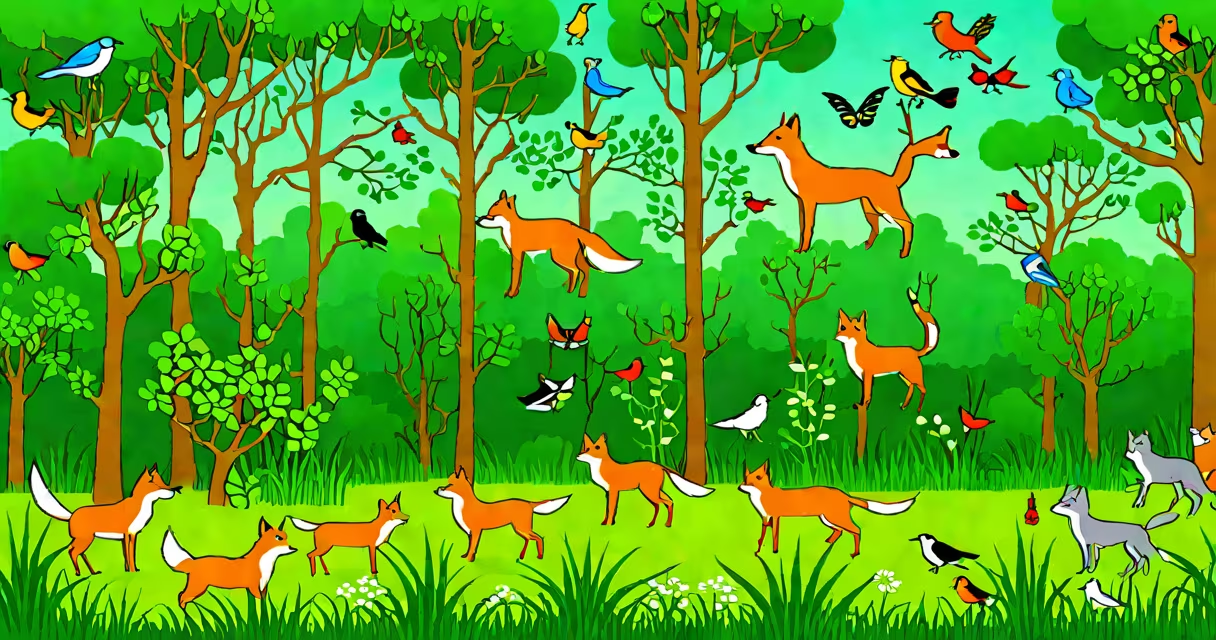
Food chains and food webs describe how energy flows through ecosystems by showing who eats whom. A food chain is a single path of energy transfer from producers to top predators. A food web is a complex network of interconnected food chains that reflects real-world feeding relationships.
Energy enters most ecosystems through photosynthesis. Plants, algae, and cyanobacteria convert sunlight into chemical energy stored in glucose. These organisms are called primary producers. They form the base of every food chain. For example, in a grassland, grass captures solar energy and becomes food for grasshoppers. Grasshoppers are eaten by frogs, which are then eaten by snakes. The snake may be eaten by an owl. This sequence-grass → grasshopper → frog → snake → owl-is a food chain.
Food webs go beyond linear paths. In reality, each organism consumes multiple species and is consumed by several others. A single grasshopper might eat different grasses and be eaten by frogs, lizards, or birds. A frog might eat grasshoppers, worms, and small fish. These overlapping relationships create a web. The complexity of a food web increases biodiversity and stability. When one species declines, others can often compensate, reducing system collapse risk.
Energy transfer between trophic levels is inefficient. Only about 10% of energy from one level moves to the next. This is known as the 10% rule. For example, if 1,000 units of energy are captured by plants, only about 100 units reach herbivores. Of those, only 10 units reach carnivores. By the time energy reaches apex predators, such as eagles or wolves, less than 1 unit remains.
This inefficiency limits the number of trophic levels in an system. Most food chains have four or fewer levels. Fewer than five levels exist because energy diminishes too quickly to support additional consumer levels. In marine ecosystems, phytoplankton feed zooplankton, which feed small fish, which feed larger fish. Top predators like tuna or sharks occupy the highest level.
Decomposers play a important role in completing the cycle. Fungi, bacteria, and detritivores break down dead organisms and waste. They release nutrients back into the soil or water, making them available for producers. Without decomposers, ecosystems would run out of essential elements like nitrogen and phosphorus.
Organisms are grouped by their role in energy flow:
| Role | Examples | Function |
|---|---|---|
| Producers | Grass, trees, algae, phytoplankton | Make their own food using sunlight or chemicals |
| Primary Consumers | Grasshoppers, rabbits, zooplankton | Eat producers |
| Secondary Consumers | Frogs, small fish, spiders | Eat primary consumers |
| Tertiary Consumers | Snakes, hawks, large fish | Eat secondary consumers |
| Apex Predators | Eagles, lions, sharks | Top of the food chain; rarely hunted |
| Decomposers | Bacteria, fungi, earthworms | Break down dead matter and recycle nutrients |
Each role maintains balance. If primary consumers increase without predators, plant populations decline. If apex predators disappear, herbivore numbers surge, leading to overgrazing and habitat degradation. The 1995 reintroduction of gray wolves to Yellowstone National Park reversed decades of elk overpopulation, allowing willow and aspen regrowth. This restored stream health and increased bird diversity-a clear example of how top-down regulation shapes entire ecosystems.
People often confuse food chains with food webs. A food chain is a simplified model. It shows one direction of energy flow. A food web shows multiple interactions. Real ecosystems do not follow single pathways. A single animal may appear in many food chains.
Another misunderstanding is that energy "cycles" through ecosystems. Energy does not cycle-it flows. It enters as sunlight, is converted to chemical energy, and eventually exits as heat. Nutrients, however, do cycle. Carbon, nitrogen, and phosphorus are reused through decomposition and biogeochemical processes.
A non-obvious fact: Some food webs begin with chemosynthesis, not photosynthesis. In deep-sea hydrothermal vents, bacteria use hydrogen sulfide to produce energy. Tube worms, clams, and crabs depend on these bacteria. This system functions entirely without sunlight. It proves that life can thrive without solar input, challenging the assumption that all food chains start with plants.
Consider a pond system. Algae and aquatic plants are producers. Daphnia (tiny crustaceans) eat algae. Small fish like minnows eat daphnia. Larger fish like bass eat minnows. Herons and kingfishers prey on bass. Decomposers break down dead fish and plants.
Now map the connections. Daphnia may also eat detritus. Minnows may eat insect larvae. Bass might consume crayfish. Herons eat various fish. This creates a web with multiple entry points and exit routes. If algae die off due to pollution, daphnia decline, affecting minnows, bass, and birds. The entire system destabilizes.
I observed this pattern firsthand during a summer field study at Lake Mendota in Wisconsin. After a nutrient runoff event, algal blooms turned the water green. Within weeks, oxygen levels dropped. Fish died. Bird sightings vanished. The food web collapsed in under a month. This showed how fragile interdependence can be.
Understanding food chains and food webs helps predict system responses to change. Human activities like deforestation, overfishing, and pesticide use disrupt these systems. Removing a keystone species-like sea otters in kelp forests-can cause cascading effects. Otters eat sea urchins. Without otters, urchins overgraze kelp, destroying habitat for fish and invertebrates.
Conservation strategies rely on food web analysis. Protecting a single species is insufficient if its food sources or predators are threatened. Effective management considers entire networks. The U.S. Endangered Species Act evaluates threats across trophic levels, not just individual species.