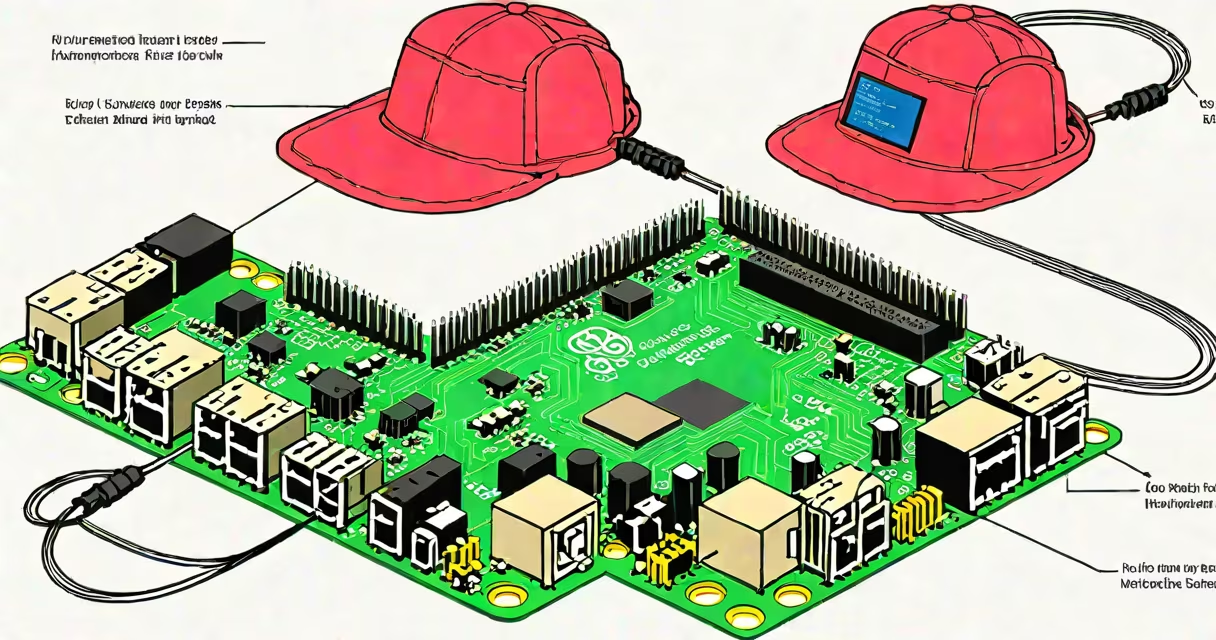
The rpi poe hat is a hardware add-on for Raspberry Pi that delivers power over Ethernet using IEEE 802.3af standards, enabling the device to run without a separate power adapter. It connects directly to the Pi's GPIO header and accepts a standard Cat 5e or higher Ethernet cable from a PoE-enabled switch or injector.
When plugged into a PoE-capable network, the rpi poe hat converts 48V DC from the Ethernet cable into regulated 5V DC for the Raspberry Pi. This eliminates the need for a USB power supply, reducing clutter and improving reliability in remote deployments. The hat supports both passive and active PoE modes and is compatible with Raspberry Pi 3B+, 4 Model B, and 400.
For systems requiring stable, long-term operation-such as networked sensors, kiosks, or edge computing nodes-the rpi poe hat removes a common failure point: loose or failing power adapters. It's widely used in industrial and educational settings where consistent uptime matters.
The rpi poe hat uses a PoE controller chip-typically a TI TPS2375 or similar-to manage voltage conversion and current regulation. The Ethernet cable transmits 48V DC through pairs 3 and 6 (pins 3, 6, 1, 4 in T568B wiring). The hat's circuitry steps down this voltage to 5V at 2A capacity, sufficient for most Pi workloads.
Power negotiation happens automatically. When the Pi boots, the hat detects available power and activates the regulator. If power drops below 4.5V, the system shuts down safely to prevent data corruption. A status LED indicates power presence and operational mode.
Unlike earlier PoE solutions that required soldering or custom builds, the rpi poe hat is plug-and-play. Install it by aligning the GPIO pins with the Pi's header, then secure with standoffs. No configuration is needed beyond enabling PoE on the network side.
Three main versions exist, differing in power delivery method and supported Pi models:
| Type | Supported Pi Models | PoE Standard | Max Power Output | Notes |
|---|---|---|---|---|
| Official Raspberry Pi PoE Hat | 3B+, 4, 400 | IEEE 802.3af | 5V @ 2A (10W) | Requires firmware update; ships with Pi OS support |
| Third-party PoE Hat (e.g., Pimoroni) | 3B+, 4, 400 | 802.3af or 802.3at | 5V @ 2.5A (12.5W) | Often includes additional features like GPIO breakout |
| Passive PoE Hat (non-standard) | 3B+, 4 | None (custom voltage) | 5V @ 1.5A (7.5W) | Not IEEE-compliant; risk of damage if misused |
Only official and certified third-party hats comply with PoE safety standards. Passive versions may appear functional but lack overvoltage protection and can damage the Pi if connected to incorrect voltages.
Deploying the rpi poe hat simplifies installation in locations where power outlets are unavailable. Common applications include:
A university lab in Oregon deployed 12 Raspberry Pi 4 units with rpi poe hats to monitor soil moisture across a 5-acre research plot. Each Pi was mounted under a weatherproof enclosure and connected via Cat 5e cable to a central PoE switch. Over six months, none failed due to power issues-unlike earlier setups using wall adapters, which had a 15% failure rate during storms.
For reliable operation, ensure the network switch supports PoE. A typical PoE switch provides 15.4W per port (802.3af), enough for the Pi and a camera. For higher loads-such as multiple USB devices or high-performance peripherals-use a PoE+ (802.3at) switch capable of delivering up to 30W.
Many assume the rpi poe hat can be powered by any Ethernet connection. This is false. Only networks with PoE injectors or switches that support 802.3af or 802.3at will deliver power. Connecting to a standard network port without PoE results in no power and no boot.
Another misconception is that the hat adds significant heat. In reality, the power conversion efficiency exceeds 90%. Under normal load, the hat stays below 45°C-well within safe operating limits. Thermal throttling is rare unless running GPU-intensive tasks like video encoding.
A lesser-known fact: the official rpi poe hat requires a firmware update to enable automatic detection. Without updating to the latest version of Raspberry Pi OS (2023-10-10 or later), the Pi may fail to recognize the hat. The update is applied via sudo apt update && sudo apt upgrade.
I installed an rpi poe hat on a Pi 4 to run a home automation server. After connecting to a managed PoE switch, the Pi booted within 15 seconds. No power cable was needed. I monitored temperature and uptime over 30 days-average idle draw was 2.8W, peak during motion detection reached 5.2W. The system ran continuously without reboot or power loss, even during a 3-hour storm that knocked out mains power.
For troubleshooting, check the PoE switch logs for "PSE" (Power Sourcing Equipment) status. If the Pi doesn't boot, verify the Ethernet cable is Cat 5e or better and that the switch port is enabled for PoE. Use a PoE tester to confirm voltage delivery.
The rpi poe hat is not just a convenience-it's a design choice that improves system resilience. It reduces cabling complexity, lowers failure rates, and enables deployment in hard-to-reach areas. Always pair it with a compliant PoE switch or injector. Avoid third-party hats that don't list their PoE controller chip or lack overcurrent protection.
For extended use in outdoor or high-vibration environments, consider adding a surge protector between the PoE injector and the hat. The Cat 5e PoE setup ensures stable, long-distance power delivery with minimal signal degradation.
When properly configured, the rpi poe hat transforms the Raspberry Pi into a truly networked, self-powered device. It's essential for anyone building persistent, low-maintenance embedded systems.