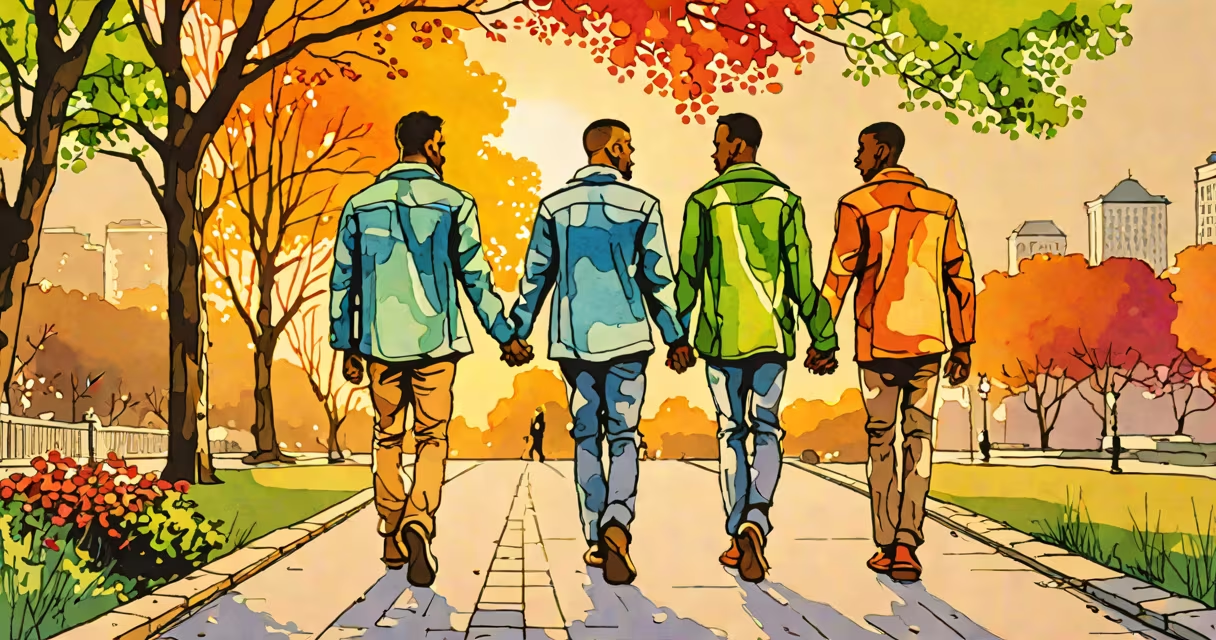
Gay love stories are narratives-fictional or real-that center on romantic relationships between men, emphasizing emotional intimacy, shared identity, and mutual commitment. They depict love beyond societal expectations, often reflecting personal journeys of acceptance, resilience, and joy.
These stories appear in film, television, literature, and personal memoirs. They show how love develops through conversation, trust, and shared history-not just physical attraction. A gay love story may begin with a chance meeting, grow through quiet moments of understanding, and endure challenges like family disapproval or social stigma.
Unlike broad categories such as "romance," gay love stories focus on the specific context of male same-sex relationships. They are not about gender roles or assumed behaviors. Instead, they explore how individuals build lasting bonds rooted in authenticity. The genre includes both uplifting tales and those confronting hardship, offering representation for people who see themselves in these experiences.
At their core, gay love stories follow character-driven arcs where emotional growth and connection take priority over plot mechanics. They unfold through dialogue, internal monologue, and shared actions-like cooking a meal together, going through a difficult conversation, or simply sitting in silence without needing to fill the space.
For example, in the film *Call Me by Your Name* (2017), the relationship between Elio and Oliver develops slowly. Their bond forms through long walks, music, and late-night talks. The story doesn't rely on dramatic confrontations or grand gestures. Instead, intimacy grows from small details-the way Elio watches Oliver's hands while he plays piano, or how Oliver hesitates before saying "I love you." This realism makes the emotional stakes feel immediate and earned.
These stories thrive when characters have agency. The romance isn't a subplot to a larger narrative about survival or transformation. It stands on its own as meaningful. When a gay love story centers on a couple's daily life-choosing a home, managing finances, attending friends' weddings-it normalizes queer relationships without needing to justify them.
Gay love stories exist across multiple formats, each with distinct storytelling strengths:
| Format | Key Features | Example |
|---|---|---|
| Fictional film | Visual pacing, emotional cues through performance, limited interiority | *Moonlight* (2016) |
| Novel or short story | Deep internal perspective, detailed setting, slower development | *The Song of Achilles* by Madeline Miller |
| Documentary | Real people, real timelines, archival footage, interviews | *The Celluloid Closet* (1995) |
| Personal essay or memoir | First-person reflection, nonlinear structure, emotional honesty | *Intimacy* by David Sedaris |
Each format shapes how audiences experience the relationship. Film relies on visuals and music to convey emotion. A novel allows readers to inhabit a character's thoughts. Memoir grounds the story in lived reality, making it harder to dismiss as fantasy.
Representation matters because seeing oneself reflected reduces isolation. According to the Human Rights Campaign, 40% of LGBTQ+ youth report feeling suicidal due to rejection. When young people encounter gay love stories that show happy, stable relationships, it counters internalized shame and offers hope.
These stories also challenge misconceptions. Not all gay love stories involve conflict. Some show couples raising children, building careers, or traveling together. Others show how love persists through illness or aging. For example, the 2021 documentary *The Last Letter* follows a man caring for his partner with ALS. The film shows love not as grand gestures, but as daily acts of presence-reading aloud, adjusting pillows, holding hands during pain.
A common mistake is assuming all gay love stories must be tragic. While some narratives do address loss or discrimination, others focus on joy, humor, and everyday connection. The 2023 Netflix series *Heartstopper* portrays a high school romance between two boys with gentle pacing and warmth. It avoids melodrama and centers on quiet moments-a hand brushing against another's under a desk, a shared laugh over bad jokes. This normalization is useful.
Many assume gay love stories are only for queer audiences. But research from GLAAD shows that 68% of heterosexual viewers find these stories relatable. The emotional core-longing, fear of rejection, desire for belonging-is universal. A story about two men falling in love resonates even if the viewer hasn't experienced that identity.
Another misconception is that all gay love stories are based on real events. While autobiographical works exist, many are fictional. *Call Me by Your Name* was inspired by director Luca Guadagnino's memories, but the characters and plot were constructed. Fiction allows exploration of possibilities beyond lived experience-such as alternate histories or speculative futures where queer love is normalized.
Gay love stories are not interchangeable with "queer love stories." While all gay love stories are queer, not all queer stories are gay. A trans woman falling in love with a non-binary person, or a bisexual character going through multiple identities, involves different dynamics. Gay love stories specifically refer to men in romantic relationships.
I once attended a screening of *Brooklyn* (2015) at a queer film festival. After the credits rolled, a man in his 50s stood up and said, "That's my story." He had emigrated from Ireland to New York in the 1980s, just like the protagonist. His voice cracked when he spoke about how the film's quiet scenes-two men sharing a room, talking about home-felt like memory. That moment confirmed something I'd seen in data: stories aren't just entertainment. They're mirrors.
Gay love stories are not a niche category. They are essential parts of human expression. Whether in a novel, a film, or a personal letter, they affirm that love between men is valid, enduring, and worthy of attention. They challenge outdated views and expand empathy. When we engage with these stories, we don't just witness romance-we recognize ourselves.
Understanding gay love stories begins with listening to the voices behind them. The most authentic ones come from lived experience, but even fictional ones carry truth. They remind us that love, in all its forms, is not a performance. It's a practice. And it belongs to everyone.