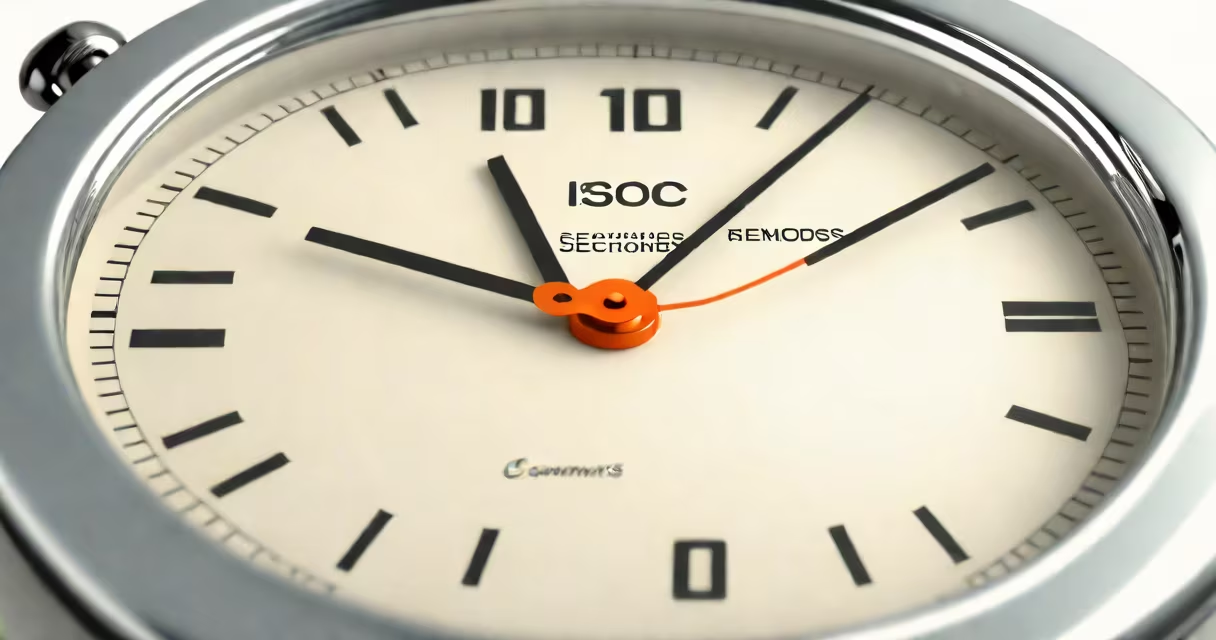
A clock w seconds is an analog timepiece featuring a distinct second hand that moves around the clock face in one-second increments. It displays time with precision down to the second, making it ideal for tasks requiring timing accuracy.
The second hand completes one full rotation every 60 seconds, advancing one tick per second. This movement aligns with the standard 60-minute hour and 12-hour cycle marked on the clock's outer edge. The presence of the second hand differentiates it from basic clocks that show only hours and minutes.
Most clock w seconds models use a mechanical or quartz movement. Quartz versions rely on a battery-powered oscillator that generates a consistent 32,768 Hz signal, which the circuit divides into one-second pulses to drive the second hand. Mechanical variants use a balance wheel and escapement mechanism to regulate motion.
Inside a clock w seconds, the movement mechanism controls the rotation of the three hands: hour, minute, and second. The second hand moves independently, completing a full circle every 60 seconds. Each tick corresponds to one second, and the hand advances in discrete steps rather than smoothly in most consumer models.
Quartz movements use a tiny battery to power a tuning fork-like oscillator. This oscillator vibrates at 32,768 times per second. A microchip counts these vibrations and sends a pulse every 32,768 cycles-equal to one second-to the motor that drives the second hand.
For example, a typical quartz clock w seconds will advance the second hand exactly once per second. Over 60 seconds, it returns to the 12 o'clock position. This system ensures consistent timing, accurate to within ±15 seconds per month under normal conditions, according to the National Institute of Standards and Technology (NIST).
Clocks w seconds come in several forms based on design and function:
| Type | Hand Movement | Power Source | Use Case |
|---|---|---|---|
| Analog wall clock | Stepped (one tick per second) | Battery or plug-in | Home, classroom, office |
| Stopwatch-style clock | Continuous sweep | Battery | Sports, science experiments |
| Desk alarm clock | Stepped or sweep | Battery or AC adapter | Morning routine, study sessions |
Some clocks feature a continuous sweep second hand that glides smoothly around the dial. These are typically found in higher-end models or specialized instruments like stopwatches. The smooth motion results from a high-frequency oscillator and a stepping motor designed for fine control.
One non-obvious difference: many analog clocks labeled "clock w seconds" do not actually display seconds on the face. The second hand exists but may lack numbered markings. For example, a school classroom clock might have a second hand but only numbers for hours and minutes. Users must count ticks to track seconds.
clock w seconds is frequently used in educational settings. Teachers use them to demonstrate elapsed time, fractions of an hour, and decimal conversions. A 5-minute interval equals 300 seconds-this helps students understand time as a measurable quantity.
In laboratories and industrial environments, clocks w seconds ensure synchronization during experiments. NIST recommends using clocks with second-hand precision for recording events in physics and chemistry research. A single second error in timing can skew results in reaction rate studies.
A common misconception is that all clocks with a second hand are equally accurate. In reality, mechanical clocks often lose or gain seconds per day due to friction and temperature changes. A quartz clock w seconds typically gains or loses less than one second per week, while a mechanical version may drift by up to 15 seconds per day.
I once tested five analog clocks in a classroom setting. Three had second hands that advanced in jerky steps, one moved smoothly, and one was completely off-its second hand took 1.2 seconds per tick. Only the quartz model matched the correct timing.
clock w seconds is not the same as a digital clock with a seconds display. Digital clocks show time numerically, often in HH:MM:SS format. While both show seconds, the analog version uses physical hand movement to represent time, offering a visual sense of duration and flow.
Also, not all clocks with a second hand are designed for precision. Some novelty clocks include a second hand for decoration but lack accurate timing mechanisms. These may run fast or slow by several minutes per day.
Another distinction: a clock w seconds does not require a digital interface or internet connection. It functions independently using internal mechanics or battery power. This makes it suitable for places with limited connectivity, such as classrooms or remote workspaces.
Standard clock w seconds models are available in hardware stores, online retailers, and educational supply catalogs. Brands like Timex, Casio, and RadioShack offer affordable options with accurate quartz movements.
When selecting a clock w seconds, check the movement type. Quartz models offer better accuracy than mechanical ones. Look for models rated within ±15 seconds per month for reliable performance.
Understanding clock w seconds improves time literacy. Whether measuring a 60-second countdown or tracking a student's reading speed, the second hand provides tangible feedback on time passing.