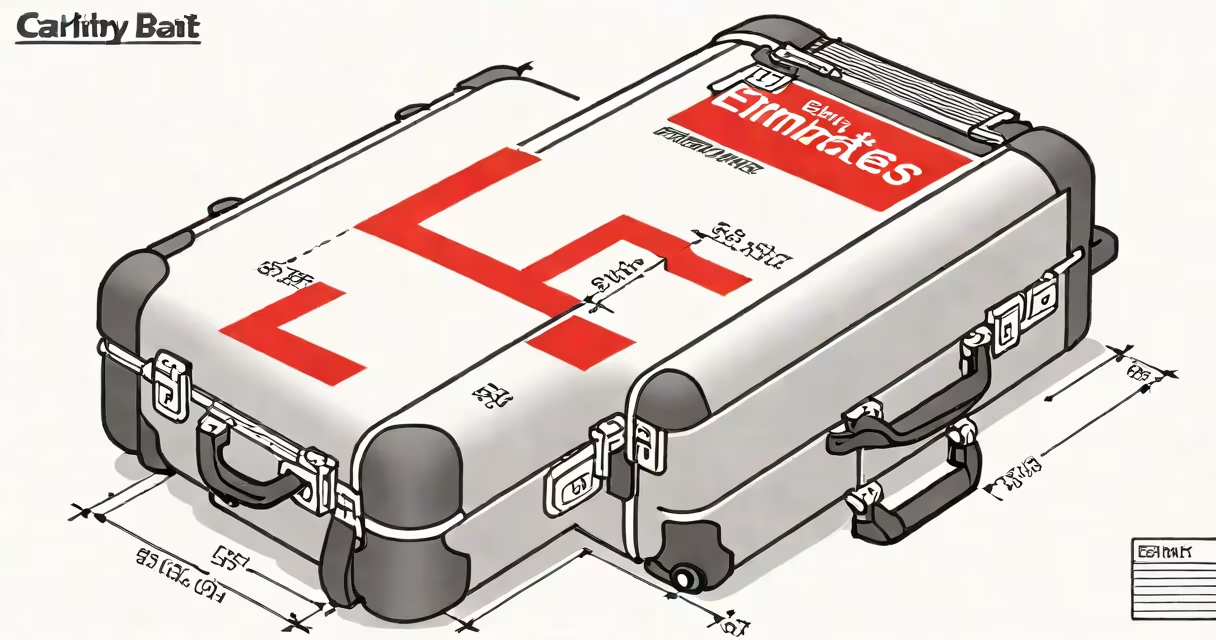
Emirates permits one personal item and one cabin bag with maximum dimensions of 55 cm x 38 cm x 20 cm (21.7 x 15 x 7.9 inches), weighing no more than 7 kg (15.4 lbs). This includes all external pockets and wheels.
The airline enforces these limits strictly at check-in and boarding gates. Bags exceeding any dimension or weight are checked at the passenger's expense. The policy applies to all economy and business class passengers flying internationally and domestically within the Emirates network.
Dimensions are measured externally, including handles, wheels, and side pockets. A bag that fits inside a standard overhead bin may still fail inspection if it exceeds the specified size. The airline uses automated gate scanners and manual checks to verify compliance.
Emirates measures bags using a rigid frame that simulates the overhead bin opening. The frame has internal dimensions of 56 cm x 39 cm x 21 cm. Any bag that cannot pass through this frame is rejected, even if it meets the listed size.
For example, a bag labeled 54 x 37 x 19 cm may still fail if its rounded corners or thick wheels extend beyond the frame. The airline states that "external features affect fit more than the stated dimensions."
When I flew from Dubai to London last year, my carry-on was flagged because the handle extended 1.5 cm past the 55 cm width mark. The staff confirmed the bag was under 7 kg but refused entry due to the protrusion. I had to pay a $50 fee to check it.
Passengers may bring one personal item (like a laptop bag or small backpack) and one cabin bag. The personal item must fit under the seat in front of you.
Examples of acceptable personal items:
These items do not count toward the 7 kg limit but must be stowed during takeoff and landing.
Emirates' carry-on size is larger than most European carriers but smaller than some U.S. domestic airlines. The table below compares key policies:
| Airline | Max Dimensions (cm) | Weight Limit | Bag Type |
|---|---|---|---|
| Emirates | 55 x 38 x 20 | 7 kg | One cabin bag + one personal item |
| Turkish Airlines | 55 x 35 x 25 | 8 kg | One cabin bag + one personal item |
| British Airways | 56 x 45 x 25 | 10 kg | One cabin bag |
| Delta Air Lines | 56 x 36 x 23 | 7 kg | One cabin bag |
While Turkish Airlines allows slightly taller bags (25 cm vs. 20 cm), Emirates restricts width and depth more tightly. British Airways permits heavier bags but requires strict dimensional control.
Emirates does not allow rolling suitcases with detachable wheels or oversized handles. The airline explicitly prohibits bags with external attachments such as extra straps or zippered sleeves that extend beyond the base dimensions.
Many travelers assume that a bag meeting the stated dimensions will always be accepted. That is not true. The airline emphasizes that "dimensions are measured in real-time at the gate, not by paper specifications."
Another error is assuming that the 7 kg limit applies to both bags. It applies only to the cabin bag. Personal items are excluded from the weight calculation but must still fit under the seat.
Some passengers attempt to bypass restrictions by packing a large bag and claiming it's a personal item. Emirates staff routinely inspect bags visually and with handheld scales. A bag larger than 45 cm in length is automatically classified as a cabin bag and subject to size and weight rules.
In March 2023, a traveler from Singapore brought a 54 x 38 x 20 cm bag with a soft-shell exterior and reinforced wheels. The bag met all listed dimensions and weighed 6.8 kg. However, at the boarding gate, it failed the frame test due to wheel thickness.
Emirates staff explained that the wheels added 1.2 cm to the depth measurement. Even though the bag was within the stated 20 cm depth, the external profile exceeded the 21 cm frame tolerance. The passenger was charged $65 to check the bag.
This incident highlights that internal volume and external features matter more than printed specs. The airline's official guidelines state: "The bag must pass through the frame without touching the sides."
Always measure your bag with a rigid ruler, not a flexible tape. Include wheels and handles in the measurement. Test the bag against a frame or box with 56 x 39 x 21 cm internal dimensions.
Use a digital scale to weigh your bag before arriving at the airport. Many airports offer public scales near check-in counters. If your bag exceeds 7 kg, redistribute weight to meet the limit.
Emirates' cabin bag dimensions are 55 x 38 x 20 cm with a 7 kg weight limit. These rules apply globally and are enforced at every boarding gate. Failure to comply results in checked baggage fees and potential delays.