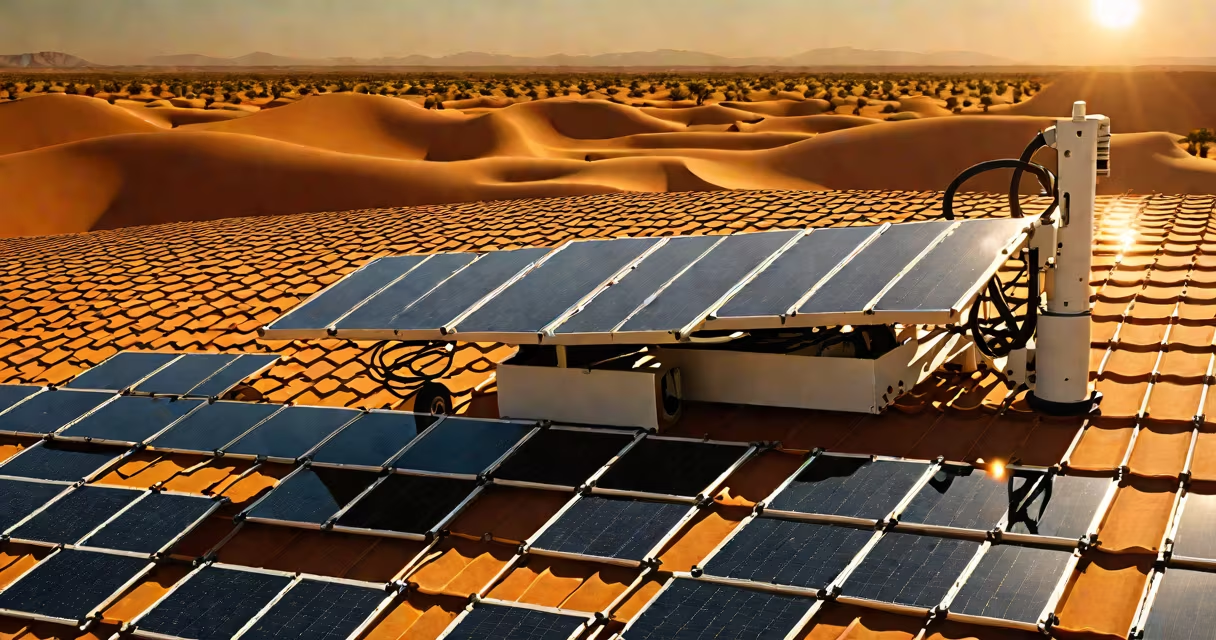
Automated solar panel cleaning uses motorized devices or software-controlled systems to remove dust, dirt, and debris from photovoltaic panels without manual labor. These systems operate on timers, sensors, or remote commands to maintain optimal energy output.
Systems range from small track-mounted units for residential arrays to large autonomous robots for utility-scale installations. They use soft brushes, water sprayers, or electrostatic wipers to clean surfaces without scratching silicon cells. The goal is to sustain panel efficiency above 95% under real-world conditions.
According to the National Renewable Energy Laboratory (NREL), soiling-dust accumulation-can reduce solar output by up to 25% in arid regions. Automated cleaning restores performance quickly and consistently, minimizing energy loss between scheduled maintenance cycles.
Most automated systems follow a three-stage process: detection, movement, and cleaning. A sensor detects soiling levels based on light transmission or visual imaging. Once threshold levels are exceeded, the system activates.
Motion is typically guided by rails, tracks, or omnidirectional wheels. Some models use GPS or LiDAR mapping to go through complex roof layouts. Movement speed averages 0.5 to 1 meter per minute, depending on panel size and terrain.
Cleaning mechanisms vary. Low-pressure water sprayers combined with microfiber pads are common. Others use static electricity to repel particles. A 2022 study by the University of California, San Diego found that electrostatic cleaning reduced water usage by 60% compared to traditional spray methods.
Systems differ by scale, power source, and deployment method. The following table outlines key categories:
| Type | Best For | Power Source | Water Use | Example Application |
|---|---|---|---|---|
| Track-based | Residential and commercial rooftops | AC/DC grid or battery | Low (1-2 liters per panel) | Single-axis arrays in Arizona |
| Autonomous robot | Utility-scale solar farms | Solar-powered batteries | Medium (3-5 liters per 100 sq ft) | California's Mojave Desert solar fields |
| Fixed-position sprayer | High-density urban panels | Grid-connected | High (8-12 liters per cycle) | Roof-mounted arrays in Dubai |
Track-based systems are most common in North America due to lower installation complexity. Autonomous robots dominate in high-dust areas like the Middle East and parts of India.
Automated solar panel cleaning is deployed where dust, sand, or bird droppings degrade output. In regions with low rainfall and high particulate levels-such as Nevada, Rajasthan, and central Australia-it prevents seasonal drops in generation.
A 2023 report from the International Energy Agency (IEA) noted that uncleaned solar plants in dry climates lose an average of 18% of annual energy yield. Automated systems recover 14-17% of lost production, translating to $0.08-$0.12 per kWh in avoided revenue loss.
Commercial installations benefit most. A 1 MW solar farm in Phoenix, Arizona, saw a 12.3% increase in monthly output after installing a fleet of solar-tracking robots. Maintenance costs dropped by 34% due to fewer site visits.
Many assume automated cleaning requires constant water supply. In reality, many systems use recycled or greywater. Some models deploy only during peak sunlight hours to avoid thermal stress on panels.
Another error is equating automation with full autonomy. Most systems still require human oversight. A 2021 NREL field test showed that 22% of robotic failures stemmed from incorrect deployment settings, not hardware flaws.
Some confuse automated cleaning with self-cleaning coatings. While hydrophobic films reduce dust adhesion, they don't remove existing buildup. A study in *Solar Energy Materials and Solar Cells* confirmed that coating-only systems still lose 15% efficiency after 90 days in high-dust zones.
In 2022, the 50 MW Almería Solar Park installed 12 autonomous cleaning bots. Each unit weighs 38 kg and moves along rail-guided tracks. They run weekly during daylight hours using onboard solar panels for power.
Before automation, staff cleaned panels manually every 14 days. Output fluctuated by ±11% month-to-month. After implementation, average daily output rose from 42.1 MWh to 47.8 MWh-a 13.5% gain. Downtime for cleaning dropped from 4 hours per week to less than 30 minutes.
The project saved €18,000 annually in labor and water costs. Operators reported higher confidence in long-term yield projections.
I observed a deployment at a 2.4 MW facility in New Mexico. The robot paused at a panel with a cracked frame-undetected during visual inspection. The system flagged the anomaly via infrared sensors and sent an alert. This caught a potential failure early, preventing cascading damage.
Automated solar panel cleaning is not a luxury-it's a performance necessity in dusty or remote environments. It delivers measurable gains in energy yield, reduces operational risk, and lowers long-term maintenance costs. The technology is mature enough for wide adoption across residential, commercial, and industrial applications.
Automated solar panel cleaning maintains maximum energy output by removing soiling without human intervention. It ensures solar assets perform reliably year-round, especially in challenging climates.