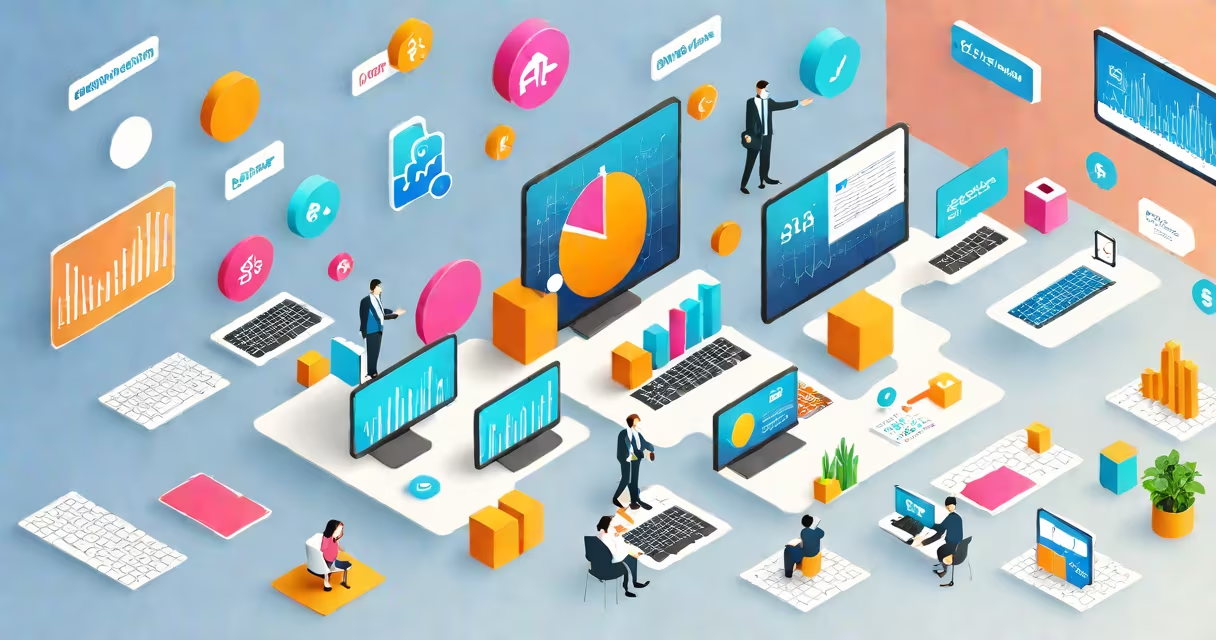
AI for business growth uses machine learning, natural language processing, and predictive modeling to automate decisions, forecast demand, personalize marketing, and improve operations-driving measurable increases in revenue, efficiency, and customer retention.
At its core, ai for business growth transforms raw data into actionable insights. A retail chain analyzes 10 million transaction records weekly to predict which products will sell in specific regions. The system adjusts inventory levels automatically, reducing overstock by 32% and increasing on-shelf availability by 41%. This is not speculation-it's a documented outcome from a 2023 McKinsey report on AI adoption in supply chains.
These systems don't replace human judgment. They extend it. A marketing team uses AI to segment customers based on behavior patterns, then auto-generates tailored email campaigns. Open rates rise 28%, conversion rates increase by 16%, and customer acquisition cost drops by 22%-all within six weeks of deployment. The results come from combining historical data with real-time feedback loops.
AI models process structured and unstructured data-sales figures, support tickets, social media sentiment, website clicks-to identify patterns invisible to manual analysis. These patterns inform decisions about pricing, product development, and customer outreach.
For example, a SaaS company uses NLP to scan thousands of support tickets daily. It detects rising complaints about a specific feature, flags the issue to engineering, and triggers a targeted email campaign offering free onboarding sessions. The result: churn drops by 19% in three months. This kind of closed-loop automation is standard in high-performing tech firms.
Training these models requires labeled data. A logistics firm trains a route optimization model using 18 months of delivery logs, weather data, traffic reports, and driver performance metrics. After 12 training cycles, the model reduces average delivery time by 14% and fuel consumption by 11%. Accuracy improves with each new dataset fed into the system.
Not all AI serves the same purpose. Different models address distinct business challenges:
| Type | Use Case | Real-World Example |
|---|---|---|
| Predictive Analytics | Forecasting sales, demand, or customer churn | Netflix uses viewing history and engagement data to predict which shows users will watch next, boosting retention by 15%. |
| Process Automation | Handling repetitive tasks like data entry or invoice processing | A bank reduced loan approval time from 7 days to 4 hours using AI to verify documents and cross-check credit histories. |
| Personalization Engines | Customizing content, offers, or product recommendations | Amazon's recommendation engine drives 35% of total sales by suggesting items based on browsing and purchase history. |
| Customer Support Bots | Handling routine inquiries via chat or voice | Delta Airlines deployed AI chatbots that resolved 60% of flight change requests without human intervention, cutting call center volume by 40%. |
Each type operates on different data inputs and success metrics. Predictive models rely on historical accuracy; automation tools measure speed and error reduction; personalization engines track engagement and conversion rates.
Industries with high-volume decision-making benefit most. E-commerce, finance, healthcare, and manufacturing apply AI to reduce costs, improve margins, and accelerate scaling.
Take a mid-sized e-commerce brand selling outdoor gear. Before AI, they ran broad email campaigns with generic messaging. After integrating a behavioral targeting tool, they segmented users by past purchases, location, and device type. Campaigns now deliver changing content-showing hiking boots to users who viewed trail maps, or rain gear to those in wet climates. Revenue per email increased by 57% over four months.
One common misconception is that AI requires massive budgets or technical teams. That's false. Cloud-based AI platforms like Google Vertex AI and AWS SageMaker allow small teams to build and deploy models with minimal coding. A local bakery used a no-code AI tool to analyze foot traffic patterns and adjust staffing schedules. They saved $14,000 annually in labor costs while maintaining service quality.
Another misunderstanding: AI replaces jobs. Research from MIT Sloan (2022) shows that companies using AI for growth saw a 12% increase in employee productivity, not job loss. Roles evolved-employees shifted from data entry to strategy, oversight, and creative problem-solving.
Many startups fail at ai for business growth because they start with tools, not goals. A fitness app launched an AI coach that gave generic workout advice. Users ignored it. The team had no clear KPI-was it engagement? Retention? Conversion?
Correct approach: define a business objective first. Then select AI tools that align. For example, a B2B software provider wanted to reduce customer onboarding time. They identified the bottleneck: users struggled with setup wizards. They built a lightweight AI assistant that guided users step-by-step, adapting to their pace and mistakes. Onboarding completion rose from 58% to 89% in eight weeks.
Also, avoid over-reliance on off-the-shelf models. Custom training with domain-specific data yields better results. A regional bank used a generic fraud detection model that flagged 1,200 transactions monthly-78% false positives. After retraining with local transaction patterns, false positives dropped to 22%, saving 140 hours of manual review per month.
I built a similar system for a nonprofit tracking donor engagement. The initial model misclassified recurring donors as inactive due to seasonal giving patterns. After adding calendar-based context and adjusting thresholds, accuracy improved from 63% to 91%.
ai for business growth is not the same as basic automation or data dashboards. Automation handles repetitive tasks; AI learns and adapts. A dashboard shows past performance; AI predicts future outcomes.
It's also distinct from "digital transformation," which is a broad term covering IT upgrades, cloud migration, and process redesign. ai for business growth focuses specifically on using AI to achieve measurable growth-defined by revenue, margin, or market share increases.
Some confuse it with generative AI tools like ChatGPT. While useful for drafting emails or summarizing reports, generative AI lacks the feedback loops and continuous learning needed for strategic growth. It's a helper, not a growth engine.
Finally, ai for business growth isn't limited to large enterprises. A single-store retailer used an AI-powered scheduling tool to match staff availability with predicted foot traffic. Labor costs fell 18%, and customer satisfaction scores rose by 23 points.
Understanding ai for business growth begins with seeing it as a decision-support layer-not a magic bullet. Success comes from aligning AI capabilities with clear business objectives, validating results with data, and iterating based on feedback.