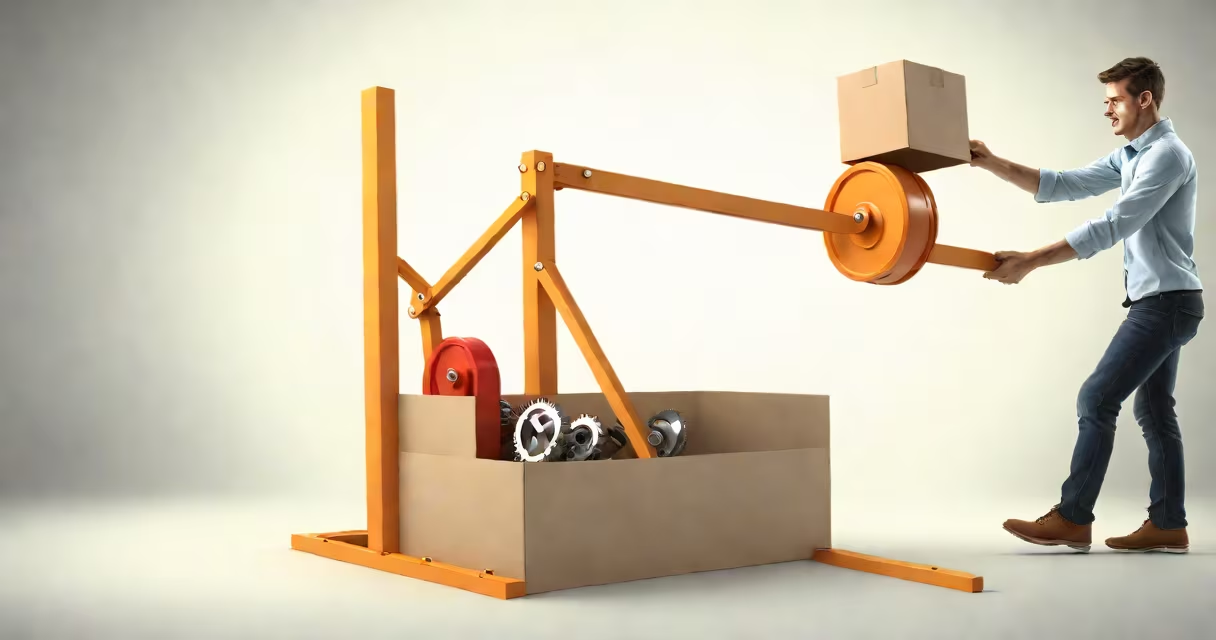
Work energy and simple machines class 9 covers the relationship between force, motion, and energy transfer through basic tools like levers, pulleys, and inclined planes. This topic introduces how mechanical advantage reduces effort while conserving energy.
Simple machines are devices that change the direction or magnitude of a force. They don't create energy-they redistribute it. When you push a box up a ramp, you apply less force than lifting it straight up, but over a longer distance. The work done remains the same: force × distance. This principle forms the foundation of work energy and simple machines class 9.
Energy is the capacity to do work. In class 9 physics, work is calculated as force applied over a distance in the direction of the force. If you push a 10 N box 5 meters horizontally, you've done 50 joules of work. Energy transforms from one form to another-mechanical to heat, for example-through friction or resistance.
Work is measured in joules (J). One joule equals one newton-meter. If a person applies 20 N of force to move a crate 3 m across a floor, they perform 60 J of work. This is input work-the energy you supply. Output work is the useful work done, such as lifting the crate vertically against gravity.
Efficiency measures how much of the input work becomes output work. A machine with 80% efficiency converts 80 J of input into 80 J of output for every 100 J input. Real machines lose energy to friction, sound, and heat. For example, a pulley system may require 120 J of input to lift a box that gains only 90 J of potential energy-efficiency is 75%.
The law of conservation of energy applies: energy cannot be created or destroyed. In simple machines, input energy equals output energy plus losses. A well-lubricated lever may achieve 90% efficiency, meaning only 10% of the energy is lost to heat and wear.
There are six classical simple machines: lever, wheel and axle, pulley, inclined plane, wedge, and screw. Each alters force or distance to make tasks easier.
| Machine | How It Works | Real-World Example |
|---|---|---|
| Lever | Rotates around a fulcrum; multiplies force based on arm length | Seesaw, crowbar |
| Pulley | Changes direction of force; multiple pulleys reduce required force | Flagpole hoist, window blinds |
| Inclined Plane | Reduces vertical force needed by increasing distance | Ramp, staircase |
| Wedge | Converts force into splitting or piercing action | Knife, axe |
| Screw | Rotational version of inclined plane; holds materials together | Wood screw, jar lid |
| Wheel and Axle | Rotates to multiply torque; small force on large wheel moves load | Doorknob, bicycle pedal |
Each machine provides mechanical advantage-the ratio of output force to input force. A lever with a 3:1 mechanical advantage lets you lift a 300 N weight with only 100 N of effort. But you must move your hand three times farther than the load moves.
Non-obvious fact: mechanical advantage doesn't increase energy-it redistributes it. A 5:1 lever reduces force fivefold but increases distance traveled by five times. Total work stays constant, assuming no friction.
Many students think simple machines "create" energy or "save" work. They don't. A pulley system doesn't reduce the total work needed-it spreads it over time or changes direction. You still do the same amount of work, just with less force over more distance.
Another misconception: all machines are efficient. In reality, even well-designed ones lose energy. A bicycle chain loses about 5-10% of input power to friction. A poorly maintained pulley can waste 30% of effort as heat.
Some confuse work with effort. Effort is subjective; work is measurable. Pushing a wall for 10 minutes expends effort but does zero work because the wall doesn't move. Work requires displacement in the direction of force.
Consider a 50 kg box being pushed up a 3 m long ramp inclined at 30°. The height gained is 1.5 m. The gravitational force is mass × gravity = 50 kg × 9.8 m/s² = 490 N. Work done against gravity is 490 N × 1.5 m = 735 J.
If a student pushes the box with 250 N of force along the ramp (3 m long), input work is 250 N × 3 m = 750 J. Output work is 735 J. Efficiency = (735 / 750) × 100 = 98%. The remaining 15 J is lost to friction.
This example shows how work energy and simple machines class 9 applies to everyday tasks. The ramp reduces the force needed from 490 N (lifting straight up) to 250 N, making the task feasible for a single person.
I once observed a group of students use a 2-meter plank (inclined plane) to roll a 20 kg barrel onto a truck bed. The plank was placed at a 15° angle. Calculating the ideal mechanical advantage (length ÷ height), they found it was 3.86. With friction, actual mechanical advantage dropped to 2.9. They adjusted their pushing force accordingly. The experiment confirmed that real-world machines never reach ideal efficiency.
Work energy and simple machines class 9 differs from thermodynamics. While both involve energy, thermodynamics deals with heat, entropy, and irreversible processes. Simple machines focus on mechanical systems with minimal thermal loss.
Also, simple machines aren't always faster. A lever may reduce force but take longer to complete the movement. Speed and efficiency are separate concepts. A high mechanical advantage doesn't guarantee speed.
Finally, energy transfer in machines is not instantaneous. Forces propagate through materials at finite speeds. In a rope-pulley system, tension builds gradually-not instantly. This delay matters in engineering but is often ignored in class 9 problems.
Understanding work energy and simple machines class 9 helps explain everything from opening a jar to designing cranes. It's not just theory-it's how humans have moved heavy loads since ancient times.