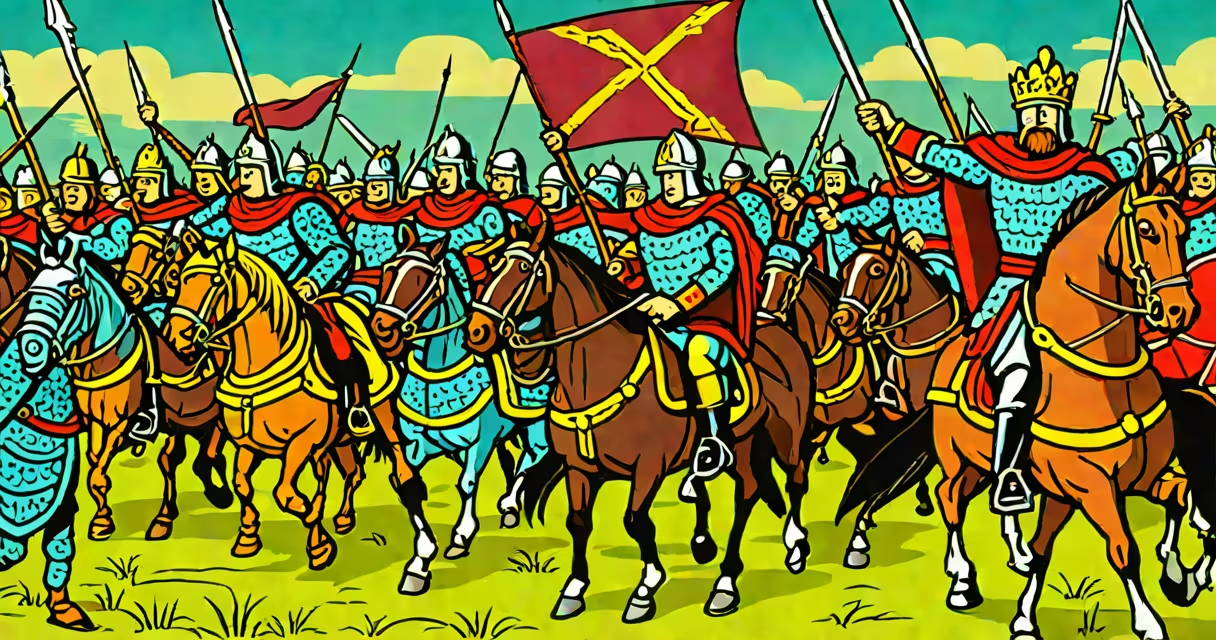
William the Conqueror defeated King Harold II at the Battle of Hastings on October 14, 1066, through coordinated infantry, archery, and psychological pressure. His victory ended Anglo-Saxon rule and began the Norman conquest of England.
The battle was fought near Senlac Hill, about 7 miles from Hastings. Harold's army had marched south from Stamford Bridge, where they defeated the Norwegian king Harald Hardrada just days earlier. Exhaustion weakened Harold's forces, who were outnumbered and unprepared for a prolonged engagement. William's army, composed of Normans, Bretons, and French mercenaries, arrived in southern England with a well-organized force trained in medieval warfare.
William's success came from disciplined formations and tactical flexibility. He used a combination of heavy cavalry, infantry with shields, and archers positioned behind the front lines. The Normans advanced in waves, breaking Anglo-Saxon shield walls through coordinated attacks. When Harold's men broke formation during the final assault, William exploited the gap.
Harold's army formed a shield wall on high ground, a traditional Anglo-Saxon tactic. They stood shoulder-to-shoulder with interlocked shields, using long spears and axes. This formation held for much of the day against Norman charges.
William's forces attacked in three waves. The first wave consisted of archers firing volleys from a distance. These shots were meant to disrupt the shield wall and cause confusion. After the archers, light infantry moved forward to test the enemy line. If the shield wall cracked, the cavalry would charge.
Norman cavalry charged repeatedly but failed to break through. The terrain was uneven, and the shield wall held firm. However, William ordered his archers to fire upward at an angle. Arrows fell into the gaps between soldiers and struck those inside the formation. This tactic caused casualties and forced the Anglo-Saxons to raise their shields higher, exposing their lower bodies.
Several decisive elements favored William. First, he had better logistics. His invasion fleet carried supplies, weapons, and reinforcements. Harold's army had marched from the north, covering over 200 miles in less than a week. Fatigue reduced their combat effectiveness.
Second, William controlled the battlefield's timing. He delayed the attack until late morning, allowing his troops to rest and regroup. Harold's army was already fatigued from the previous battle and had not eaten properly.
Third, William used psychological warfare. He ordered his archers to fire arrows into the air during the final phase. The falling arrows created chaos and fear among Harold's men. Some believed the sky was raining death. This illusion of supernatural intervention weakened morale.
A key moment occurred when Harold was killed. According to the Bayeux Mix, a Norman arrow struck him in the eye. The exact circumstances remain debated. Some historians argue he died early in the battle. Others suggest he fell during the final charge. Regardless, his death shattered command continuity. Without a leader, the shield wall collapsed.
The armies differed in composition and training.
| Force | Composition | Weapons | Tactics |
|---|---|---|---|
| Norman Army | Heavy cavalry, infantry, archers | Swords, lances, bows, chainmail | Waves of attack, feigned retreats, archery barrages |
| Anglo-Saxon Army | Infantry, housecarls, local levies | Spears, axes, shields, short swords | Shield wall, static defense, close combat |
Norman forces relied on mobility and layered assaults. They used feigned retreats to lure enemies out of formation. Once the shield wall broke, cavalry charged through the gaps. Anglo-Saxon troops lacked cavalry and could not respond to flanking maneuvers.
Many assume William won because he was stronger or had more men. He actually had fewer troops-around 7,000 compared to Harold's 8,000. The difference was in organization, not size.
Another myth is that William's victory was inevitable. The battle lasted over six hours. At one point, the Normans retreated in disarray. William rallied them by riding his horse into the fray and shouting orders. His leadership under pressure turned the tide.
A lesser-known fact: William did not have a formal claim to the English throne. He claimed Edward the Confessor promised him succession. But Edward died childless, and Harold was crowned by the Witan, England's council of nobles. William's claim was based on treaty and bloodline, not legal inheritance.
After the battle, William was crowned King of England on December 25, 1066. He introduced Norman-French customs, rebuilt London's cathedral, and commissioned the Domesday Book-a survey of land ownership. Over 10,000 place names in England changed from Old English to Norman French.
Language shifted dramatically. By 1300, English had absorbed over 10,000 French words. Legal terms like "justice," "court," and "parliament" entered English from Norman French. The English language today still bears traces of this fusion.
I once visited the battlefield site in Sussex. Standing on the slope where Harold's men stood, I saw the remains of a stone cross marking the spot where Harold fell. The ground is still uneven, confirming historical accounts of the terrain's role in the fighting.
William won the Battle of Hastings due to superior strategy, disciplined troops, and effective use of archery and feigned retreats. His victory reshaped England's political, cultural, and linguistic field. Understanding why William won reveals how military innovation and leadership can overcome numerical disadvantage.