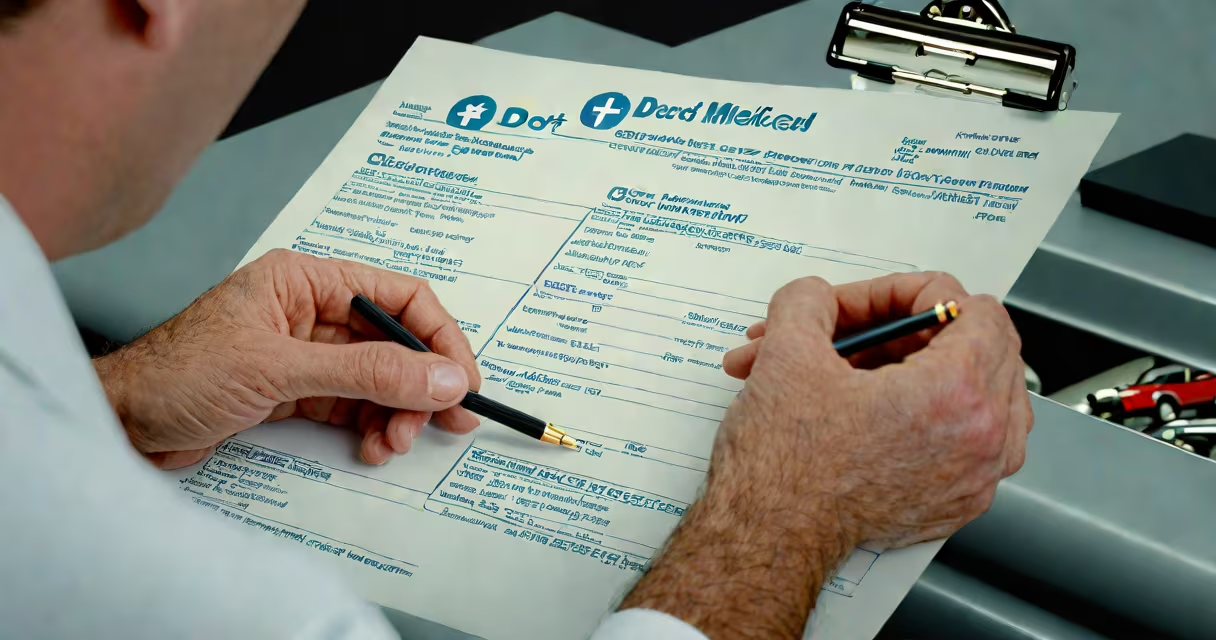
Dot medical certification is a federally required physical examination conducted by a licensed medical examiner to determine whether a commercial motor vehicle operator meets the minimum health and physical standards set by the Federal Motor Carrier Safety Administration (FMCSA).
The process confirms that a driver can safely operate a commercial vehicle without posing a risk due to medical conditions such as uncontrolled hypertension, sleep apnea, or vision impairment. A valid certificate is required for anyone operating a commercial vehicle in interstate commerce.
Without this certification, a driver cannot legally operate a commercial vehicle across state lines. The FMCSA mandates that the exam be performed by a certified medical examiner listed on the National Registry of Certified Medical Examiners (NRCME).
The DOT medical exam evaluates seven key areas: vision, hearing, blood pressure, cardiovascular health, neurological function, musculoskeletal ability, and mental health. Each area is assessed against specific thresholds outlined in the FMCSA's Medical Examiner's Handbook.
For example, visual acuity must be at least 20/40 in each eye, with or without corrective lenses. Hearing must allow detection of a whispered voice at six feet. Blood pressure above 140/90 mmHg may require treatment and follow-up before certification is issued.
The examiner completes Form MCSA-5876, the Medical Examiner's Report, which includes findings, recommendations, and a decision on certification. The form is then submitted to the NRCME database, where it becomes part of the national record accessible to employers and enforcement agencies.
Only physicians, nurse practitioners, physician assistants, and certain other licensed healthcare professionals approved by the FMCSA can serve as certified medical examiners. These providers must complete a training course and pass an exam administered by the National Registry of Certified Medical Examiners.
Examiners must be licensed in the state where they perform exams and maintain current credentials. They are not employed by the FMCSA but are independently authorized to conduct evaluations under federal guidelines.
There are currently over 13,000 active certified medical examiners across the United States. Each examiner is assigned a unique identification number used to validate the authenticity of the medical certification.
| Type of Examiner | Required License | Scope of Practice |
|---|---|---|
| Physician (MD or DO) | State medical license | Full authority to certify or deny |
| Nurse Practitioner (NP) | State NP license + prescriptive authority | Can certify if state law allows |
| Physician Assistant (PA) | State PA license + supervision agreement | Varies by state regulation |
Every commercial driver in the U.S. who operates a vehicle transporting hazardous materials, carrying more than eight passengers, or weighing over 10,001 pounds must have a valid DOT medical certification.
Employers, including trucking companies and transit agencies, require this certification before hiring or assigning a driver to a route. Failure to maintain certification results in immediate suspension from driving duties.
A real-world example: In 2022, a long-haul trucker in Texas was pulled over for a routine inspection. His DOT certification had expired. He was cited for operating without valid medical documentation and fined $1,200. The violation led to a 30-day suspension of his commercial driver's license.
Many people mistake DOT medical certification for a standard physical or a drug test. It is neither. While a drug screen may be administered separately, the DOT exam focuses solely on physical and mental fitness to drive safely.
Another misconception is that certification lasts indefinitely. In reality, most certifications are valid for two years if no health issues are detected. If a condition like diabetes or epilepsy is present, the examiner may issue a one-year certification with restrictions.
The FMCSA does not issue the certification itself. The medical examiner signs the form and enters the data into the NRCME system. The driver receives a copy, but the official record is stored digitally.
One non-obvious fact: A driver can be denied certification based on a single abnormal finding-even if health appears good. For example, a blood pressure reading of 160/100 mmHg triggers automatic disqualification until treated and re-evaluated.
I once observed a DOT physical exam at a truck stop in Oklahoma. The medical examiner, a retired family physician, reviewed the driver's history, measured blood pressure, tested vision with a Snellen chart, and asked about sleep patterns. When the driver admitted to snoring loudly and feeling fatigued during shifts, the examiner ordered a sleep study. The driver was disqualified until he completed treatment for obstructive sleep apnea.
This case highlights how the exam isn't just a box-checking exercise-it identifies risks that could lead to accidents. The FMCSA estimates that 20% of fatal crashes involving commercial vehicles involve a driver with an untreated medical condition.
Each certification serves a distinct purpose. DOT medical certification is unique in that it directly impacts public safety through regulatory compliance.
Understanding what is dot medical certification means recognizing it as a mandatory, federally enforced check on driver health. It's not optional. It's not a formality. It's a requirement designed to prevent accidents caused by preventable medical issues.