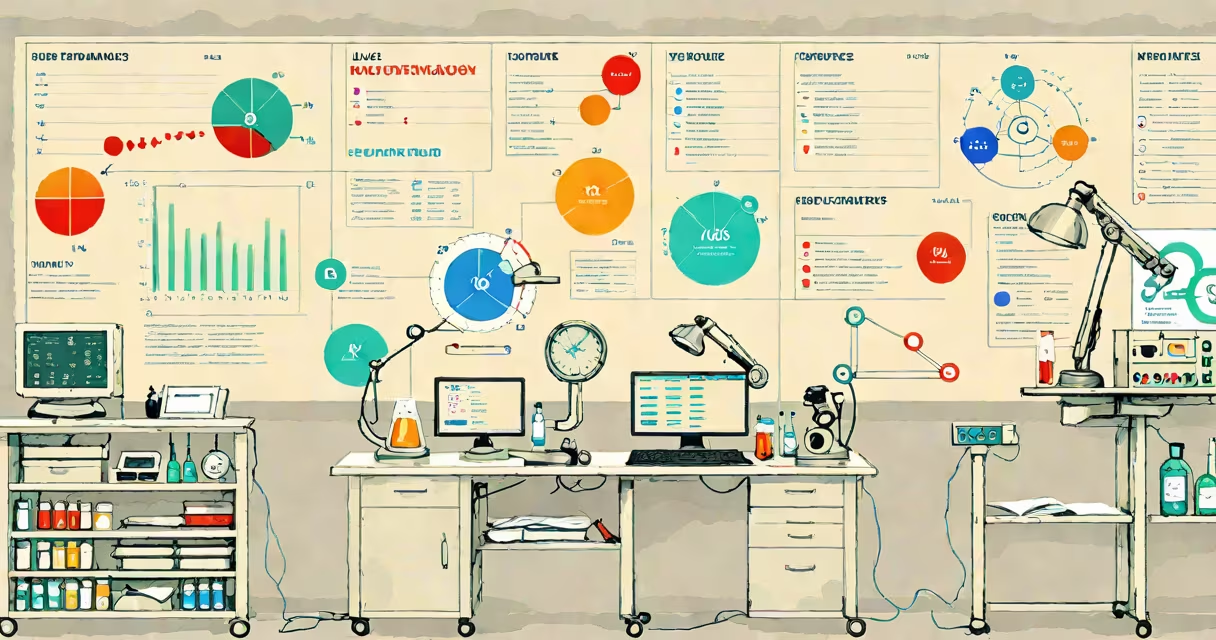
A laboratory information system (LIMS) is a software platform that automates and tracks the entire lifecycle of samples and tests in clinical, research, and industrial laboratories. It captures data from sample collection through analysis, result reporting, and archiving, ensuring accuracy, compliance, and traceability.
LIMS integrates with instruments, electronic health records, and quality control systems to eliminate manual entry, reduce human error, and support regulatory standards such as CLIA, HIPAA, and ISO 17025. It enables labs to process thousands of samples daily while maintaining audit trails and metadata for each step.
For example, a hospital blood testing lab using LIMS receives a patient's blood draw, assigns a unique barcode to the sample, logs the request, routes the specimen to the correct analyzer, records the result, flags abnormal values, and sends the report to the clinician-all within minutes and with full documentation.
LIMS operates as a central database that controls every stage of a lab's operations. When a sample enters the system, it is registered with metadata: patient ID, test type, collection time, and handling instructions. The system assigns a unique identifier-usually a barcode-and stores the chain of custody.
Once logged, the system schedules tests based on priority, equipment availability, and staff workload. As instruments complete analyses, they send results directly to the LIMS via API or file transfer. The system validates results against predefined ranges, flags outliers, and triggers alerts for critical values.
After validation, reports are generated and sent to authorized users. All actions are timestamped and logged, creating a permanent record. This traceability is essential during audits or investigations into test discrepancies.
LIMS consists of five core modules: sample management, test scheduling, instrument integration, result reporting, and compliance tracking. These components work together to maintain data integrity and operational efficiency.
There are three primary deployment models:
| Type | Deployment | Use Case | Example |
|---|---|---|---|
| On-Premise | Installed locally on lab servers | High-security environments with strict data control | Hospitals with internal IT teams |
| Cloud-Based | Hosted on remote servers (AWS, Azure) | Scalable labs needing rapid deployment | Pharmaceutical R&D labs with global teams |
| Hybrid | Combines local and cloud storage | Regulated labs requiring on-site backups | Clinical reference labs with federal oversight |
Some LIMS platforms specialize in specific domains. For instance, genomics LIMS supports high-throughput sequencing workflows, managing DNA extraction logs, library prep steps, and variant calling pipelines. A clinical microbiology LIMS handles antibiotic susceptibility testing and infection control reporting.
LIMS is standard in regulated environments. Clinical labs must comply with CLIA (Clinical Laboratory Improvement Amendments) and HIPAA (Health Insurance Portability and Accountability Act), which require secure, auditable records of all test activities. LIMS helps every test is traceable to the person who performed it, the instrument used, and the date and time of processing.
Research institutions rely on LIMS to manage complex, multi-step experiments. A university genetics lab studying cancer mutations uses LIMS to track tissue samples from biopsy to sequencing, store raw FASTQ files, and link results to patient phenotypes. Without LIMS, cross-referencing data across hundreds of experiments would take weeks.
In pharmaceutical development, LIMS supports Good Manufacturing Practice (GMP) compliance. During drug trials, every batch of compound must be tested for purity, potency, and stability. LIMS logs every test, stores calibration data for instruments, and generates audit-ready reports for FDA submissions.
LIMS is often confused with other health IT systems. It is not the same as an electronic health record (EHR), which contains patient medical histories and treatment plans. While LIMS may pull patient data from an EHR, it focuses solely on lab-specific processes-not clinical care.
Similarly, LIMS differs from a health information system (HIS), which manages administrative functions like billing, scheduling, and inventory. HIS covers the hospital side; LIMS covers the lab side. A single institution may use both systems, but they serve distinct purposes.
Another misconception is that LIMS only benefits large labs. In reality, small diagnostic clinics with fewer than 100 daily tests still gain significant advantages. One community lab in rural Oregon reduced turnaround time for strep tests from 48 hours to under 6 hours after implementing a cloud-based LIMS. They also cut duplicate testing by 30% due to better sample tracking.
LIMS is not a replacement for skilled lab technicians. It enhances their work by handling repetitive tasks-like labeling, routing, and reporting-but cannot interpret biological significance or troubleshoot instrument failures. Human oversight remains essential.
In 2021, the New York City Department of Health deployed a cloud-based LIMS to manage SARS-CoV-2 testing during the pandemic. Before implementation, the lab processed 1,200 tests per day manually, with frequent delays and data entry errors.
After deploying the LIMS, the lab automated sample registration, instrument integration, and result reporting. Each test was assigned a barcode scanned at every stage. Results were automatically validated against known thresholds and flagged for review if abnormal.
The system reduced average test turnaround time from 24 hours to 4 hours. Error rates dropped from 5.3% to 0.7%. During peak demand, the lab scaled capacity from 1,200 to 5,000 tests per day without hiring additional staff.
This success was documented in a 2022 study published by the Journal of Clinical Microbiology, which cited LIMS as a key enabler of public health response agility during outbreaks.
Understanding what is a laboratory information system reveals its role as a foundational tool in modern lab operations. It is not a luxury-it is a necessity for accuracy, compliance, and scalability in healthcare, research, and industry.