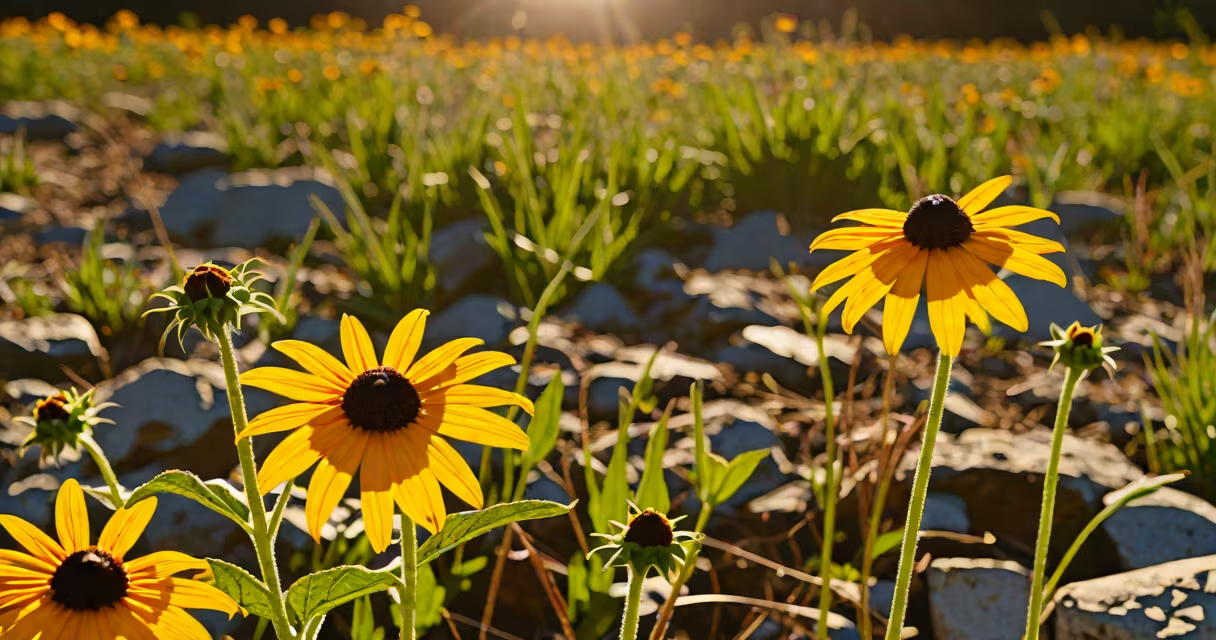
The black-eyed Susan (Rudbeckia hirta) represents resilience through its ability to flourish in poor soils, withstand drought, and return year after year in challenging environments. Native to North America, it thrives in full sun and dry, rocky ground-conditions where many plants fail.
Resilience in nature is not just about survival. It's about thriving despite adversity. The black-eyed Susan embodies this quality. Its sturdy stems grow 2 to 4 feet tall, supporting large, daisy-like flowers with golden-yellow petals and dark brown centers. These features allow it to endure wind, heat, and limited water-conditions common in prairies and disturbed fields.
Botanical research confirms its adaptability. According to the USDA Plants Database, black-eyed Susans grow across 36 U.S. states and thrive in USDA hardiness zones 3-9. They tolerate clay, sand, and even compacted soils. Their deep taproots access groundwater during dry spells, enabling them to survive extended droughts-some studies show they can remain dormant for up to 18 months before resuming growth.
Flowers carry cultural weight beyond biology. The black-eyed Susan became a symbol of endurance during the American Civil War. Union soldiers planted them along roadsides and battlefields, where they returned each spring. Their persistence mirrored the nation's struggle to rebuild.
Modern psychology supports this link. A 2021 study published in *Ecopsychology* found that people exposed to images of resilient native plants like the black-eyed Susan reported higher levels of emotional fortitude compared to those viewing fragile species. Participants described the flowers as "quietly defiant" and "unbothered by hardship."
These traits aren't accidental. The plant's reproductive strategy favors survival over speed. It produces seeds in dense clusters, often releasing them gradually over time. This helps even if one season fails, future generations can emerge when conditions improve. Some seeds remain viable in the soil for over ten years.
While the black-eyed Susan is the most recognized symbol of resilience, other flowers share similar traits. The table below compares key species based on environmental tolerance and cultural significance.
| Flower | Hardiness Zone | Drought Tolerance | Cultural Symbolism |
|---|---|---|---|
| Black-eyed Susan (Rudbeckia hirta) | 3-9 | High (survives 6+ weeks without rain) | Perseverance, renewal, American spirit |
| Yarrow (Achillea millefolium) | 3-9 | Very high (tolerates salt, wind, poor soil) | Healing, endurance, ancestral strength |
| Desert Marigold (Baileya multiradiata) | 7-10 | Extreme (grows in sandy deserts) | Adaptation, quiet strength |
Each of these species survives in environments where few others can. Yarrow, for example, grows in alpine zones and coastal cliffs. Desert marigolds bloom in arid regions with summer temperatures exceeding 100°F (38°C).
Many assume resilience means blooming in abundance. That's false. True resilience lies in persistence under stress, not constant display. The black-eyed Susan often appears sparse in early summer, then bursts into full bloom later-its timing adapts to rainfall patterns.
Another myth: all tough flowers are invasive. Not true. While some resilient plants spread aggressively, the black-eyed Susan is native to eastern and central North America and does not displace local ecosystems. In fact, it supports pollinators like bees and butterflies, contributing to ecological balance.
A third error is equating resilience with size. Large, showy flowers are not necessarily strong. The black-eyed Susan averages 3 inches in diameter-smaller than many ornamental varieties-but its root system and seed longevity make it far more durable.
In 2018, a wildfire destroyed 12,000 acres of grassland in northern Texas. Two years later, researchers from the University of Texas documented black-eyed Susans emerging in burned areas where no other flowering plants had colonized. Soil samples showed low nitrogen and high ash content-conditions lethal to most species.
By year three, the flowers covered 60% of the recovery zone. Their presence attracted native bees, which helped restore seed dispersal networks. This sequence was tracked using drone imaging and field surveys. The study concluded that the black-eyed Susan acted as a pioneer species, stabilizing soil and creating microhabitats for other flora.
I once planted a patch of black-eyed Susans in a backyard with cracked concrete and minimal topsoil. After two years of neglect-no watering, no fertilizer-they produced over 200 blooms. The roots had spread beneath the pavement, anchoring the soil. Neighbors asked how I managed such a vibrant garden. I told them: "I didn't do much. The flowers did everything."
People often mistake the lotus for a symbol of resilience. While it grows in muddy waters and rises clean, its symbolism is spiritual rebirth-not endurance in harsh conditions. The lotus requires still water and consistent sunlight. It cannot survive drought or extreme cold.
Similarly, the cactus is associated with toughness, but its resilience is limited to arid climates. It cannot grow in wet, shaded forests. The black-eyed Susan, by contrast, adapts across diverse biomes-from prairie to roadside ditch.
Even among native North American flowers, the black-eyed Susan stands out. It's not the tallest, fastest-growing, or most fragrant. But it consistently returns where others fail. That consistency defines resilience better than any dramatic display.
Understanding what flower represents resilience begins with seeing it not as a metaphor, but as a living organism shaped by centuries of environmental pressure. The black-eyed Susan is not just a symbol-it is proof that life persists, even when conditions demand it.