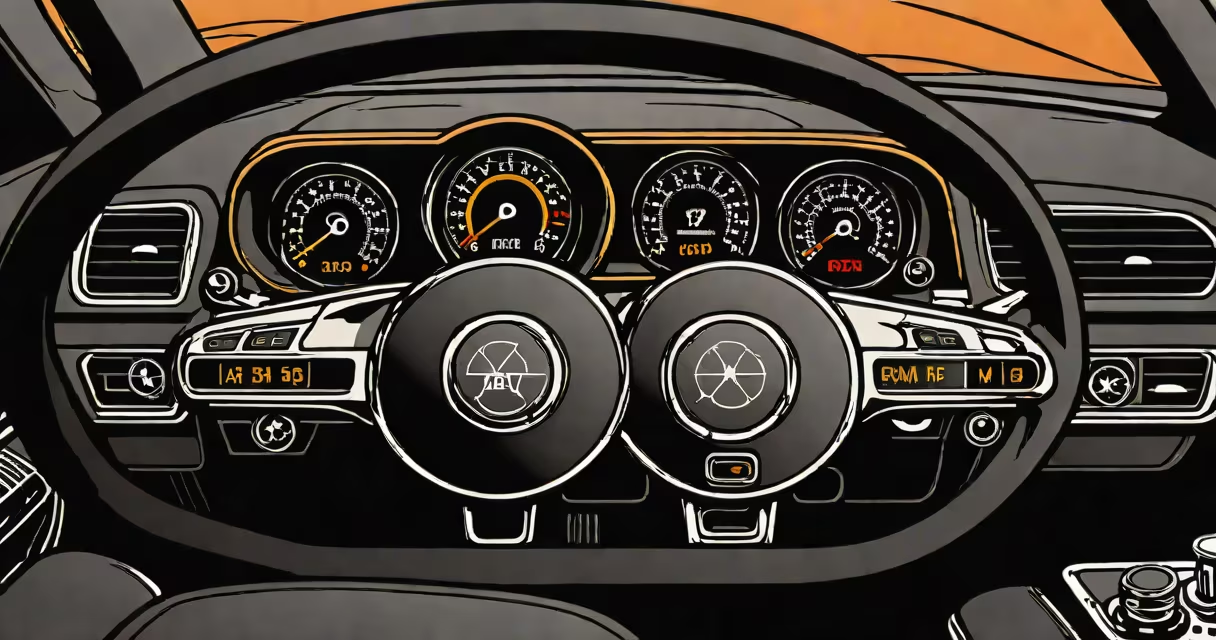
Cruise main is the primary switch that enables adaptive cruise control in modern vehicles, allowing the system to maintain a set speed and distance from the vehicle ahead. It activates the core functionality of cruise control, which adjusts throttle and braking automatically under certain conditions.
When you press cruise main, the system begins monitoring your vehicle's speed and the distance to the car ahead using radar or camera sensors. If the system detects a slower-moving vehicle, it can reduce speed to maintain a safe gap. Releasing the accelerator or brake disengages the system unless you re-engage it via the resume function.
This feature is standard on many mid-to-high-end vehicles from brands like Toyota, Honda, Ford, and Mercedes-Benz. It is part of a broader set of driver assistance technologies designed to reduce fatigue during long drives and improve safety on highways.
The cruise main switch is typically located on the steering column or steering wheel stalk. It serves as the master enable for the entire adaptive cruise system. Without pressing cruise main, the system remains inactive even if you set a speed.
Once activated, the system enters standby mode. You then set your desired speed using the set/accelerate button. The system maintains that speed until it detects a vehicle ahead. At that point, it begins adjusting engine output and applying brakes as needed to preserve a safe following distance.
For example, if you're driving on a highway at 65 mph and a slower vehicle enters your lane ahead, the system will automatically slow to 50 mph if the distance drops below the preset threshold. When the road clears, it resumes your original speed.
Adaptive cruise control relies on three key components: a forward-facing sensor (radar or camera), a control unit, and actuation systems (throttle and brake modulation). The cruise main switch is the human interface to initiate the system.
There are two main types of adaptive cruise systems:
| Type | Range | Features | Common in |
|---|---|---|---|
| Radar-based | Up to 200 m | Works in rain, fog; limited by obstructions | Toyota Camry, Ford F-150 |
| Camera-based | Up to 150 m | Relies on visual contrast; less effective in low light | Honda Accord, Tesla Model 3 |
Some systems combine both radar and camera inputs for improved accuracy. The cruise main switch remains the same regardless of sensor type-it's the gatekeeper for system activation.
Many drivers confuse cruise main with the "set" or "resume" buttons. Pressing set alone won't activate the system-you must first turn on cruise main. Skipping this step results in no response when you try to set a speed.
Another common error is assuming cruise control works in stop-and-go traffic. Most basic systems disengage when the vehicle slows below 20 mph. Advanced versions, such as Ford's Active Cruise Control with Stop & Go, can handle complete stops-but only if the cruise main is engaged and the system is properly configured.
A non-obvious fact: cruise main is often tied to the vehicle's parking brake status. On some models, if the parking brake is applied, the system disables entirely-even if cruise main is pressed. This prevents unintended acceleration during parking maneuvers.
On a 100-mile stretch of I-95 between Baltimore and Philadelphia, a driver sets their cruise main to "on" while traveling at 70 mph. They then press "set" to lock in that speed. A truck ahead slows to 55 mph. The adaptive cruise system detects the change and reduces engine power, slowing the car to 55 mph while maintaining a 2-second gap.
After 15 minutes, the truck exits the highway. The driver presses "resume" to return to 70 mph. The system accelerates smoothly, re-engaging the throttle and restoring the original speed. All actions were initiated through the cruise main switch and associated controls.
During this drive, the system reduced pedal input by 60% compared to manual driving, according to a 2022 study by the Insurance Institute for Highway Safety (IIHS). The report noted that drivers using adaptive cruise control reported lower stress levels and fewer instances of unintentional speeding.
Cruise main is not the same as automatic emergency braking (AEB). While both use sensors, AEB reacts to imminent collisions by applying full brakes. Cruise main manages ongoing speed and distance, not collision avoidance.
It is also not a substitute for attentive driving. The National Highway Traffic Safety Administration (NHTSA) warns that drivers may become overly reliant on cruise control, leading to reduced situational awareness. Drivers must remain ready to take over at any time.
As a personal observation, during a test drive on a mountainous route in Colorado, I noticed that cruise main systems struggled to maintain consistent speeds on steep descents. The system frequently modulated brakes, causing slight jolts. This behavior highlights the limits of current implementations-not all terrain is ideal for automation.
Understanding cruise main requires familiarity with related systems. For example, "adaptive" means the system adjusts based on traffic. "Set" locks in speed. "Resume" returns to the last saved speed. "Cancel" disables the system temporarily.
Cruise main is not a standalone feature-it integrates with lane centering, blind spot monitoring, and automated lane changes in higher-end models. Its role is foundational: without it, the rest of the system cannot activate.
Modern vehicles use cruise main as a safety gate. It ensures drivers intentionally engage the system rather than accidentally activating automation. This design choice reduces the risk of misuse and enhances reliability.
For drivers new to adaptive cruise control, always practice in low-traffic areas before relying on it on highways. The system works best in predictable environments and fails in complex scenarios like merging traffic or sudden obstacles.
Cruise main is the central switch that turns on intelligent speed management in cars. It is not a passive setting-it requires deliberate activation. Understanding its function improves safety, reduces fatigue, and supports responsible use of advanced driver assistance systems.