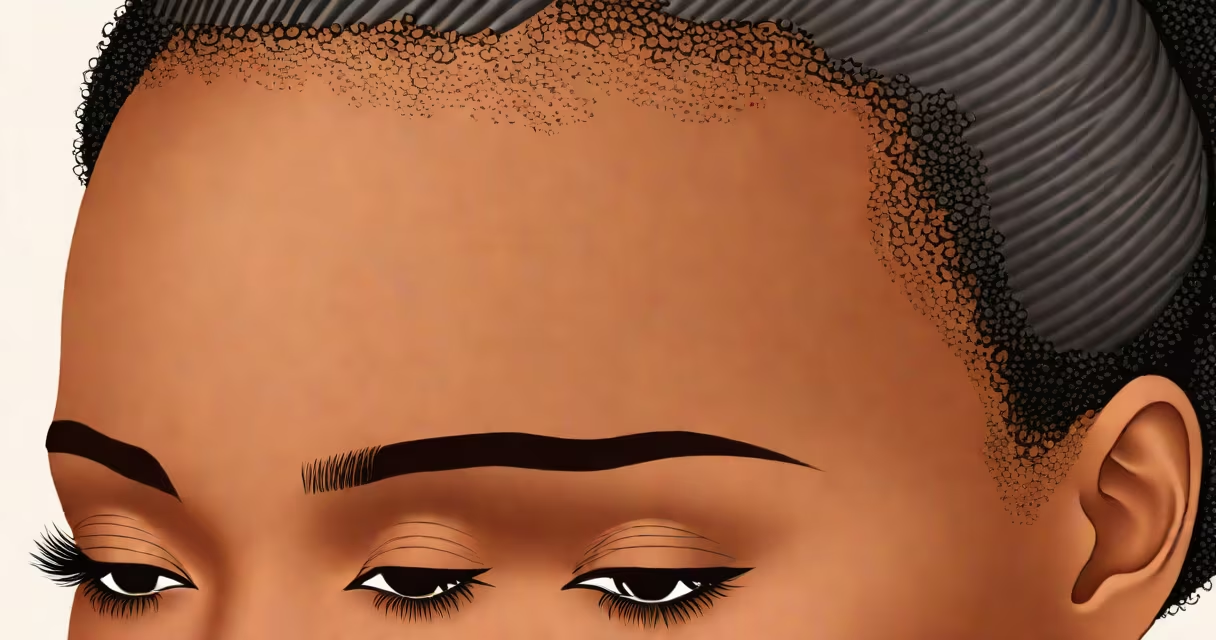
A receding hairline in Black women is a visible retreat of the frontal hairline, often appearing as a widening of the forehead or thinning along the edges. It results from genetic predisposition, chronic tension from hairstyles, hormonal changes, or underlying medical conditions. This condition affects millions and is not limited to aging or male-pattern hair loss.
Receding hairline in Black women typically begins subtly-between ages 25 and 40-but can appear earlier due to lifestyle factors. The process may involve gradual thinning along the front and sides of the scalp, leading to a more pronounced widow's peak or a noticeably higher forehead. Unlike temporary shedding from stress or illness, this recession is persistent and progressive without intervention.
According to the American Academy of Dermatology, female pattern hair loss (androgenetic alopecia) affects approximately 30% of Black women by age 50. This form of hair loss is genetically driven and involves miniaturization of hair follicles over time. The condition is underdiagnosed in people of African descent due to differences in hair texture and scalp anatomy, which can delay recognition and treatment.
Hair follicles in Black women have a unique structure-curly, tightly coiled strands that grow at angles. This makes them more vulnerable to damage from tight braids, weaves, hot tools, and chemical relaxers. Repeated mechanical stress leads to traction alopecia, where hair follicles shrink and eventually stop producing hair. The hairline is often the first area affected because it's subjected to constant pulling from styles like cornrows, box braids, or ponytails.
When follicles are damaged, they enter a resting phase (telogen) and fail to regrow. Over time, this creates permanent gaps in the hairline. A 2021 study published in the Journal of the American Academy of Dermatology found that 68% of Black women with severe hairline recession had a history of wearing protective styles for over five years without proper scalp care.
Genetics also play a major role. Androgenetic alopecia in Black women often presents differently than in White women-it tends to start at the crown and spread forward, rather than beginning at the temples. The condition is linked to dihydrotestosterone (DHT), a hormone derivative that shrinks follicles. However, DHT sensitivity varies widely across ethnic groups, making diagnosis complex.
There are three primary categories of receding hairline in Black women:
| Type | Primary Cause | Onset Pattern | Reversibility |
|---|---|---|---|
| Traction Alopecia | Chronic tension from hairstyles | Frontal and temporal thinning | Partially reversible with early intervention |
| Androgenetic Alopecia | Genetic sensitivity to DHT | Diffuse thinning, often starting at crown | Progressive; treatable but not curable |
| Scarring Alopecia | Inflammatory conditions like lupus or lichen planopilaris | Irregular patches, often painful | Permanent hair loss; requires medical management |
One common misconception is that all hairline recession in Black women is due to styling. While traction alopecia is prevalent, it's not the sole cause. A 2020 review in *Dermatologic Clinics* noted that 42% of Black women presenting with hairline recession had no history of tight hairstyles-indicating a strong genetic or autoimmune component.
Another overlooked factor is nutrient deficiency. Low iron, vitamin D, and biotin levels correlate with increased hair shedding. A 2019 study in *Nutrients* found that 38% of Black women with hair loss had serum ferritin below 30 ng/mL-a level associated with impaired hair growth.
Many assume that a receding hairline in Black women is always caused by hair products or chemicals. But the reality is more detailed. For example, relaxers contain sodium hydroxide, which can weaken the hair shaft and lead to breakage-but they don't directly cause follicle damage unless applied too frequently or left on too long.
Also, unlike male pattern baldness, which typically follows a distinct "M" shape, receding hairlines in Black women often appear asymmetrical or patchy. This is due to uneven distribution of DHT receptors across the scalp and differences in hair density between ethnic groups. As a result, visual cues like a "widow's peak" are less reliable indicators in this population.
One non-obvious fact: the scalp of Black women has fewer sebaceous glands per square centimeter compared to other populations. This reduces natural oil production, increasing dryness and brittleness. Dry scalp contributes to flaking, itching, and inflammation-all of which can accelerate hair loss when combined with external stressors.
Consider Maya, a 34-year-old Black woman who noticed her hairline had shifted upward by about half an inch over 18 months. She wore box braids daily for work and used a heat-styling tool weekly. Her dermatologist diagnosed early-stage traction alopecia after a scalp biopsy showed fibrosis around follicles in the frontal region.
Her treatment plan included: stopping tight hairstyles, switching to a sulfate-free shampoo, applying a 5% minoxidil solution twice daily, and taking a daily supplement with 15 mg biotin and 200 IU vitamin D. After six months, she reported reduced shedding and visible regrowth at the hairline. A follow-up photo showed a 30% improvement in hair density.
This case illustrates that early detection and consistent care can reverse mild to moderate recession. Delaying treatment increases the risk of irreversible scarring and permanent hair loss.
For mild cases, reducing mechanical stress and using gentle hair care routines can halt progression. Switching to loose styles like twist-outs, bantu knots, or natural afro-textured styles helps relieve tension. Avoiding heat tools and minimizing chemical processing protects the scalp barrier.
Topical treatments such as minoxidil 5% are FDA-approved for female pattern hair loss. Clinical trials show that 40% of women using it consistently see improved hair count after four months. However, results vary-some Black women report slower response due to differences in skin absorption and melanin content.
Oral medications like spironolactone (an anti-androgen) are sometimes prescribed off-label to reduce DHT effects. A 2022 study in *JAMA Dermatology* found that 58% of Black women on spironolactone experienced stabilization of hair loss within six months. Side effects include fatigue and breast tenderness, requiring monitoring.
Advanced treatments include low-level laser therapy (LLLT) and platelet-rich plasma (PRP) injections. LLLT devices like the Capillus Pro deliver red light to stimulate follicular activity. PRP uses the patient's own blood to regenerate tissue. A 2021 trial showed 65% of participants had measurable regrowth after three sessions spaced monthly.
For those seeking cosmetic solutions, scalp micropigmentation (SMP) offers a realistic illusion of hair density. A single session costs $1,500-$3,000 and lasts 3-5 years. SMP doesn't regrow hair but improves appearance and confidence.
Consult a dermatologist if you notice sudden shedding, scalp pain, or visible scarring. A board-certified dermatologist can perform a trichoscopy-an imaging technique that magnifies the scalp-to assess follicle health. They may also order blood tests to check for thyroid dysfunction, iron deficiency, or elevated androgens.
Early diagnosis prevents irreversible damage. The National Institutes of Health reports that 70% of hair loss cases in Black women are treatable when caught before significant scarring occurs.