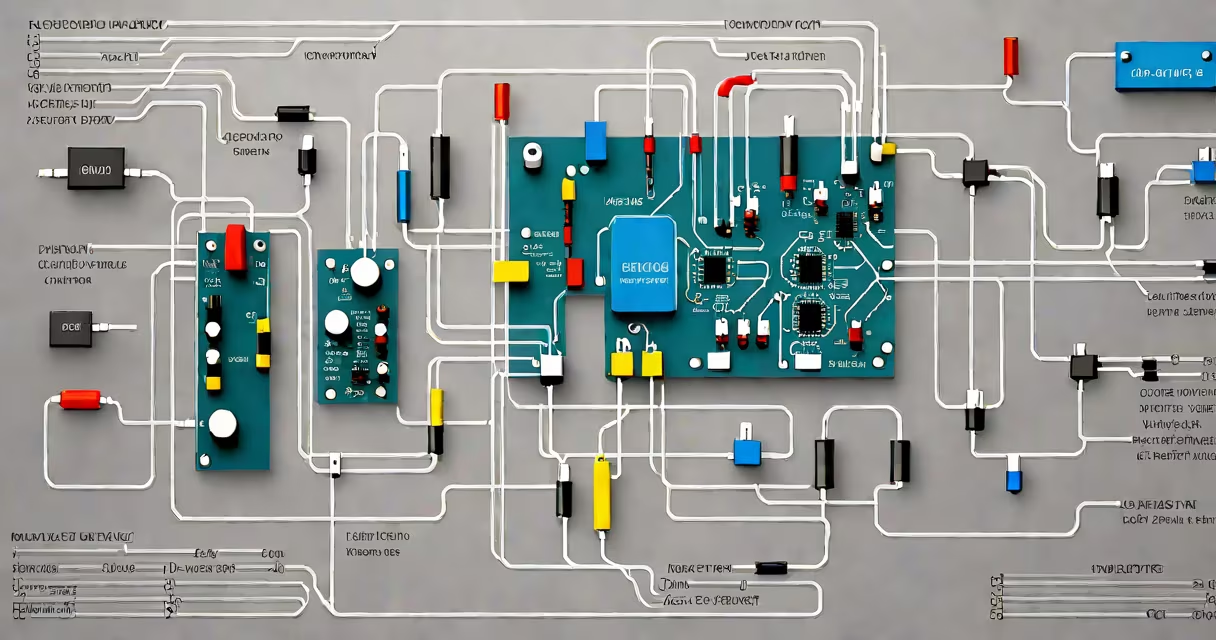
Electrical engineering programs require a structured sequence of mathematics, physics, circuit theory, signals and systems, and electronics courses to build technical proficiency. These courses form the academic core of a BSc electrical engineering degree.
Electrical engineering education follows a progressive structure. First-year students take foundational math and physics courses to develop analytical skills. Second-year coursework introduces circuit analysis, electromagnetics, and basic electronics. By the third year, students study advanced topics such as digital signal processing, control systems, and power electronics. The final year includes design projects and electives tailored to specialization areas like communications, robotics, or embedded systems.
Each course builds on prior knowledge. For example, understanding differential equations is essential before analyzing changing circuits. A student who skips vector calculus may struggle with Maxwell's equations in electromagnetics. This sequencing ensures mastery of increasingly complex concepts.
The curriculum balances theory and application. Lab sessions reinforce classroom learning-students construct circuits, measure voltages, and debug failures. Design projects simulate real-world engineering challenges, such as building a low-power sensor network or optimizing a motor controller.
Four subject clusters define the standard electrical engineering curriculum:
These subjects are taught through lectures, problem sets, labs, and exams. Most universities require a minimum grade of C or better in prerequisite courses before advancing.
For example, MIT's introductory course 6.002 Circuits and Electronics covers Kirchhoff's laws, Thevenin equivalents, operational amplifiers, and frequency response. Students complete weekly lab assignments using breadboards and oscilloscopes to validate theoretical predictions.
Many assume electrical engineering is primarily about wiring or fixing appliances. That role belongs to electricians or industrial maintenance technicians. Electrical engineers design systems-power grids, wireless networks, medical imaging devices, and autonomous vehicles-that require deep mathematical modeling and simulation.
Another misconception is that programming is optional. In reality, software skills are critical. Students learn C, C++, MATLAB, and Python to simulate circuits, process signals, and program microcontrollers. A 2022 survey by the IEEE found that 87% of entry-level EE jobs require scripting or coding proficiency.
Some confuse electrical engineering with computer engineering. While both involve circuits and computation, computer engineering emphasizes hardware-software integration and embedded systems. Electrical engineering focuses on energy, signals, and large-scale system behavior.
Here is a representative four-year plan from a U.S. ABET-accredited BSc electrical engineering program:
| Year | Term | Course Title | Credit Hours |
|---|---|---|---|
| 1 | Fall | Calculus I | 4 |
| 1 | Spring | Physics I: Mechanics | 4 |
| 2 | Fall | Linear Algebra and Differential Equations | 4 |
| 2 | Spring | Electricity and Magnetism | 4 |
| 3 | Fall | Circuits and Systems | 4 |
| 3 | Spring | Signals and Systems | 4 |
| 4 | Fall | Senior Design Project I | 3 |
| 4 | Spring | Senior Design Project II | 3 |
This sequence reflects the progression from fundamentals to synthesis. A student completing this path gains the ability to model complex systems, analyze transient responses, and implement feedback loops.
I designed a battery-powered temperature sensor during my junior year. Using a thermistor and an op-amp comparator, I built a circuit that triggered an LED when temperature exceeded 35°C. The project required applying Ohm's law, understanding RC time constants, and writing a simple Arduino sketch to read analog values. It was the first time I saw theory translate into physical behavior.
Graduates enter industries requiring rigorous training. Power companies hire engineers to maintain grid stability. Semiconductor firms rely on experts in analog and digital design. Telecommunications firms need professionals skilled in signal modulation and error correction.
According to the U.S. Bureau of Labor Statistics, electrical engineers earn a median annual wage of $103,390. The highest-paying roles often require advanced coursework in control theory, RF design, or machine learning applied to signal processing.
Students who skip core courses risk falling behind. One case study from Georgia Tech showed that students who failed Calculus III were 3.4 times more likely to drop out of the EE program. Retention rates improve when institutions offer supplemental instruction and early intervention.
Not all electrical engineering programs are identical. Some emphasize power systems, others focus on communications or robotics. However, the core curriculum remains consistent across accredited programs. ABET standards mandate coverage of circuits, electromagnetics, electronics, and systems.
A lesser-known fact: many programs require a capstone design course in the final year. This project must integrate multiple disciplines-mechanical, materials, software-and meet real-world constraints like cost, size, and safety. At Stanford, senior teams developed wearable EEG devices for seizure detection, combining neural signal processing with low-power embedded design.
Electronics courses differ from those in computer science. EE curricula teach transistor-level design, noise analysis, and power efficiency. Computer science programs focus on algorithms, data structures, and high-level language frameworks. The overlap exists, but the depth and intent differ.