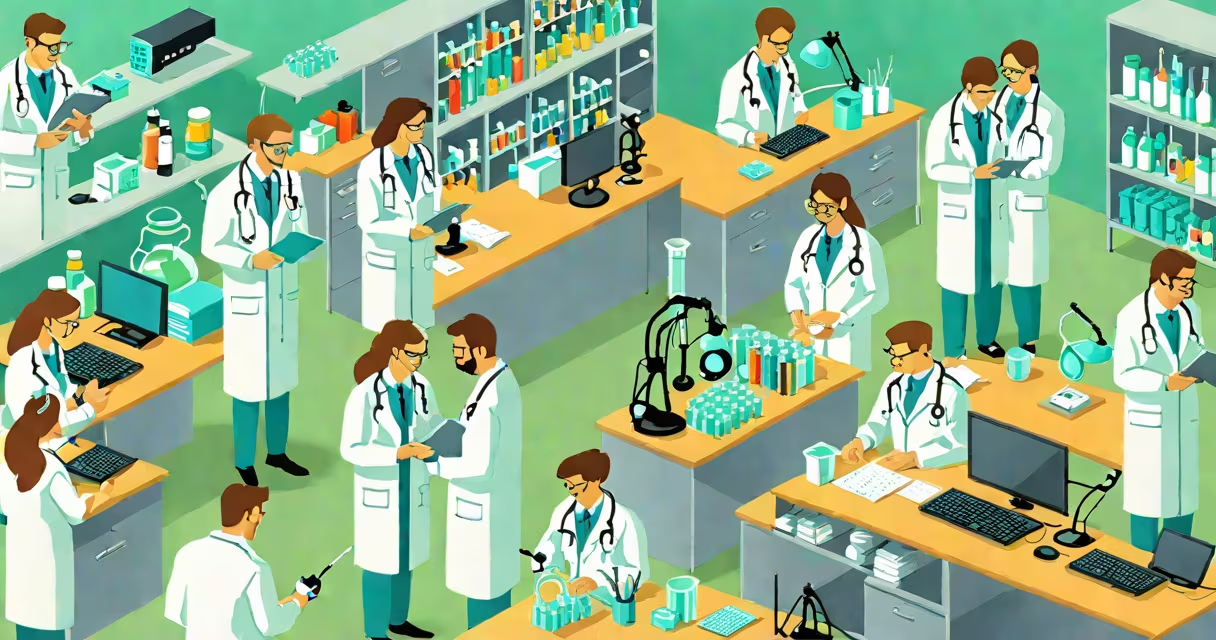
As a biology major, you can pursue careers in healthcare, research, environmental conservation, biotechnology, education, public policy, and data-driven life sciences. Your training in living systems, experimental design, and analytical reasoning opens doors across multiple sectors.
Biology majors study the structure, function, growth, origin, evolution, and distribution of living organisms. This foundation prepares you for roles requiring critical thinking, data interpretation, and problem-solving in complex systems. You're not limited to labs or medical school-you can apply your skills in tech, government, nonprofits, and private industry.
According to the National Science Foundation, about 60% of biology bachelor's graduates enter fields outside traditional academic research within five years. Many move into health-related professions, while others join biotech startups, environmental agencies, or science communication teams. The versatility of the degree stems from its focus on evidence-based inquiry and adaptability across disciplines.
Your coursework in genetics, cell biology, ecology, and physiology builds a structure for understanding biological processes at multiple scales-from molecular pathways to system dynamics. These competencies translate into practical abilities such as designing experiments, analyzing datasets, interpreting scientific literature, and communicating complex ideas.
For example, a student who completed a senior thesis on microbial communities in urban soils went on to work for a city sanitation department, helping assess contamination risks in stormwater runoff. Their ability to collect soil samples, run PCR tests, and interpret results directly informed infrastructure planning decisions.
Another graduate used their biochemistry background to join a nonprofit focused on sustainable agriculture. They analyzed pesticide residues in crops using chromatography techniques learned in lab courses and advised farmers on safer alternatives. Their role combined technical skill with community outreach-showcasing how biology applies beyond textbooks.
Here are key directions biology majors take after graduation, with actual job titles and typical entry-level salaries (U.S., 2023 data from the U.S. Bureau of Labor Statistics and PayScale):
| Career Path | Typical Entry-Level Roles | Avg. Starting Salary | Required Skills |
|---|---|---|---|
| Healthcare Support | Laboratory technician, phlebotomist, medical assistant | $35,000-$45,000 | Sample handling, safety protocols, basic diagnostics |
| Biotechnology & Pharma | Research assistant, quality control analyst | $48,000-$60,000 | Cell culture, assay development, regulatory compliance |
| Environmental Science | Field ecologist, environmental consultant | $42,000-$55,000 | Species identification, GIS mapping, impact assessments |
| Science Communication | Medical writer, science educator, content specialist | $40,000-$58,000 | Clear writing, public speaking, storytelling with data |
| Public Health & Policy | Program coordinator, epidemiology aide | $44,000-$52,000 | Statistical analysis, report writing, stakeholder engagement |
These roles don't require a graduate degree. Many employers value hands-on experience gained through internships, volunteer work, or independent projects during college.
One student I mentored took a summer internship at a hospital microbiology lab. After collecting patient swabs and running bacterial cultures, they identified a drug-resistant strain of *Staphylococcus aureus* in a sample. Their findings were reported to infection control staff, leading to updated isolation procedures. That experience led to a full-time job as a clinical lab technician after graduation.
Many assume biology majors must go to medical school or become researchers. While those are valid paths, they represent less than half of all outcomes. The misconception arises because media coverage focuses heavily on doctors and scientists, not the wide range of support roles in science.
Another common error is equating biology with "natural sciences only." In reality, modern biology integrates computational tools, statistics, and engineering principles. A biology major may spend more time coding in Python than dissecting frogs-especially in genomics, synthetic biology, or ecological modeling.
For instance, a 2022 study published in *Nature Biotechnology* found that 37% of new biotech hires with biology degrees had taken at least two programming or data science courses. These individuals often work on machine learning models predicting protein folding patterns-an area where biology meets artificial intelligence.
Beyond subject knowledge, biology majors develop transferable skills valued across industries:
These aren't just soft skills-they're measurable assets. A 2021 report by the Association of American Colleges and Universities found that 85% of employers prioritize critical thinking and written communication in hiring, even for technical positions.
Start by identifying what aspects of biology excite you most. Did you enjoy fieldwork? Consider environmental consulting or park management. Loved dissecting specimens? Explore forensic science or anatomical illustration. Found yourself drawn to lab automation? Look into biomanufacturing or pharmaceutical production.
Take advantage of campus resources: career centers, alumni networks, and faculty research groups. Attend departmental seminars-even ones outside your immediate interest. You might discover a niche like marine pharmacology or bioethics in AI.
Consider gaining experience through paid or unpaid roles. Volunteer at a nature reserve, assist in a university lab, or contribute to citizen science projects like eBird or iNaturalist. These experiences build your resume and clarify your interests.
Being a biology major doesn't define your future-it equips you to shape it. With the right direction, your degree becomes a launchpad for meaningful work in science, society, and innovation.