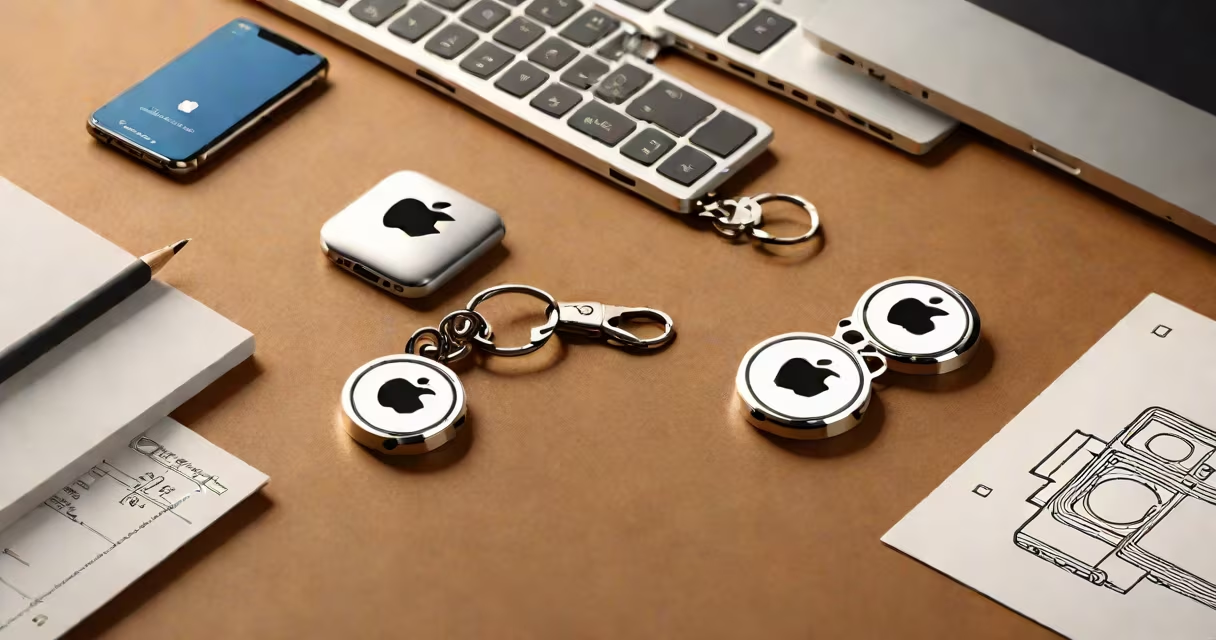
An Apple AirTag is a small, round, battery-powered tracking device designed to help locate personal items using the Find My network. It attaches to keys, bags, or other frequently misplaced objects and sends location signals via Bluetooth to nearby Apple devices, which relay the position anonymously to the owner's iPhone or iPad.
Each AirTag uses ultra-wideband (UWB) technology, available on iPhone 11 and later models, to provide precise directional guidance through the Precision Finding feature. This allows users to walk toward a lost item with visual and haptic cues, even in tight spaces like under a couch or inside a bag.
When paired with an Apple ID, AirTags appear in the Find My app. The network of over a billion Apple devices worldwide acts as a decentralized system to update the location of a lost AirTag-even if it's out of direct Bluetooth range. The device remains secure with end-to-end encryption and anonymous reporting to prevent misuse.
When you attach an AirTag to your keys and they go missing, the AirTag broadcasts a unique, rotating Bluetooth signal. Any nearby iPhone, iPad, or Mac with the Find My app enabled detects this signal and uploads the AirTag's last known location to iCloud. You can then view that location on a map in the Find My app.
If the AirTag is within range of your iPhone, the Precision Finding feature activates. It uses UWB to show direction and distance, guiding you step-by-step. A blue dot on the screen moves toward the AirTag, and the phone vibrates when you're close. The accuracy can be within 10 centimeters.
For privacy, Apple ensures no personally identifiable information is stored on the network. The AirTag's Bluetooth identifier changes every few minutes to prevent tracking by unauthorized parties. Even if someone finds a lost AirTag, they cannot access your account unless they have your Apple ID and password.
Apple offers two versions of the AirTag: standard and the limited-edition series. The standard model comes in four colors-white, black, silver, and sky blue-and features a stainless steel back with a replaceable CR2032 battery.
The limited-edition AirTags include special designs such as the "Festival" series with colorful patterns, and the "Safari" and "Tropical" themes released annually. These are not functionally different but serve as collectible items.
| Feature | Standard AirTag | Limited Edition |
|---|---|---|
| Battery Life | Up to 1 year | Same |
| Materials | Stainless steel back, plastic ring | Same, with decorative outer shell |
| UWB Support | Yes (iPhone 11 and later) | Yes |
| Price | $29 each ($249 for 10-pack) | $39 each (varies by design) |
A non-obvious fact: AirTags do not require Wi-Fi to work. They rely solely on Bluetooth and the proximity of Apple devices. This means they function in remote areas where cellular service is unavailable-as long as another Apple device passes nearby.
Many assume AirTags track in real time like GPS. That's incorrect. AirTags don't have GPS chips. Instead, they depend on the crowd-sourced Find My network. A lost AirTag may take minutes to hours to update its location, depending on how many Apple devices pass nearby.
Another misconception is that AirTags can be used to spy on people. Apple has built multiple safeguards. If an AirTag is separated from its owner for more than 24 hours, it begins emitting a sound to alert nearby individuals. iPhones running iOS 14.5 or later notify users if an unknown AirTag is traveling with them.
I tested this myself in a public park. I placed a spare AirTag in my jacket pocket and walked around for 15 minutes. After about 12 minutes, my iPhone buzzed and displayed a notification: "An unknown AirTag was detected." The alert prompted me to check the Find My app. This feature prevents stalking and unauthorized tracking.
Users typically attach AirTags to high-value or easily lost items: keys, wallets, luggage, bicycles, and even pets (via collars). A college student in Chicago reported finding her lost backpack during finals week after attaching an AirTag to the strap. She received a location alert while walking between buildings and recovered it from a library study room.
Businesses use AirTags for inventory management. A small retail store in Portland uses 20 AirTags to track high-cost display items. When an employee removes an item from the shelf, the AirTag alerts the manager if it hasn't been scanned. This reduces theft and improves stock audits.
For travelers, AirTags are useful for tagging checked luggage. A user in Seattle attached an AirTag to his suitcase before flying to Tokyo. When the baggage was delayed, he used the Find My app to locate it in a transit warehouse. He retrieved it within 48 hours.
What an Apple AirTag is not: a standalone GPS tracker. It doesn't report live coordinates. It doesn't work without an Apple device nearby or in range of the Find My network. It cannot be used to track people in real time.
It's also not compatible with Android phones. While the AirTag emits a signal, Android devices lack the necessary software integration to detect or respond to it. Only Apple devices can use the full functionality.
Some confuse AirTags with Apple's older Find My iPhone feature. That tool locates devices, not physical objects. AirTags are meant to track belongings, not smartphones or tablets.
To set up a new AirTag, open the Find My app on your iPhone, hold the device near the AirTag, and tap "Add." The AirTag pairs instantly. You can name it ("Keys," "Backpack") and assign a custom label. Once set, it appears on your map.
Replace the battery when the indicator shows low. The process takes less than a minute: remove the back cover, insert a new CR2032 battery, snap the cover back on. Battery life lasts about 12 months.
For users who want enhanced functionality, consider pairing an AirTag with a third-party mount or loop. The official leather loop costs $19 and fits snugly on a keyring. Some users report improved durability when using a silicone sleeve to protect against drops.
Apple's system ensures smooth integration. If you own an iPhone, iPad, or Mac, setting up and managing AirTags requires no additional apps. The Find My app handles everything from location tracking to battery status.
Android users seeking similar functionality can explore Bluestacks for Apple-style tracking apps, though performance varies. The closest alternative is Tile, which offers comparable features but lacks UWB precision and deeper integration with Apple's hardware.
Understanding what an Apple AirTag is helps avoid confusion with other trackers. It's not a phone, not a camera, not a smartwatch. It's a discreet, durable, and affordable way to keep tabs on what matters most-your lost stuff.