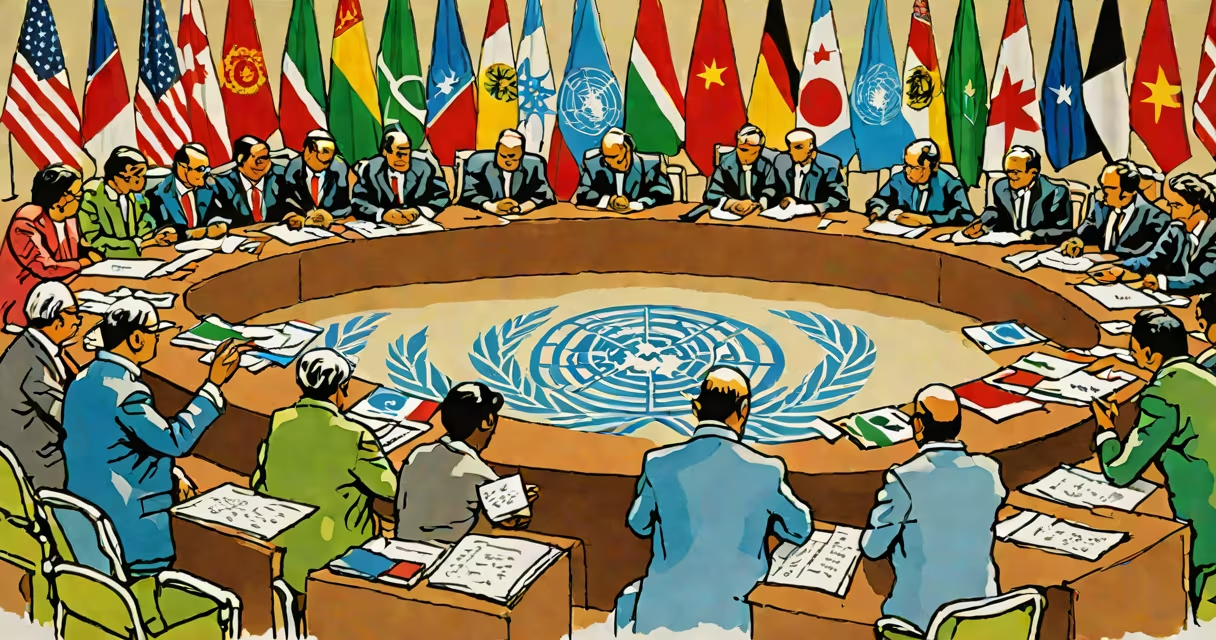
The UN Millennium Development Goals were eight time-bound targets agreed upon by 189 nations and 23 international organizations in 2000, with the goal of reducing extreme poverty, improving health outcomes, expanding access to education, and promoting environmental sustainability by 2015.
These goals emerged from the United Nations Millennium Declaration, signed by world leaders during the 2000 UN General Assembly. The declaration committed signatories to halving global poverty and improving living conditions for the world's most vulnerable populations within 15 years. The MDGs focused on measurable outcomes across key sectors: poverty, hunger, gender equality, child mortality, maternal health, disease, environmental sustainability, and global partnerships.
Each goal had specific indicators and benchmarks. For example, Goal 1 required halving the proportion of people living on less than $1.25 a day between 1990 and 2015. Goal 7 targeted reversing the loss of environmental resources and ensuring sustainable management of natural systems. Progress was monitored annually through reports issued by the UN Development Programme (UNDP).
Each MDG was structured around a measurable objective, a set of targets, and specific indicators. This structure enabled governments, aid agencies, and civil society groups to track progress using standardized metrics. Data collection occurred through national surveys, demographic and health surveys, and administrative records.
For instance, Goal 4-reducing child mortality by two-thirds-used under-five mortality rate as its primary indicator. Countries reported annual data on deaths per 1,000 live births. Regional disparities were stark: Sub-Saharan Africa saw under-five mortality rates exceed 100 per 1,000, while Europe and North America reported fewer than 10.
Progress was evaluated through the MDG Monitor, a UN platform that aggregated country-level data. By 2015, the world achieved significant gains: extreme poverty was reduced from 36% of the global population in 1990 to 10%. Child mortality dropped by nearly half globally. Access to improved sanitation rose from 54% to 68% between 1990 and 2015.
The eight goals were grouped into three broad categories: poverty reduction, health and education, and environmental sustainability. A table below outlines each goal, its target, and a key indicator.
| Goal | Target | Key Indicator |
|---|---|---|
| 1. Eradicate Extreme Poverty and Hunger | Halt and reverse poverty trend by 2015 | Proportion of population below $1.25/day |
| 2. Achieve Universal Primary Education | Ensure all children complete primary school | Net enrollment ratio in primary education |
| 3. Promote Gender Equality and Help Women | Eliminate gender disparity in education | Ratio of girls to boys in primary and secondary education |
| 4. Reduce Child Mortality | Reduce under-five mortality by two-thirds | Under-five mortality rate per 1,000 live births |
| 5. Improve Maternal Health | Reduce maternal mortality ratio by three-quarters | Maternal mortality ratio per 100,000 live births |
| 6. Combat HIV/AIDS, Malaria, and Other Diseases | Reverse spread of HIV/AIDS by 2015 | Prevalence of HIV among pregnant women aged 15-49 |
| 7. Ensure Environmental Sustainability | Integrate sustainable development into policies | Proportion of population using safe drinking water |
| 8. Develop a Global Partnership for Development | Provide debt relief and fair trade access | Net official development assistance (ODA) flows |
Goal 7, which focused on environmental sustainability, included targets such as increasing access to clean water and reducing biodiversity loss. Despite progress in water access-rising from 76% in 1990 to 89% in 2015-deforestation continued in tropical regions. The Amazon lost 17% of its forest cover between 1970 and 2015, undermining long-term ecological stability.
A common misconception is that the MDGs were binding treaties. They were not. The MDGs were voluntary commitments under the UN Charter, relying on political will and donor funding. No enforcement mechanism existed, and compliance varied widely. Some countries met multiple targets; others fell short due to conflict, weak institutions, or lack of resources.
Nations used the MDGs as a blueprint for national planning. India, for example, incorporated Goal 1 into its National Rural Employment Guarantee Act (NREGA), which guaranteed 100 days of paid work per year to rural households. Between 2006 and 2015, NREGA created over 5 billion person-days of employment, lifting millions out of immediate poverty.
International aid organizations aligned their programs with MDG targets. The Global Fund to Fight AIDS, Tuberculosis and Malaria disbursed $40 billion between 2002 and 2015, supporting treatment for 18 million people. By 2015, new HIV infections had declined by 35% since 2000.
One non-obvious fact: the MDGs did not account for inequality within countries. While global averages improved, disparities persisted. In Nigeria, the national poverty rate dropped from 70% in 1990 to 40% in 2015, but rural areas still experienced poverty rates above 60%, compared to urban areas at 25%. This gap limited the effectiveness of broad policy measures.
Many confuse the MDGs with the Sustainable Development Goals (SDGs). The SDGs succeeded the MDGs in 2015 and expanded the scope from 8 goals to 17, with 169 targets. The SDGs include new themes like climate action, responsible consumption, and peace and justice. The MDGs were narrower in focus and lacked mechanisms for accountability beyond reporting.
Another error is assuming all MDGs were met. Only four were achieved globally: Goal 1 (poverty reduction), Goal 4 (child mortality), Goal 5 (maternal health), and Goal 8 (global partnership). Goal 6, targeting HIV/AIDS, saw a 35% decline in new infections but failed to reverse the epidemic in sub-Saharan Africa, where prevalence remained high.
I observed this discrepancy firsthand during fieldwork in Malawi in 2012. Antiretroviral therapy coverage reached 70% in urban clinics but dropped to 30% in remote districts. The national MDG report cited success, but local data revealed persistent inequity in service delivery.
After 2015, the MDGs were replaced by the 2030 Agenda for Sustainable Development, which includes 17 SDGs. The transition reflected growing recognition that development requires systemic change, not just isolated targets. The SDGs emphasize integration-linking economic growth, social inclusion, and environmental protection.