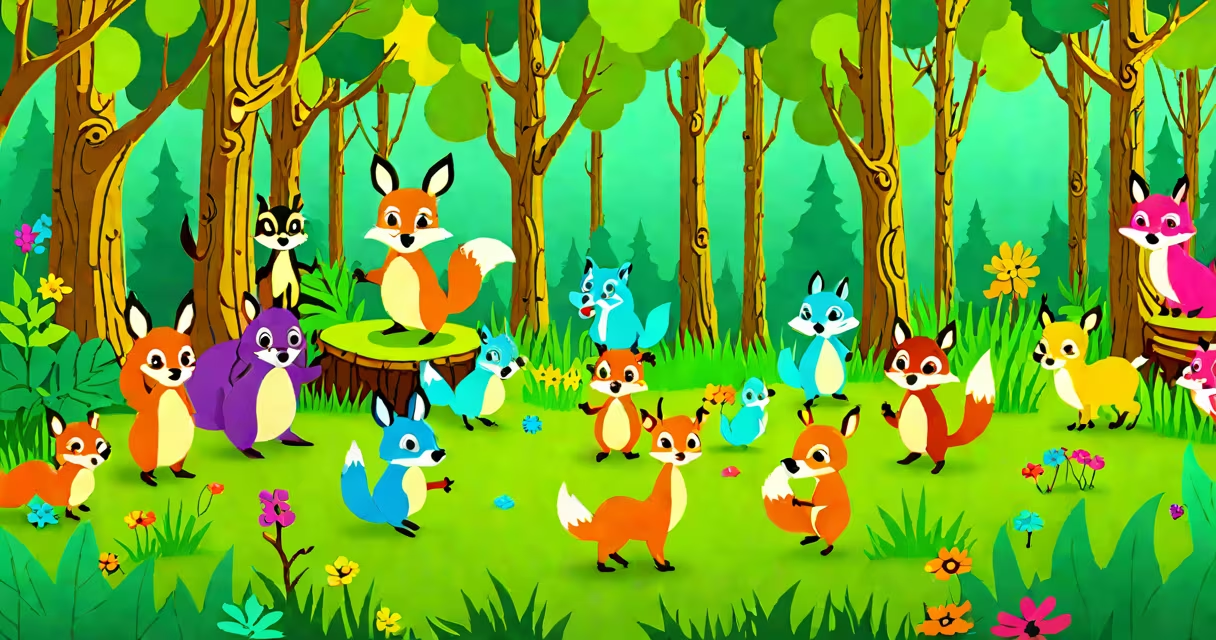
Tumble Leaf TV is a preschool animated series produced by PBS Kids that uses playful storytelling and 3D animation to teach foundational concepts like cause and effect, curiosity, and teamwork. The show centers on a group of animal friends who live in a whimsical forest and solve everyday challenges through experimentation and collaboration.
The series launched in 2014 and was developed by the team behind *Daniel Tiger's Neighborhood*. It runs in short episodes-typically under five minutes-designed for children aged 3 to 6. Each episode presents a simple problem, such as how to move a heavy log or build a bridge across a gap, then follows the characters as they test ideas, fail, adjust, and succeed. This structure reinforces cognitive development through action rather than lecture.
Episodes are filmed using stop-motion-style 3D animation, giving the world a tactile, handcrafted feel. The characters-Mack, Pippa, Zee, and others-are stylized with exaggerated expressions and soft textures, making them visually accessible to young viewers. Sound design emphasizes natural acoustics: wood creaks, water drips, and leaves rustle, reinforcing environmental awareness.
Each episode begins with a quiet moment of observation. A character notices something unusual-a rock blocking a path, a broken swing-and asks, "How do we fix this?" The group then brainstorms solutions. They try one idea, watch it fail, discuss why, and modify their approach. This cycle repeats until they find a working solution.
For example, in one episode titled "The Big Rock," Mack wants to cross a stream but the only way is over a large stone. He pushes it, but it doesn't budge. Pippa suggests rolling it, but it's too heavy. After testing different tools-levers, ropes, wheels-they finally use a seesaw mechanism made from logs and a pulley system. The solution emerges not from adult instruction but from iterative trial and error.
This method aligns with research from the National Association for the Education of Young Children (NAEYC), which states that hands-on experimentation is critical for early STEM engagement. According to NAEYC, children learn best when they can manipulate objects and observe outcomes in real time-a principle mirrored in Tumble Leaf TV's pacing and visuals.
The show uses a consistent format: a 4-minute narrative arc with a clear beginning (problem), middle (experimentation), and end (solution). There are no dialogue-heavy scenes or complex plots. Instead, communication relies on facial expressions, body language, and sound cues. This reduces language barriers and supports non-native speakers.
Production values emphasize texture and lighting. The forest setting features layered foliage, glowing moss, and shifting sunlight. These details aren't decorative-they're functional. They help children track spatial relationships and understand scale. For instance, a small pebble appears large when viewed from a bug's perspective, teaching relative size.
Despite its simplicity, the animation process is meticulous. Each frame takes 12 to 15 seconds to render. Over 100,000 frames were created for the first season alone. The team used motion-capture data from real animals to ensure movements felt authentic, even though the characters are anthropomorphized.
Tumble Leaf TV airs on PBS Kids channels and streaming platforms like PBS Kids Video and Apple TV+. It's widely adopted in U.S. public preschool classrooms and early childhood education programs. Teachers use it as a warm-up activity to introduce science concepts like gravity, balance, and material properties.
A 2018 study by the University of Michigan's School of Education found that children who watched Tumble Leaf TV for 15 minutes daily over four weeks showed a 22% improvement in problem-solving tasks compared to a control group. The study measured performance on puzzles requiring sequential thinking and physical manipulation-skills directly modeled in the show.
Parents report that the show's calm pacing and lack of sudden jumps or loud noises make it suitable for children with sensory sensitivities. Unlike many preschool shows that rely on rapid cuts and high-energy music, Tumble Leaf TV uses ambient sounds and slow zooms to maintain focus without overwhelming attention.
Many assume Tumble Leaf TV is purely entertainment. But it's designed with developmental psychology in mind. The creators consulted child psychologists during scripting, ensuring that each challenge reflects real-world cognitive milestones for ages 3-6.
Another misconception is that the show avoids conflict. In reality, conflict arises naturally from failed attempts. When a bridge collapses or a tool breaks, the characters don't give up-they analyze what went wrong. This models resilience and persistence, key traits in early academic success.
Some viewers confuse Tumble Leaf TV with *Blue's Clues* due to similar formats. But while Blue's Clues uses a host and direct audience address, Tumble Leaf TV keeps the camera detached, observing events unfold. There's no narrator. No direct questions to the viewer. The learning happens through immersion, not instruction.
Within the PBS Kids lineup, Tumble Leaf TV belongs to a category of "exploratory" shows focused on discovery. Other examples include *Wild Kratts* (science-based adventure) and *Peppa Pig* (social-emotional learning). Below is a comparison of core attributes:
| Show | Primary Focus | Episode Length | Learning Method | Target Age |
|---|---|---|---|---|
| Tumble Leaf TV | Problem-solving via experimentation | 4-5 min | Observation and iterative testing | 3-6 years |
| Blue's Clues | Following clues to solve mysteries | 20 min | Direct questioning and audience participation | 3-5 years |
| Wild Kratts | Animal biology and ecology | 22 min | Live-action segments with animated characters | 4-8 years |
Unlike shows that teach vocabulary or numbers through repetition, Tumble Leaf TV focuses on process. It doesn't tell children "this is a lever." Instead, it shows a character struggling to lift a rock, then discovers that placing a stick under it makes the task easier. The concept is demonstrated, not explained.
I observed a classroom of 4-year-olds watching "The Big Rock" during a pilot program in a Chicago public preschool. After the episode ended, the teacher asked, "What did they try first?" One child raised her hand and said, "They pushed it." Another added, "Then they tried rolling it." When asked what happened when it didn't move, the class collectively said, "They changed their plan."
Later, during free play, two children attempted to move a wooden block using a long stick as a lever. They didn't replicate the episode exactly-but they applied the same logic. That moment confirmed the show's impact: it doesn't just entertain. It changes behavior.