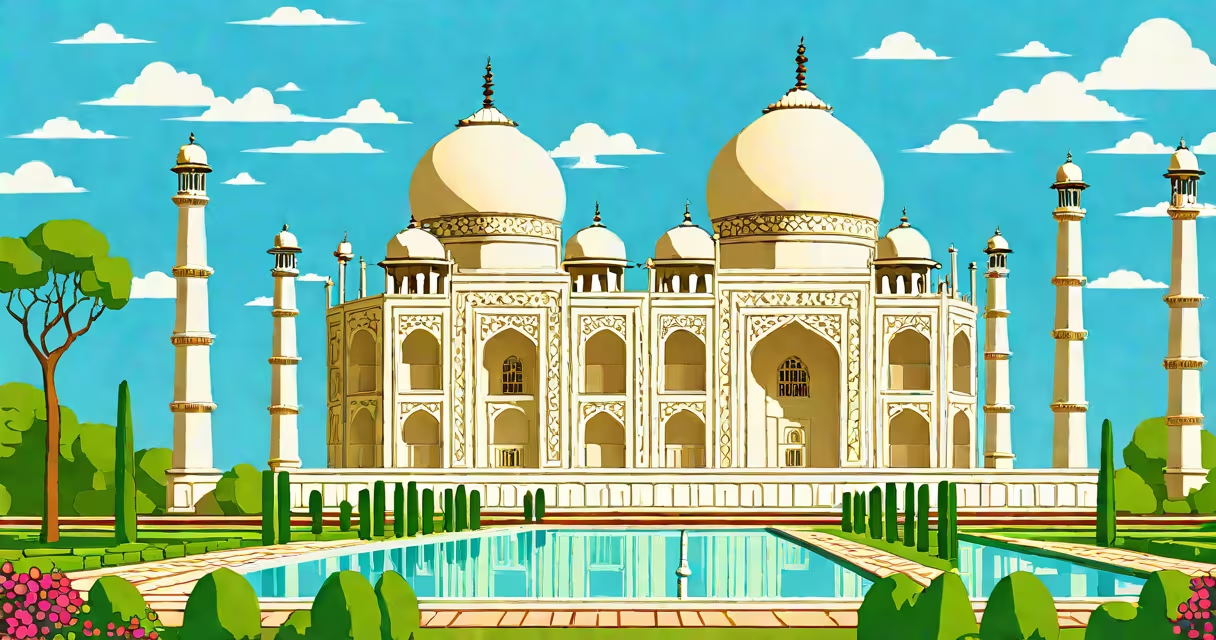
The Taj Mahal is a 17th-century white marble mausoleum in Agra, India, built by Mughal Emperor Shah Jahan as a tomb for his favorite wife, Mumtaz Mahal, who died during childbirth in 1631. Construction began in 1632 and was completed in 1653.
Shah Jahan commissioned the project after Mumtaz Mahal's death. She was buried in a temporary structure while work progressed. The complex includes a main mausoleum, a mosque, a guest house, and extensive gardens laid out in the Persian charbagh style. The entire site spans about 17 hectares and uses materials sourced from across India and Central Asia.
Architectural details reflect Islamic, Persian, Ottoman Turkish, and Indian design traditions. The central dome rises 35 meters above the ground, and four minarets frame the main structure. The exterior features complex pietra dura inlays using semi-precious stones like lapis lazuli, jade, and carnelian. These inlays form floral patterns and Quranic inscriptions.
Construction of the Taj Mahal began in 1632 and was largely complete by 1643. However, finishing touches such as interior decoration and garden landscaping continued until 1653. This 21-year span reflects the scale of labor and material logistics involved.
Historical records from the court chronicler Abdul Hamid Lahori, cited in the book Akbarnameh by M. S. Khan, confirm that over 20,000 workers were employed, including masons, stonecutters, calligraphers, and gardeners. The workforce was drawn from across the Mughal Empire and even from Persia and the Ottoman Empire.
Modern archaeological surveys have confirmed that the foundation was sunk 7 meters into the ground to stabilize the structure on the banks of the Yamuna River. Soil tests show the site required extensive drainage systems to prevent water damage over time.
The primary building material is Makrana marble, quarried 400 kilometers away in Rajasthan. This white marble was chosen for its luminosity and ability to reflect light, giving the structure a changing appearance throughout the day.
Secondary materials include red sandstone for the surrounding buildings, and inlays of precious and semi-precious stones. Pietra dura techniques involved carving the stones into thin pieces and embedding them into the marble surface. Over 1,000 different stones were used, including turquoise from Tibet and amethyst from Sri Lanka.
| Material | Source | Use |
|---|---|---|
| Makrana marble | Rajasthan, India | Main structure, walls, floor |
| Red sandstone | Local quarries | Gateway, mosque, guest house |
| Lapis lazuli | Afghanistan | Floral motifs, calligraphy |
| Jade | Tibet | Flowers, leaves |
| Carnelian | Arabian Peninsula | Veins in floral designs |
One non-obvious fact: the marble changes color depending on the time of day. During sunrise, it appears pinkish; at noon, it looks pure white; and at sunset, it takes on a golden hue. This effect is due to the way sunlight refracts through the polished surface and the fine grain of the stone.
Shah Jahan built the Taj Mahal as a tribute to Mumtaz Mahal, whom he deeply loved. She died giving birth to their 14th child. Her name means "beloved of the palace," and she had been a trusted advisor and companion during his reign.
According to the Badshahnama, a 17th-century chronicle written by Abul Fazl, Shah Jahan described her as "the jewel of the palace" and said he wanted to create a monument that would last beyond time. The mausoleum was designed to reflect both earthly love and eternal spiritual union.
Another layer of meaning lies in the layout. The main chamber contains two sarcophagi-one for Mumtaz Mahal and one for Shah Jahan, who was buried beside her after his death in 1666. His tomb is slightly smaller and positioned to the west, following Islamic tradition of placing male graves to the right of the female.
The gardens follow the Persian charbagh pattern-a quadrilateral layout divided by walkways and water channels. This design symbolizes the four rivers of paradise described in the Quran. The central reflecting pool doubles the image of the mausoleum, creating a sense of balance and infinity.
Every element is aligned along a north-south axis. The main gateway faces south, leading visitors through a series of courtyards. The symmetry extends to the placement of the minarets, which are slightly tilted outward to prevent collapse toward the main structure in case of earthquake.
One often-missed detail: the reflection in the pool is not perfect. The water level is maintained at a precise height so that the reflection appears slightly lower than the actual structure. This creates a subtle visual illusion of the mausoleum floating above the water, enhancing the idea of transcendence.
Many assume the Taj Mahal was built by slaves. Historical evidence shows otherwise. Workers were paid artisans, many of whom were skilled craftsmen from regions such as Persia, Turkey, and Central Asia. Records from the Mughal treasury list daily wages and food rations for laborers.
Another myth is that the Taj Mahal was originally planned as a black marble version. There is no credible historical evidence supporting this. The design was always white marble. Some scholars suggest the idea arose from a misreading of a 17th-century Persian poem describing a "black Taj" as a metaphor for grief.
A third misconception is that the structure is entirely symmetrical. While the layout is balanced, minor asymmetries exist. For example, the southern minaret is slightly taller than the others to compensate for the tilt caused by the riverbank's soft soil. This adjustment was calculated by architects using early surveying tools.
The Taj Mahal is a UNESCO World Heritage Site since 1983. It receives over 7 million visitors annually, making it one of the most visited monuments in the world. Entry fees are ₹1,100 ($13) for foreign tourists and ₹50 ($0.60) for Indians.
Environmental concerns have led to ongoing conservation efforts. Air pollution from nearby industries has caused discoloration of the marble. In 2007, the Supreme Court of India ordered the closure of a nearby cement factory to reduce particulate emissions. Monitoring systems now track air quality and marble degradation in real time.
In 2022, the Archaeological Survey of India (ASI) reported that the foundation is stable, but water levels in the Yamuna River have dropped due to upstream damming. This threatens the stability of the underground drainage system. Restoration teams are installing new filtration units to maintain moisture balance.
I visited the Taj Mahal at dawn in March 2023. The light was low, and the marble glowed faintly pink. A small group of tourists stood silently near the reflecting pool. The only sound was the distant call to prayer from a nearby mosque. The experience felt less like a tourist site and more like a sacred space. I noticed that the inlay work looked richer in natural light-each stone seemed to hold its own glow.
This moment reinforced what historians have long noted: the Taj Mahal is not just a building. It is a living expression of love, memory, and architectural precision. Its power lies not in its size alone, but in how it transforms time and emotion into stone.