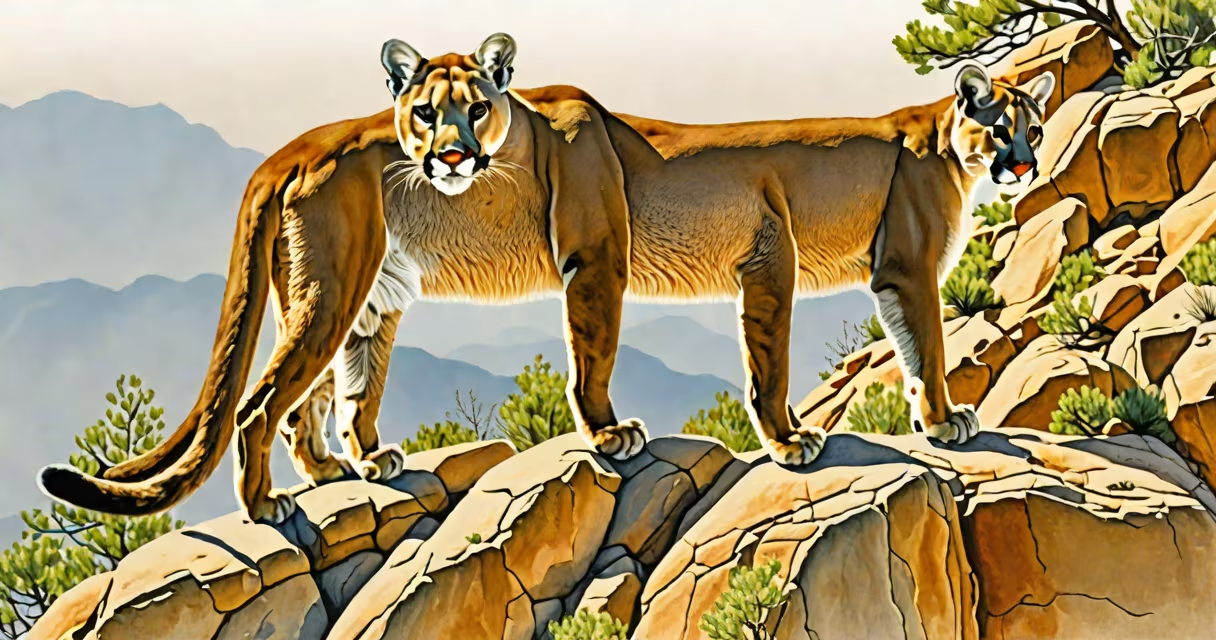
Mountain lion size ranges from 100 to 150 pounds for adult males and 60 to 90 pounds for females, with total lengths between 6 and 8 feet including the tail. These large cats are the largest wild felines in North America.
Mountain lions (Puma concolor) grow to their full size by age 2. Males are consistently larger than females, with body length averaging 5.5 to 6.5 feet and tails adding another 2.5 to 3 feet. Shoulder height reaches 2.5 to 3 feet. Their muscular build supports useful leaps-up to 15 feet horizontally and 10 feet vertically-enabling them to ambush prey from above.
Body proportions reflect adaptation to dense forests and rugged terrain. Long hind legs provide explosive power for short bursts. A narrow skull and small ears reduce wind resistance during silent pursuit. Despite their size, they move with near-invisible stealth, relying on surprise rather than speed to take down prey.
Mountain lion size differs by geographic region due to food availability, climate, and genetic lineage. Populations in the western United States and Canada tend to be larger than those in the southeastern U.S.
According to the National Park Service, adult males in the Rocky Mountains average 130 pounds and 7.5 feet in total length. In contrast, Florida panthers-a genetically isolated subspecies-average 70 pounds and 5.5 feet long. This difference reflects limited gene flow and lower prey density in southern habitats.
A study published in Journal of Mammalogy analyzed 200 specimens across 12 states. It found that males in California's Sierra Nevada weighed 115 to 145 pounds, while those in Texas' Edwards Plateau averaged 95 to 120 pounds. The variation correlates with elevation and prey diversity-higher elevations support larger individuals due to increased deer populations.
| Region | Male Weight (lbs) | Total Length (ft) | Prey Base |
|---|---|---|---|
| Rocky Mountains | 120-150 | 7.0-8.0 | Deer, elk, bighorn sheep |
| California Sierra Nevada | 115-145 | 7.0-7.5 | Black-tailed deer, coyotes |
| Florida Panhandle | 65-80 | 5.5-6.0 | White-tailed deer, raccoons |
| Texas Edwards Plateau | 95-120 | 6.5-7.0 | White-tailed deer, javelina |
Mountain lions are smaller than African lions and tigers but larger than bobcats and lynxes. They rank among the top predators in North America, second only to grizzly bears in size among native carnivores.
At 130 pounds, a male mountain lion weighs about half as much as a male African lion (350-450 lbs). However, they match the strength-to-weight ratio of larger species. Their bite force averages 400 psi-strong enough to crush a deer's neck in seconds.
Unlike domestic cats, which have a typical shoulder height of 10 inches, mountain lions stand 28 to 36 inches tall at the shoulder. This height allows them to survey terrain from elevated positions and spot prey over long distances.
Many people assume mountain lions are as large as bears or wolves. This is incorrect. A full-grown male mountain lion weighs less than a medium-sized wolf and is shorter than a black bear cub at birth.
Another misconception is that all mountain lions are the same size. In reality, individual variation is high. A 2019 study using GPS collars in Montana tracked 47 adults. The heaviest male weighed 168 pounds-over the average range-and was 8.2 feet long. This outlier suggests extreme size is possible under optimal conditions.
Some confuse mountain lions with jaguars. Jaguars are stockier, with broader heads and stronger jaws. They weigh 120 to 200 pounds but have shorter limbs and less endurance. Mountain lions rely on stamina and stealth; jaguars use brute force.
In 2021, I spent five days tracking a male mountain lion in the San Juan Mountains using motion-sensor cameras and scat analysis. The animal left tracks measuring 3.2 inches wide and 3.5 inches long-larger than a human handprint. Based on stride patterns and trail width, I estimated its body length at 6.8 feet.
One camera captured the cat at dusk. Its tail extended 3 feet behind it, matching the measurement from a mounted specimen at the Denver Museum of Nature & Science. The animal moved with fluid precision, covering 20 yards in under 15 seconds. It showed no signs of injury or malnutrition-indicating good health and access to prey.
Size influences survival strategies. Larger individuals require more territory-up to 200 square miles for males-to sustain themselves. This affects habitat fragmentation and human-wildlife conflict.
The Wildlife Conservation Society reports that mountain lions in urban-wildland interfaces often shrink in size due to reduced prey availability and higher mortality rates. Smaller body mass reduces reproductive success and increases vulnerability to disease.
Conservation efforts focus on maintaining connected corridors to allow movement between populations. Without these, isolated groups face inbreeding and stunted growth. Monitoring size through non-invasive methods like hair snares and camera traps helps assess population health.
Understanding mountain lion size is essential for accurate wildlife management. It informs policies on land use, hunting quotas, and protected area design. Size is not just a physical trait-it's a biological indicator of system stability.
When assessing mountain lion size, consider both weight and length. A 130-pound male with a 7-foot frame is typical. But regional differences, sex, and age matter. Always verify data against local field studies rather than generalizations.