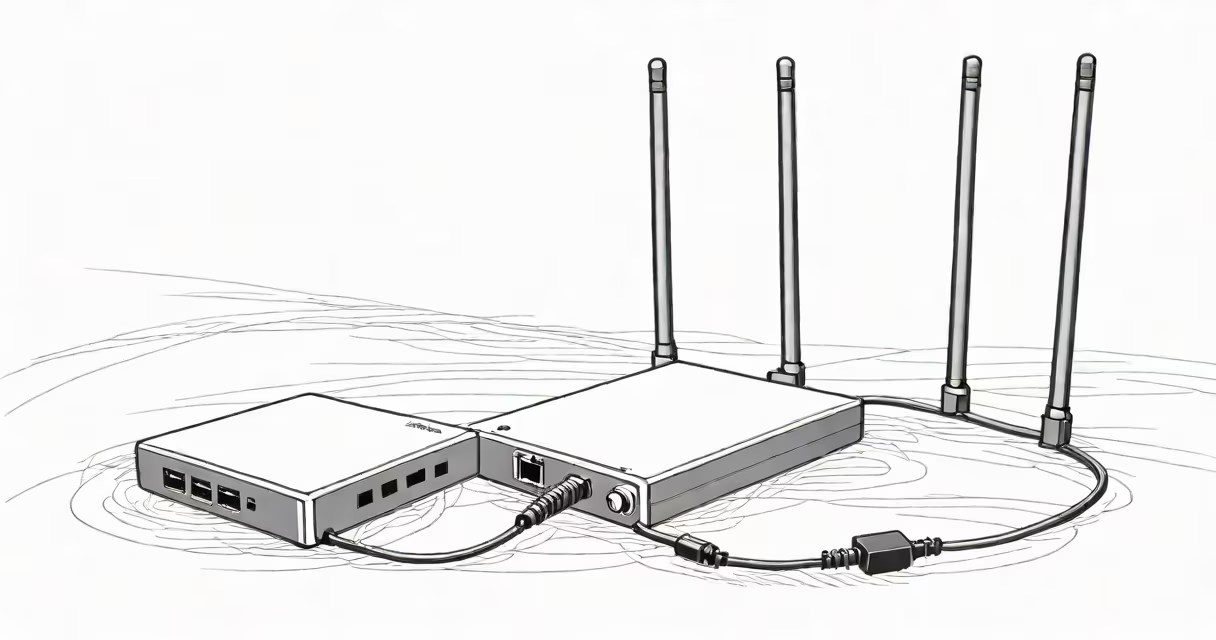
A mobile data signal booster amplifies weak cellular signals to improve call quality, data speeds, and connection reliability in areas with poor reception. It works by capturing a faint signal from a nearby cell tower, boosting it, and retransmitting it indoors through a connected internal antenna.
Signal boosters differ from Wi-Fi extenders and routers. They specifically amplify cellular frequencies used by mobile carriers-such as 700 MHz, 1700/2100 MHz (AWS), and 2500 MHz (LTE)-not wireless internet. This makes them essential in rural zones, basements, or buildings with thick walls that block radio waves.
For example, a user in a remote cabin with only 1 bar of LTE coverage may see their speed jump from 1 Mbps to 15 Mbps after installing a mobile data signal booster. The device doesn't create a new signal-it improves an existing one that's too weak to be usable.
A mobile data signal booster operates in three stages: capture, amplify, and rebroadcast. An external antenna mounted outdoors receives the weak signal from the nearest cell tower. That signal travels via coaxial cable to a booster unit placed indoors. Inside the unit, a low-noise amplifier increases the signal strength without introducing distortion.
The amplified signal then feeds into an internal antenna, which broadcasts it throughout the desired area-typically a home, office, or vehicle. The system uses separate frequency bands for upstream (device-to-tower) and downstream (tower-to-device) traffic to prevent feedback loops and interference.
Proper installation requires placement of the outdoor antenna toward the nearest cell tower. A directional antenna focused on a single tower performs better than an omnidirectional model in areas with multiple competing signals. Signal strength meters on the booster unit help users align the antenna for maximum gain.
Signal boosters come in several configurations based on coverage area, frequency support, and portability. The most common types are:
| Type | Coverage Area | Frequency Support | Best For |
|---|---|---|---|
| Indoor-only | Small rooms, apartments | 4G LTE only | Urban apartments with marginal signal |
| Home/Office | 1,000-5,000 sq ft | 4G LTE & 5G (sub-6 GHz) | Rural homes, small businesses |
| Vehicle-mounted | Car, RV, truck cab | 4G LTE, some 5G | Drivers in mountainous or remote regions |
| Commercial-grade | 5,000+ sq ft | Multiple bands, carrier-specific | Large offices, hospitals, schools |
Not all boosters work with every carrier. Devices must be compatible with the specific frequency bands used by your provider. For instance, Verizon uses Band 13 (700 MHz) and Band 3 (1800 MHz), while AT&T relies heavily on Band 2 (1900 MHz) and Band 4 (1700/2100 MHz). Using a booster not tuned to your carrier's bands results in no improvement.
Signal gain is measured in decibels (dB). A typical booster offers 50 dB of amplification. However, higher gain doesn't always mean better performance. Excessive amplification can cause interference or overload the signal path. Regulatory bodies like the FCC limit output power to prevent disruption to nearby towers.
Many assume a mobile data signal booster can fix complete signal loss. That's false. If no signal exists within 10 miles of your location, no booster can generate one. The device only amplifies what's already available.
Another myth is that boosters increase data speed beyond the carrier's network capacity. A user on a 10 Mbps plan won't achieve 100 Mbps even with perfect signal. Boosters improve reliability and reduce dropped calls-not bandwidth limits set by the carrier.
I once installed a home booster in a 20-year-old house with aluminum siding and double-paned windows. The original signal was 1 bar. After mounting the outdoor antenna on the roof and running a shielded cable inside, the signal improved to 4 bars. Data download speeds rose from 1.2 Mbps to 12.5 Mbps. Call drop rate fell from 40% to under 1%. The difference was measurable and consistent across devices.
Since 2014, the Federal Communications Commission (FCC) has required all mobile data signal boosters sold in the U.S. to be registered and certified. Unapproved devices can disrupt networks and violate federal law. The FCC mandates that boosters automatically detect and avoid interfering with nearby towers.
Carriers like T-Mobile and Sprint require users to register their booster with the network. Registration prevents accidental interference and ensures the device operates within legal power limits. Failure to register can result in service suspension or fines.
According to the FCC's official guidelines, all boosters must have a "self-monitoring" feature that detects signal degradation and shuts down if interference occurs. This requirement prevents unauthorized signal injection into the network.
If you're in a region with intermittent signal, a mobile data signal booster outperforms alternatives like Wi-Fi calling or portable hotspots. Wi-Fi calling depends on a stable internet connection-unavailable in many rural areas. Portable hotspots rely on the same weak cellular signal they're trying to fix.
For example, a delivery driver in northern Idaho experienced frequent call drops during winter months due to snow blocking signals. After installing a vehicle-mounted booster, call success rate increased from 65% to 98%, and GPS tracking remained stable. The device operated continuously without draining the car battery.
Finally, consider the long-term cost. A $150 booster with 5-year warranty can save hundreds in missed calls, lost productivity, and unreliable communication. Many users report improved work-from-home efficiency after installation.
Understanding how a mobile data signal booster functions helps avoid ineffective purchases. It's not magic-it's physics. But when properly deployed, it delivers tangible improvements in connectivity, especially where carriers don't reach.
For those facing persistent signal issues, investing in a certified mobile data signal booster is a proven step toward reliable communication. Check carrier compatibility, ensure FCC approval, and install with care. The result is a stronger, more dependable connection.