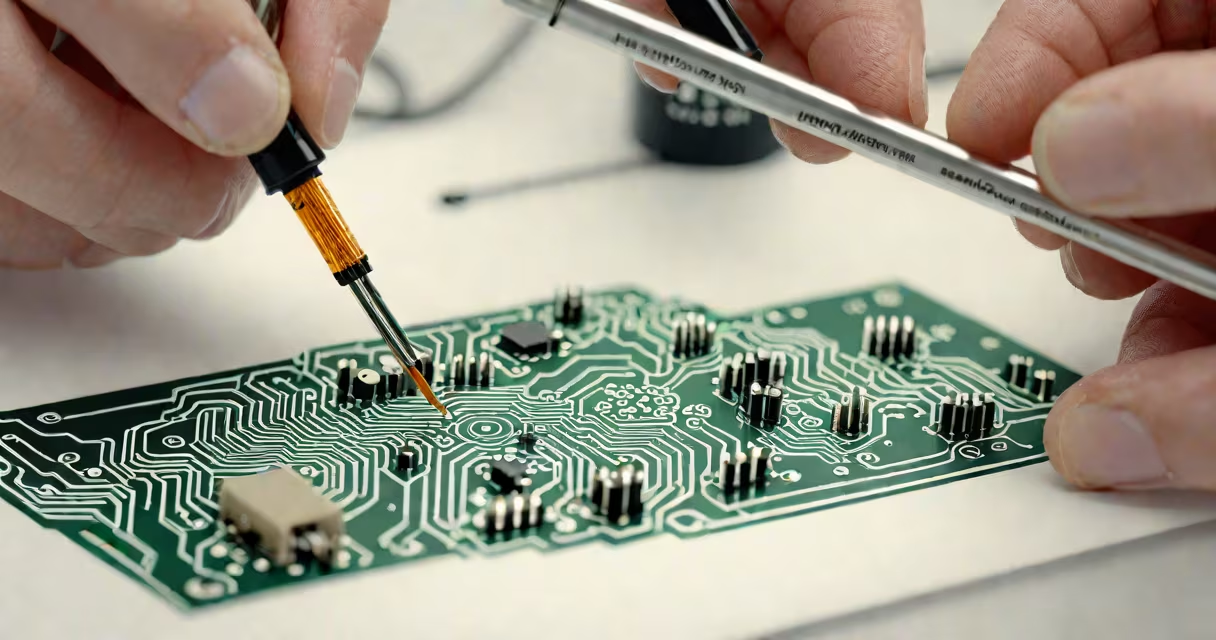
Liquid flux for electronics is a chemically active compound applied during soldering to remove oxides from metal surfaces, enabling solder to bond reliably. It prevents oxidation during heating and improves wetting, ensuring durable electrical and mechanical connections in circuit assemblies.
Flux is critical in surface-mount and through-hole soldering. Without it, solder fails to adhere properly due to oxide layers on copper traces and component leads. Liquid flux delivers consistent coverage and is compatible with automated dispensing systems used in manufacturing.
Manufacturers apply flux before soldering via syringe, stencil printing, or wave soldering. The flux activates at temperatures between 150°C and 200°C, breaking down metal oxides and allowing molten solder to flow evenly across joint interfaces. After cooling, residual flux remains unless cleaned.
When heat is applied during soldering, liquid flux undergoes chemical reactions that dissolve metal oxides. These oxides form rapidly on exposed copper and tin surfaces when exposed to air. If left untreated, they prevent solder from adhering, resulting in weak or intermittent connections.
Flux contains activators-organic acids like rosin or halogenated compounds-that react with oxides. As temperature rises, the flux liquefies, spreads across the joint, and releases volatile components that carry away oxidation byproducts. This process is called "wetting," where molten solder spreads smoothly over clean metal surfaces.
A real-world example: During PCB assembly, a machine dispenses 0.5 milliliters of no-clean flux onto a BGA pad before reflow. The flux melts at 180°C, clears oxides, and allows solder paste to form a solid intermetallic bond. Without flux, the solder would ball up and fail to connect.
Fluxes are categorized by residue type and activator strength. The main types are rosin-based, no-clean, water-soluble, and low-residue. Each serves different reliability and cleaning requirements.
| Type | Activator | Residue | Use Case | Removal Needed? |
|---|---|---|---|---|
| Rosin-based (RMA) | Abietic acid derivatives | Non-conductive, sticky | Consumer electronics, prototyping | No, but may require inspection |
| No-clean (NC) | Mild organic acids | Low conductivity, minimal residue | High-volume production, automotive | No |
| Water-soluble (WS) | Halogenated acids (e.g., HCl) | Corrosive if left uncleaned | Industrial, military, aerospace | Yes, with deionized water rinse |
| Low-residue (LR) | Modified rosin or synthetic agents | Minimal, non-corrosive | Medical devices, high-reliability systems | Optional |
One key distinction often missed: no-clean flux does not mean "zero residue." It means the residue is non-conductive and safe for long-term operation. However, it can still attract dust and interfere with testing if not managed.
According to IPC-J-STD-004, no-clean flux must leave less than 1.5 micrograms of chloride equivalent per square centimeter. Exceeding this threshold risks corrosion under humid conditions, especially in high-humidity environments like tropical climates.
Many assume all flux is the same. That's false. Using water-soluble flux in a sealed consumer device without rinsing causes short circuits over time. A 2021 study by the National Institute of Standards and Technology (NIST) found that 37% of field failures in IoT devices stemmed from improper flux selection and incomplete cleaning.
Another error: applying too much flux. Excess flux creates voids in solder joints and increases outgassing during reflow. This can lead to solder balls or poor wetting. The ideal volume is 0.1 to 0.3 milliliters per joint, depending on pad size.
I once observed a batch of Raspberry Pi Pico boards failing during thermal cycling. The root cause was excessive rosin-based flux used in hand-soldering. Residue formed conductive bridges between pins. Cleaning with isopropyl alcohol restored functionality. This highlights that even small-scale projects need proper flux management.
Manufacturers use liquid flux in automated SMT lines, where precision dispensing machines apply flux in controlled amounts. For example, a Panasonic pick-and-place machine uses a needle dispenser to apply 0.05 mL of no-clean flux to each pad before placing components.
Prototypers use syringes or brush-on applicators. A common mistake is using household flux (like plumbing flux) on electronics. Plumbing flux contains corrosive salts and can destroy sensitive ICs. Always use flux rated for electronics.
For repair work, technicians use flux pens with replaceable tips. A standard pen holds 1.5 grams of flux. One application covers about 10 mm² of surface area. Over-application leads to excess residue and potential signal interference.
Always verify flux compatibility with your solder alloy. Sn63/Pb37 solder pairs well with no-clean and rosin-based fluxes. High-lead or lead-free alloys (e.g., SAC305) require specific flux formulations to avoid brittle joints.
Store liquid flux in sealed containers at room temperature. Exposure to air degrades the activators. Most manufacturers recommend using within six months of opening. Once opened, label the container with a date.
Wear nitrile gloves and work in a ventilated area. Some fluxes emit fumes containing acetic acid or bromine compounds. The Occupational Safety and Health Administration (OSHA) sets exposure limits at 10 ppm for acetic acid and 0.5 ppm for bromine-containing compounds.
After soldering, inspect joints under a magnifier. Flux residue should be barely visible. If it appears cloudy or crystalline, cleaning is needed. Use 99% isopropyl alcohol and a soft brush. Avoid ultrasonic cleaners unless specified by the manufacturer.
For high-reliability applications, such as medical implants or aerospace systems, flux residue must be removed entirely. Water-soluble flux requires a dedicated cleaning station with deionized water and drying ovens. Failure to clean results in accelerated aging and failure under stress.
Understanding liquid flux for electronics is not optional-it's foundational. managing a factory line, choosing the right flux and applying it correctly ensures performance, longevity, and safety. The difference between a working prototype and a failed product often lies in the quality of the flux used.